Dragon Fruit

By Heidi Bornhorst

Q: Heidi when did dragon fruit come to us here in Hawaii?  Seems kinda recent to me but one of my gardening writing friends tells me its been here since the late 1800s.

Pls inform

Mahalo

KD, Kahala

A: Like you, I think it’s recent. I know night blooming cereus, a relative of dragon fruit, has been here for a long time and has an interesting survival at sea/ revival by Horticulture story. So, I did some digging.

Ken Love, one of my go to Fruit experts, informs me that yes, it’s a recent arrival to our shores and gardens.

Love says that Greg Adams brought them from Vietnam in the late 60s or early 70s. Since then others have introduced cultivars from places like Israel.

They are native to Mexico and Central America where we get the common name pitaya. Now widely grown by masterful Horticulturists and entrepreneurial Farmers in Thailand and Vietnam, we are seeing more in Hawaii home gardens and fruit markets.

There are some reports of it getting here early, maybe by that epic plantsman and translator for Alii, Don Francisco de Paula Marin. He brought us our first mango, grapes and Yellow Plumeria, among many other wonderful plants that now enhance our Hawaii gardens.

I think the red fleshed one is gorgeous especially in a mixed fruit platter. To me the white one is more ono but less colorful and pretty. I’m still waiting to try the yellow fruited one.
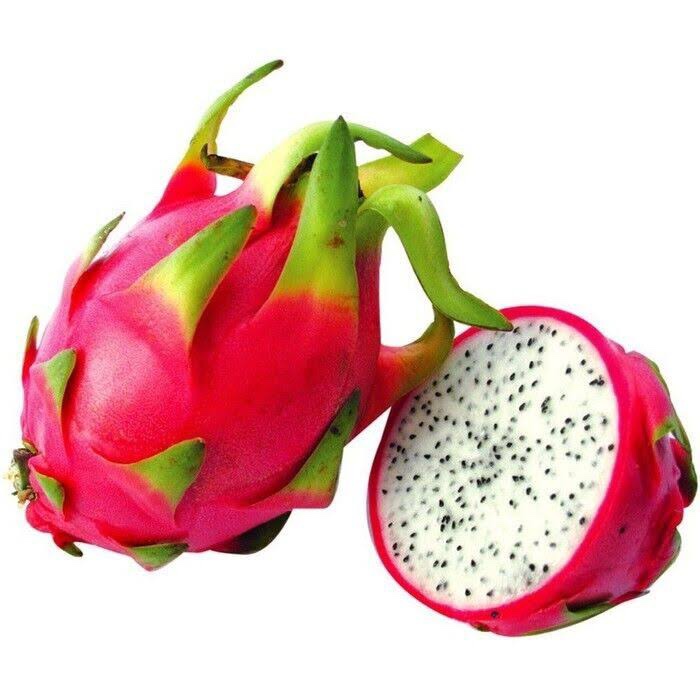
Scientists call it Hylocereus.  H. undatas is the white fleshed one, H. roja is the red fruited one and H. amarilla has yellow flesh. All are in the Cactus family, Cactaceae.

They are fun to grow if you don’t mind thorns.  The stalks are heavy and need support on a sturdy trellis or fence.  You get more fruit if you hand pollinate.

We always wonder how nutritious our Hawaii grown fruit are and dragon fruit has some great nutrients.  It is high in lycopene, as are tomatoes and watermelon. It’s a good source of calcium and iron.

Night-blooming cereus or panini o ka Punahou is a kind of cactus. The most famous planting of it in Hawaii is on the rock wall surrounding Punahou School in Makiki.

Night-blooming cereus

The plant, Hylocereus undatus, is from Mexico, where it is called pitahaya. It first landed in Hawaii around 1830 on the brig Ivanhoe, which was carrying plants collected in Mexico. Most of them died and were tossed overboard, and the nearly dead, dried-out cereus cutting looked like a goner, but First Officer Charles Brewer took care of it on the long voyage and planted it in Honolulu.

Dr. Richard Criley of UH Manoa, has been monitoring the night blooming cereus flowering cycles at Punahou school, for about 20 years, and sometimes sees fruit.  Maybe young scientists are hand pollinating them. He contends that hand pollination is needed for them to set fruit here in Hawaii.

They set fruit in Mexico where they are naturally bat pollinated. Our native bats are insect eaters and they are rare.

Its thorny stems send out aerial roots from the nodes or sections of stem. You can grow it from cuttings but watch out. It looks innocent at first but as it grows it can take over your rock wall, climb up slopes or trees, or even up your utility poles and lines.

(This happened at my parents’ home and they were without a phone for three weeks! I told my mom to keep it in a pot, but she is too kindhearted and said, “It looked so cute and helpless in the pot.”)
Espalier your Mango!

With land so valuable in Hawaii, homes and gardens are getting smaller, yet we still want to grow fruit trees, but how can we?

Even with towering monster houses and high-rises blocking sunlight and air circulation, espalier is one solution which can help your garden to be more fruitful.

What does espalier mean and how is it done, you may wonder.

Espalier is a technique that is ancient yet artful.  We think it started with the Romans, and was enhanced by Europeans with Castle courtyards. The French enhanced and grew the technique to they could have fruit year round.

The word is French, with Italian origins. Spalla means something to rest the shoulder against in Italian.

Modern landscape design does look to the French and Italians.  Some of the first beautifully designed, landscaped gardens were in Italy, check them out on your next Continental journey. (Gardens are way more fun to visit than a museum, in my opinion, and you get better outdoor exercise too)

Espalier means”to train a fruit or flowering tree to grow flat against a wall, supported by a lattice, or a framework of stakes”.

Today we can use strong cables to train and attach mango or other fruiting tree branches to keep them low, to get maximum sun and air circulation, and for easy harvesting.  Or we can do something more artful and horticultural in our Hawaiian gardens.

The European reasons to do this apply here too:

  • Walls reflect sunlight
  • Walls retain heat overnight (trees use the heat and then cool the air)
  • Orient the leafy branches to absorb maximum light
  • Train the branches parallel to the equator to get max sunlight
  • Espalier extends the growing season

There are many designs of espalier, from a simple V-shape, to fans, crosses, Belgian fences and many more.  Some are curved or spiraled.

England is known for great gardens and akamai horticulture and they have one called a free-standing step over.  They do it with apple and pear trees and we can adopt this practice for our fruit trees here in Hawaii.

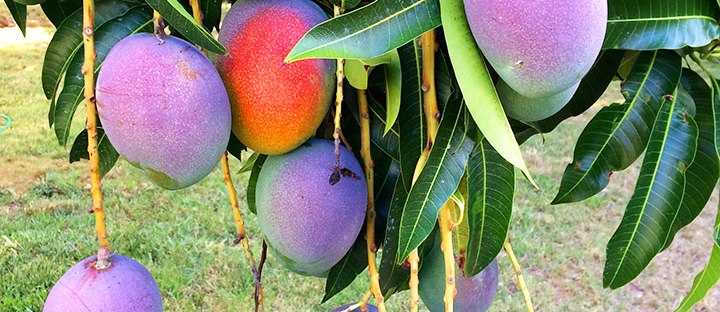
Mark Suiso of Makaha Mangoes is great proponent of mangoes and other fruit trees.  He encourages us to graft good mango varieties, prune them correctly and cherish every fruit. Recently he got us all re-excited about espalier.

Suiso and his ohana and friends have participated in Mangoes at the Moana for the last nine years.  We have learned and grown together and met many mango advocates.  It seems to me that we have more fruit these days and that more people are choosing to carefully prune and nurture their legacy mango trees.  People are planting new trees in their gardens.

It’s so important to support farmers, especially here in Hawaii.  To BUY a mango seems outrageous and not at all sustainable, please buy local!

After all, mangoes are the King (or Queen) of Fruit, just ask Queen Victoria (movie with Judi Dench, featuring her wanting to taste a mango from India)

P.s. I think we should try espalier with `Ulu or breadfruit too!  Horticulturists always love a garden challenge and what better one?

I espalier my mulberries, to keep them low for easy picking and out of my neighbor’s yard (they like the ‘golf course grass’ look) I also can net my fruit and protect them from the ravenous alien bulbuls and green escaped parrots that we have on Oahu.

In other places, such as Japan, Taiwan and Australia they do elaborate kinds of Horticulture including espalier to nurture and cherish every leaf, flower and fruit.  We could do this too!

I would love to hear from my readers, who are practicing espalier to nurture their own special fruit tree.  Please send pictures if you have them, we can all learn from and inspire each other.

Heidi Leianuenue Bornhorst is a landscaping consultant, gardener trainer and specialty VIP garden guide. She has been a professional horticulturist for more than 33 years and she is a Certified Arborist. You can contact her via email at heidibornhorst@gmail.com or at 739-5594.