Question: Heidi, what can we grow in rocky Nanakuli as a replacement for lawn grass? We don’t have the time or money to fertilize, mow, and water and we don’t like the thought of polluting our aquifer or ocean with chemical fertilizers.
Kupuna M.A., Nanakuli
Answer: Zephranthes lilies might be just the thing. They look like grass and also have gorgeous flowers, an added benefit. The pretty lily flowers tell us and the taxonomists that they are a lily, just like mondo “grass”, and Liriope.
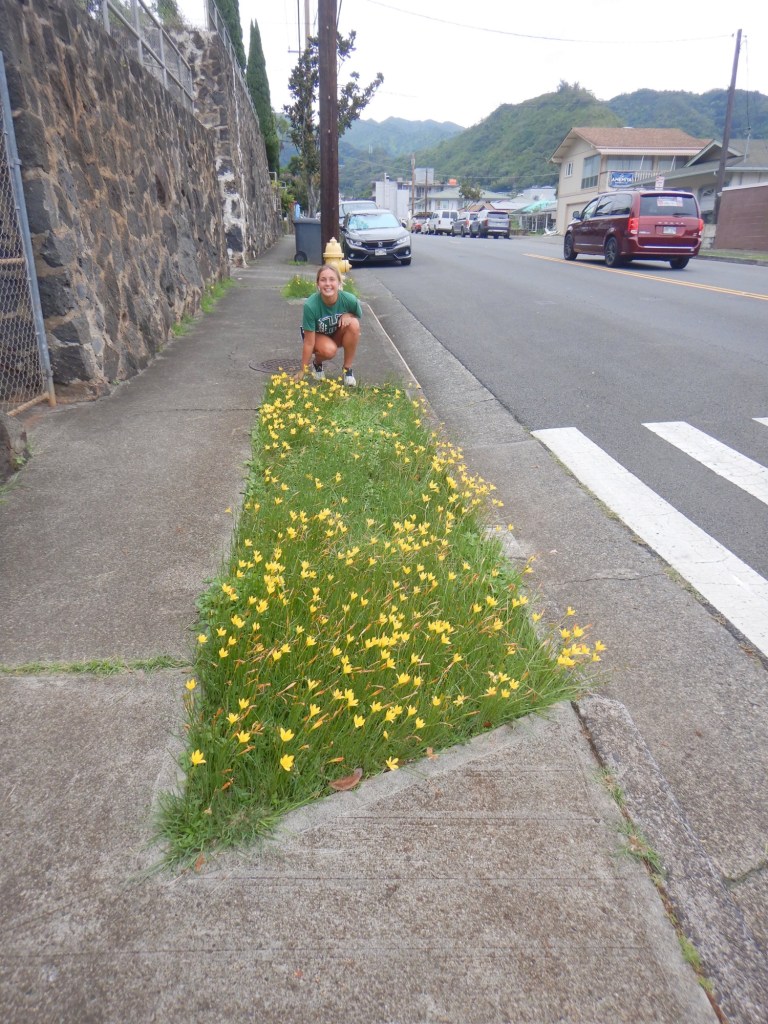
After a good rain you sometimes see yellow lilies popping up. I feel like this is a floral visit from May Moir. One good place to see them is along Palolo Avenue. They may have been the original akamai wai groundcover, planted along with gorgeous and low fuss no muss Magnolia trees, which are our City street trees.
May Moir, the late great Art Academy volunteer flower arranger, and natural Hawaiian gardener, was a big proponent of this simple plant. They are lilies and they come in yellow, pink and white. Check out the book “Floral traditions” if you want to learn more about May Moir and other volunteers who made floral designs of epic proportions for our local art center. This book makes a great Holiday gift for the gardeners, flower and art lovers on your list.
They are perfect in a Japanese or Chinese rock garden. Most of the time they look like a nice healthy mondo (also a lily) but sometimes they flower and then they are so pretty and striking.
After flowering is pau, don’t cut off the flower heads. They will form seed pods with lots of flat black seeds stacked inside They are easy to plant and grow. They also don’t need much water so we like them in our less thirsty or xeriscape gardens.
Perfect in a rock garden, edge of driveway, in a pot.
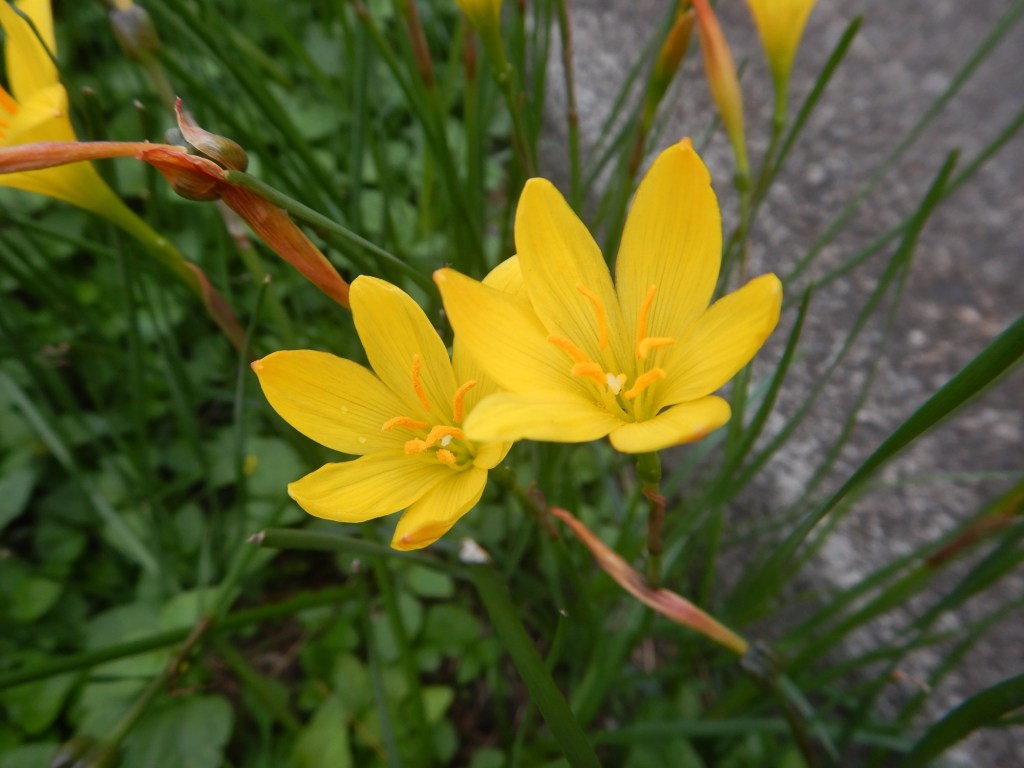
The yellow Zephyr lilies are really choice and it’s such a cheerful color. They respond to rain and a carpet of gold sprouts up. This is one of those old-fashioned plants that lend itself well to low input gardening.
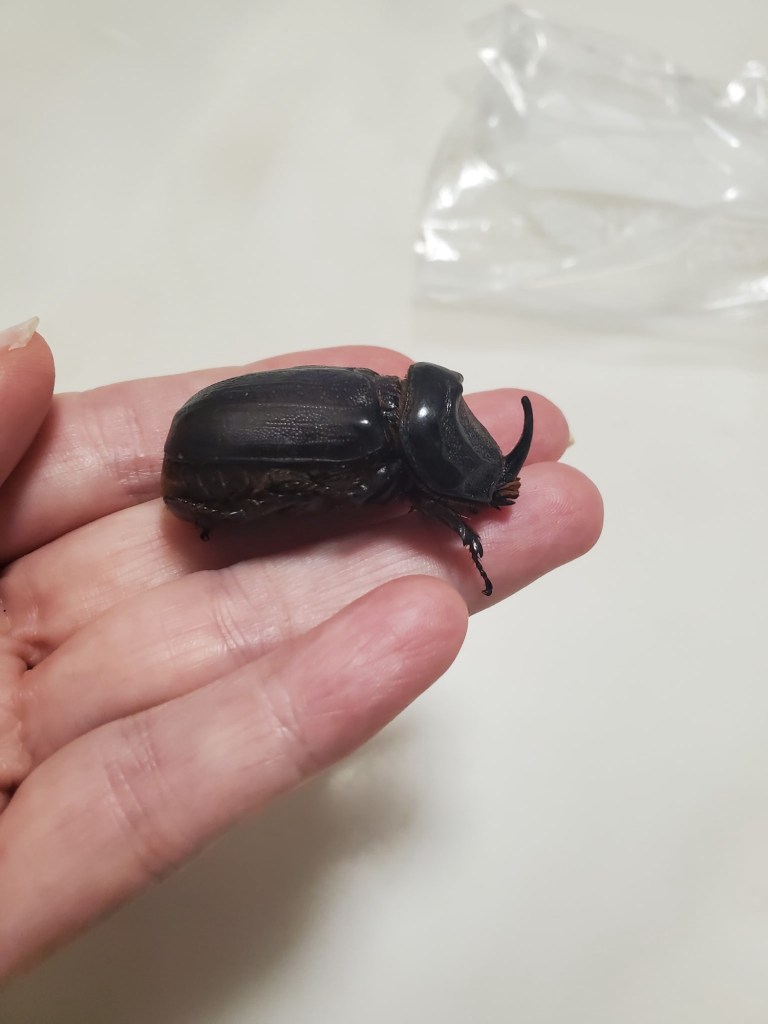
Alien Coconut Rhinoceros Beetles are currently Endangering our Niu (coconut palms), native Hawaiian Loulu palms, hala, banana and more.
Coconut Rhinoceros Beetle
This is an existential threat, not only for beauty, but for life.
Without Niu we may starve.
Imagine Hawaii with no Niu.
Coconut Rhinoceros beetles (CRB) are a serious alien pest. We really need to take this problem seriously and attack / control them on all fronts.
For years, At Every Arborist and landscape conference, we were warned about these chunky hungry beetles and warned to KAPU !! keep them out of Hawaii.
CRB are Major and serious pests in other places such as Polynesia and overall world tropics.
Now they have spread from a Navy site in 2013, to the west side, devastating the north shore and Waialua. They are bad in Waimanalo.
I was at Wahiawa Botanic Garden recently and so devastated to see all of our native Loulu palms being munched and destroyed. This upland Botanic Garden has a collection of rare Loulu palms (CRB love our native Loulu palms even more than Niu or coconuts). They also attack Royal palms.
(We have the famous ET grove of Royals, on Royal palm drive in Wahiawa.)
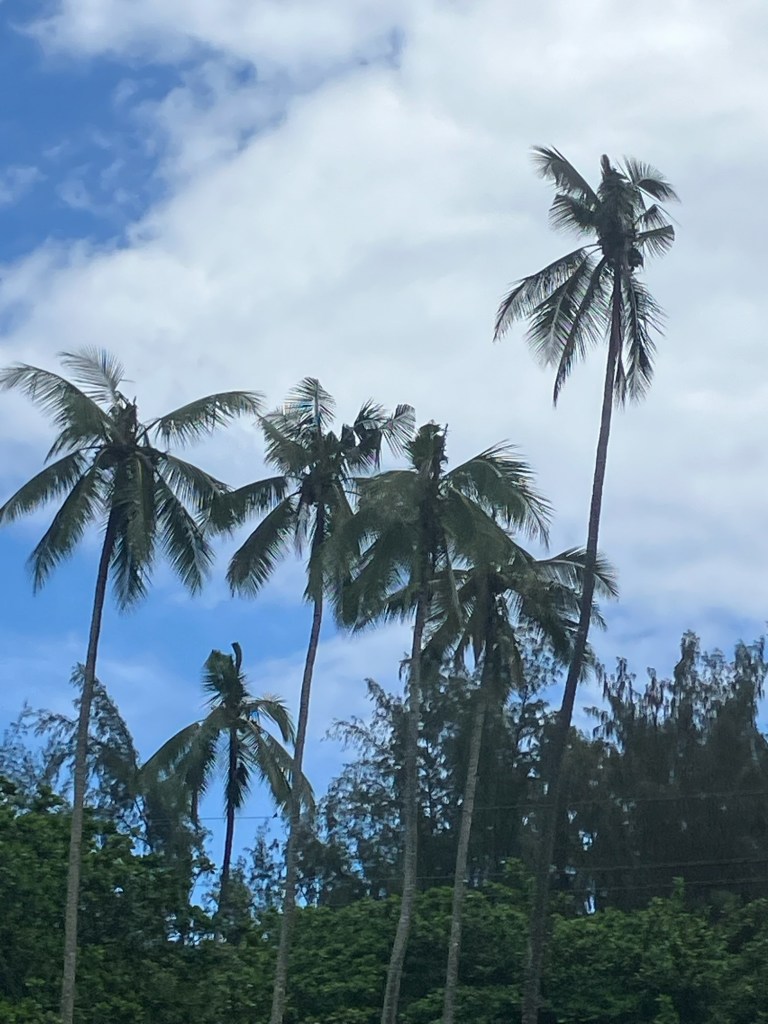
Auwe! we stopped at Kahana state park, where the precious Niu of Mary Mikahala Robinson Foster grow tall and graceful, said to be some of the best nuts for eating and drinking.
Coconuts at Kahana state park, attacked by CRB
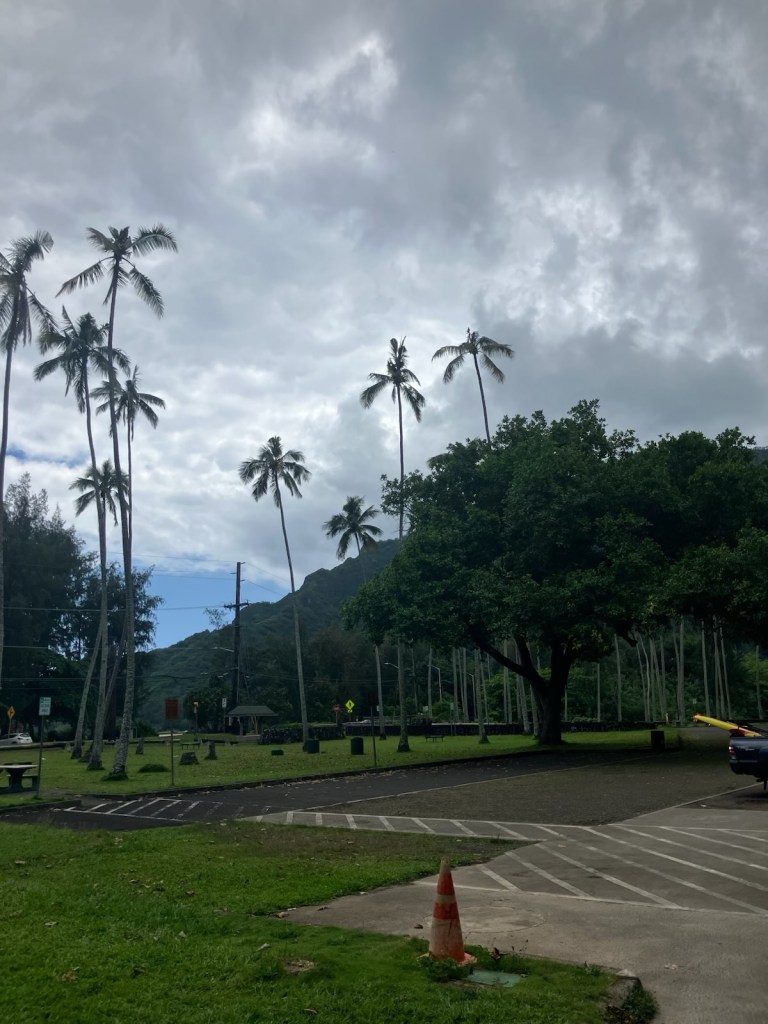
I sadly observed the classic cut out fronds, characteristic of CRB feeding on new vulnerable growth. These Niu are iconic and getting munched to death, as I write this.
Coconuts at Kahana state park, attacked by CRB
We need to get everyone to pay attention and help with control. Our Governor Green and Mayor need to get behind these efforts: Education and control.
Neighbor islands are getting hit with CRB too.
Know the life cycle, they spend the bulk of their life feeding on and in, rotting vegetation, compost piles and the like.
It should be on the News every night, along with other crimes affecting Hawaii.
Here are some of the immediate steps we can all take:
No mulch piles
No dead stumps
Netting
Traps with lights and netting
Public awareness and education
Government support and action
Search for Biocontrol
Education
Chemical treatment to save Coconut palms (Must label as treated, and cut off any flower and fruit on treated palms!) A high lift or skilled coconut climber is key for this.
Everybody’s dog, chickens and pigs can find and eat the grubs.
A Gourmet opportunity for an innovative local chef?
Nui/Coconut, Cocos nucifera is the Tree of life for Hawaiians, do we really appreciate and treasure Niu in Hawaii as well as we could?
Can you imagine Hawaii with no Coconuts? CRB also attack Hala, Loulu palms, banana and more.
Let’s get together and scientifically, attack this pest.
Netting all around the vulnerable crown of the palm. Netting of mulch piles. Nets with Lights
As my friend Mari Zane says Ho! Beneficial use for those illegal gill nets! (Her Loulu and Niu on the north shore were early casualties, but there is hope for the shorter ones.)
Wrap the nets around the crown. The nets will get the ones inside coming out of the bore holes, and get any on their way in.
Contemporary Landscaping, a nursery in Waimanalo, uses a low net about four feet tall, lit at night. This attracts and captures beetles.
Trapped beetles attract more beetles to the light, and a chance for more control.
Brown Cannon made a trap using a netted Hula hoop and is capturing them out in Waialua. He sets this hula hoop net (great recycling!) over a barrel of woody mulch.
We can all get smart and do our part!
Just when Hawaiian gardeners, City parks folks and landscapers were convinced to wisely use mulch, we find that mulch piles are endangering NIU.
CRB grubs love rotting vegetation and spend most of their life there.
We can have mulch piles and mulch dishes if we are akamai.
Turn the mulch frequently disrupting the grubs.
HOT mulch will help to kill them.
Turn your mulch and have animal helpers, keiki or your arborist ready to spot and capture the grubs.
(Dogs, pigs and chickens can be trained to eat the grubs of CRB)
Mulch and green waste piles are perfect habitat for these alien pests and their voracious grubs.
Hot mulch is OK: turn it and burn it!
Or spread mulch and compost thinly. Water it and look for CRB grubs.
As always water and nurture your palms, keep them as healthy as possible.
Let’s work together to protect and save this vital part of Hawaii. !!!
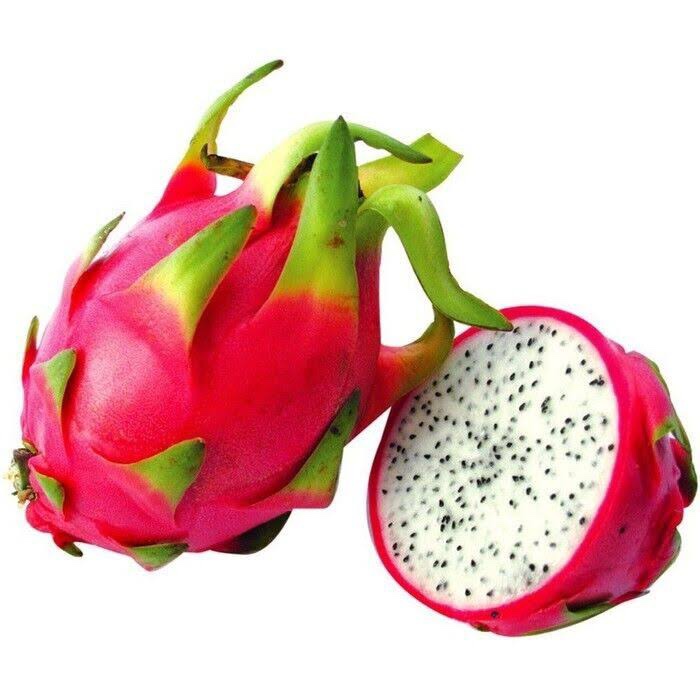
Q: Heidi when did dragon fruit come to us here in Hawaii? Seems kinda recent to me but one of my gardening writing friends tells me its been here since the late 1800s.
Pls inform
Mahalo
KD, Kahala
A: Like you, I think it’s recent. I know night blooming cereus, a relative of dragon fruit, has been here for a long time and has an interesting survival at sea/ revival by Horticulture story. So, I did some digging.
Ken Love, one of my go to Fruit experts, informs me that yes, it’s a recent arrival to our shores and gardens.
Love says that Greg Adams brought them from Vietnam in the late 60s or early 70s. Since then others have introduced cultivars from places like Israel.
They are native to Mexico and Central America where we get the common name pitaya. Now widely grown by masterful Horticulturists and entrepreneurial Farmers in Thailand and Vietnam, we are seeing more in Hawaii home gardens and fruit markets.
There are some reports of it getting here early, maybe by that epic plantsman and translator for Alii, Don Francisco de Paula Marin. He brought us our first mango, grapes and Yellow Plumeria, among many other wonderful plants that now enhance our Hawaii gardens.
I think the red fleshed one is gorgeous especially in a mixed fruit platter. To me the white one is more ono but less colorful and pretty. I’m still waiting to try the yellow fruited one.
Scientists call it Hylocereus. H. undatas is the white fleshed one, H. roja is the red fruited one and H. amarilla has yellow flesh. All are in the Cactus family, Cactaceae.
They are fun to grow if you don’t mind thorns. The stalks are heavy and need support on a sturdy trellis or fence. You get more fruit if you hand pollinate.
We always wonder how nutritious our Hawaii grown fruit are and dragon fruit has some great nutrients. It is high in lycopene, as are tomatoes and watermelon. It’s a good source of calcium and iron.
Night-blooming cereus or panini o ka Punahou is a kind of cactus. The most famous planting of it in Hawaii is on the rock wall surrounding Punahou School in Makiki.
Night-blooming cereus
The plant, Hylocereus undatus, is from Mexico, where it is called pitahaya. It first landed in Hawaii around 1830 on the brig Ivanhoe, which was carrying plants collected in Mexico. Most of them died and were tossed overboard, and the nearly dead, dried-out cereus cutting looked like a goner, but First Officer Charles Brewer took care of it on the long voyage and planted it in Honolulu.
Dr. Richard Criley of UH Manoa, has been monitoring the night blooming cereus flowering cycles at Punahou school, for about 20 years, and sometimes sees fruit. Maybe young scientists are hand pollinating them. He contends that hand pollination is needed for them to set fruit here in Hawaii.
They set fruit in Mexico where they are naturally bat pollinated. Our native bats are insect eaters and they are rare.
Its thorny stems send out aerial roots from the nodes or sections of stem. You can grow it from cuttings but watch out. It looks innocent at first but as it grows it can take over your rock wall, climb up slopes or trees, or even up your utility poles and lines.
(This happened at my parents’ home and they were without a phone for three weeks! I told my mom to keep it in a pot, but she is too kindhearted and said, “It looked so cute and helpless in the pot.”)
We had such a weird windstorm with those super strong and gusty west winds! So different then normal.
Up in our valley we lost power twice to the wind and HECO did not restore power until 9:30 p.m. on Wednesday 3/8/2023.
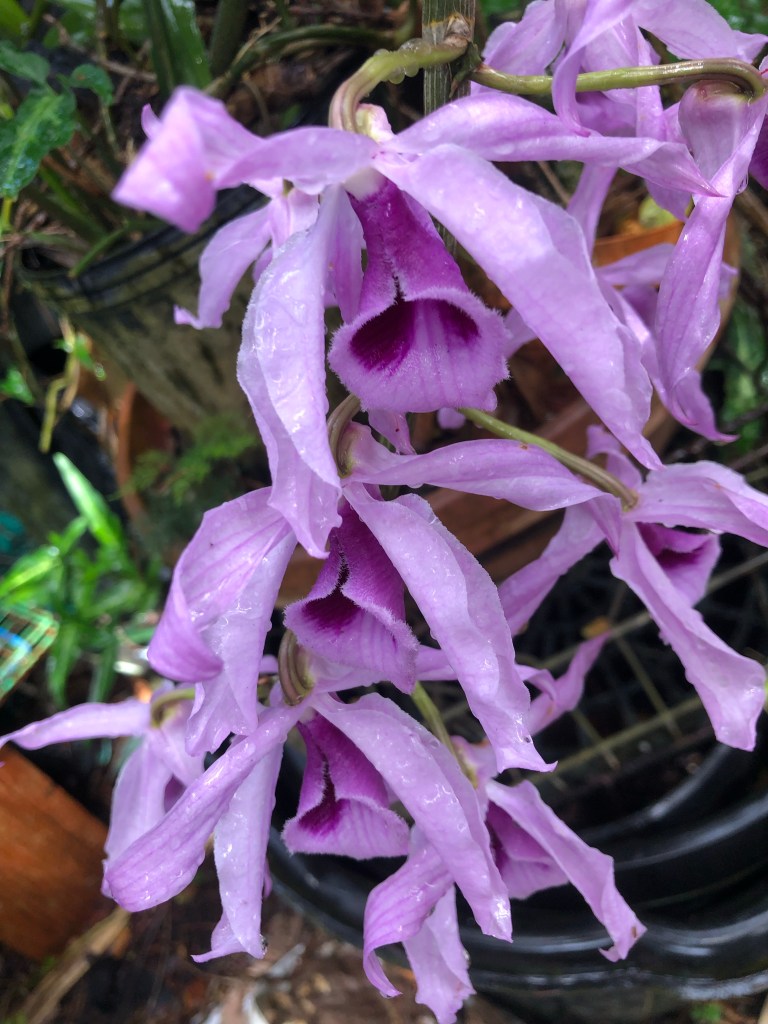
Mangoes and avocados were full of blossoms, Honohono orchids were in bud and some in bloom.
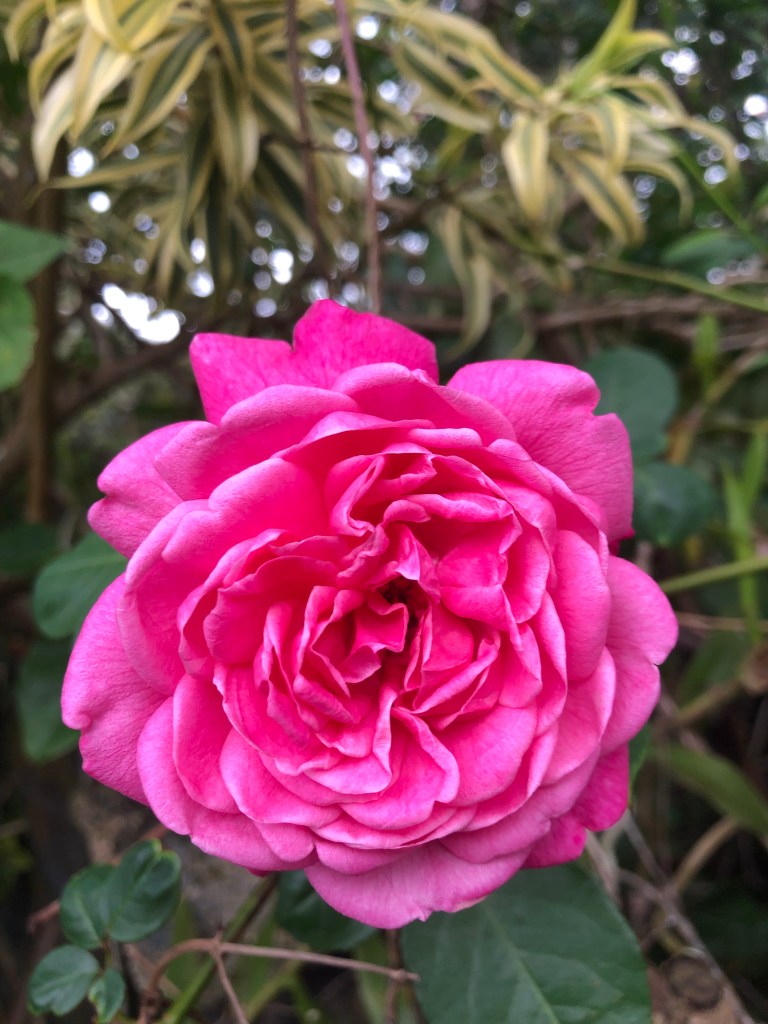
My Portuguese Madeira roses, and native Hawaiian gardenia Na`u have been blooming well, loving the cool and rainy winter were are finally having.
As I clean up the storm debris, (Mahalo for nature’s Arboriculture) including blown down dead twigs and branches, and lots of leaves, some I notice are from my mauka neighbors.
One of the tenets of true Horticulture is to OBSERVE nature and plants, to track the moon, winds, rain and other weather phenomena as see how the plants respond.
I am still reflecting on how the plants would respond.
What do you see? How are your plants after the winds?
Did you have any big tree failures? Or just small or dead branches?
The leaves are whipped on my gingers, Surinam cherries, mulberries, and ohia shed a few flowering branches. A young popolo plant got totally blasted on one side, it was just coming into fruit.
So, we shall see!
Honohono orchids had been in full glorious fragrant bloom as they budded and bloomed early this year. Originally I thought the orchids stood the wind storm but after a few days those in the main wind tunnel area of my garden wilted and withered prematurely.
Went to a neighborhood watch potluck pa`ina and a nice lady, Lokelani, that I always say hi to on my walks was there, with a gorgeous papale lauhala. She admired my honohono and said she caught a whiff of fragrance, from way across the yard, and she looked for the source of this favorite old time Hawaii fragrance, and from where? My hair!
Since she admired the orchids, I had to give them to her, along with maire ferns!
Now a couple weeks after the winds, I’m observing some of my favorite flowers and fruit trees in my garden and neighborhood:
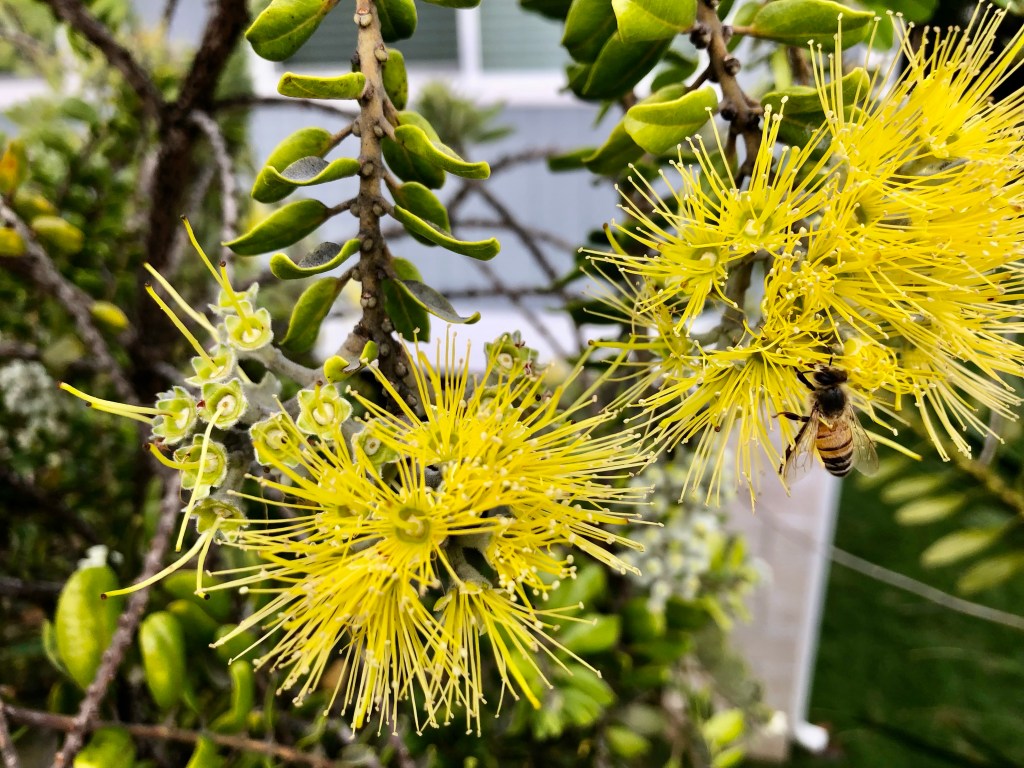
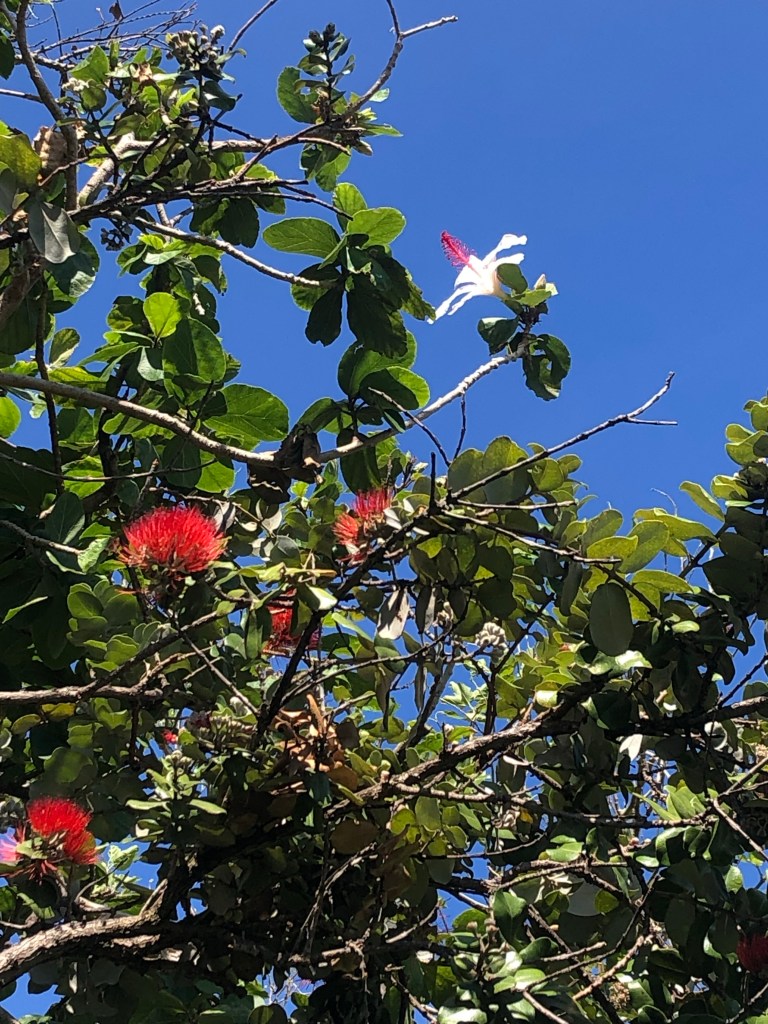
• ‘Ohi’a lehua Blooming profusely, some dead wood branches and twigs broke in the winds
• Native White Hibiscus wind whipped leaves, a few blooms at the very top of the tree
• Tahitian mountain apples were blooming before, still many flowers and now small fruit.
• Gardenias surprise early blooms two on one stem, but no other apparent buds yet. (they usually bloom for me in May).
• Na`u, native Hawaiian Gardenia lots of flowers and buds (also triggered by abundant soft rains before the winds)
• Madeira roses Blooming profusely.
• Mangoes my Friend Dawn Shim from Makakilo brought me a gift of Haden mangoes, super early for this to fruit.
• Mulberries wind whipped leaves, lots of young fruit
• Pua Keni keni usually Bloom less in winter, BUT after the storm mine are full of Buds, flowers and lots of developing green “ball” fruit. I made some lei for a fundraiser, and plucked and cut off all the young fruit, to encourage more blooms from the tree
What are YOU observing, in your garden in your unique microclimate? I would love to hear back from my Gardening Readers …..
I asked my friend and great Gardener, Mari who lives Mauka of Sunset beach how bad the shoreline erosion was, and can she access her beach?
NO, she said sadly, It’s still blocked off and there is a steep Cliff, and dangerous drop off, it is too dangerous to walk down to Sunset Beach or Kammieland.
Plus, she continues, there’s so much beach litter and trash everywhere that are a result of “temporary” sandbag burritos and black saran shade cloth.
Along with the liter there are multiple safety issues including rebar, concrete and other structural debris from coastal houses. These houses are now too close to our North shore surf swells, breaking waves and high tides.
BUT, says Mari, there is one upside to this trash and mis-use of our public beach.
My friends and I gather up the black matting erosion control debris that is floating in the ocean. (And yes, its very heavy when waterlogged).
What do you do with it then? We dry it out and SOLARIZE a most hated weed. You know that Asparagus pokey groundcover? Or sometimes called Asparagus Fern?
Asparagus “fern” is not a fern, Asparagus sprengeri is actually in the Lily family and is related ot our edible asparagus. It is very pokey, and if it pokes your bare gloveless hands, it’s kind of toxic.
I used to favor it for landscaping because it is extremely tough, xeric, and a good ground cover in a dry neglected garden.
But as a maintenance gardener I HATE it! Its pokey and the pokes from the minute thorns on the stems, can get infected. (remember to put on your garden gloves!) It has underground storage tubers, like little potatoes that make it a drought tolerant survivor plant and also Supremely difficult to eradicate.
You can dig and dig it out, but if one small tuber is left behind, Auwe! It will all sprout up again.
And it has RED FRUIT, with several black seeds inside. Birds love to find and eat red fruit and then they poop out the seeds everywhere.
AN ALL AROUND PESTY PLANT !!
We were talking about the wave erosion, high tides and overly heated water, and global warming change to north shore and illegals things people are doing..
How’s about the guy pouring concrete and rebar on the beach? Didn’t someone see it and report the Concrete Company?! Really unfortunate and unsafe issues here. Something needs to be done to save our beaches and Kai for everyone. Hard to watch.
Though there are many things we cannot control, the reuse of this beach trash to help eliminate a weedy plant in the garden, this is AKAMAI!
SOLARAZATION is a great way to control weeds without using dangerous chemical herbicides.
Often we use layers of wet newspaper, cardboard or even carpet to smother and solarize weeds, and turf grass where we don’t want it etc. Then after the weeds are safely killed, you can peel them away, restore the soil, and plant useful plants in place of alien weeds.
The black saran or shade cloth which some use as weed controlling ground cover, or in this case to slow down the power of wave erosion, can be used to solarize and kill weeds in our gardens.
This a beach clean up with a purpose!
Mahalo to Mari and her North shore friends who help clean our beaches and then grow good productive gardens.
Pandanus amaryllifolius
Working at the Honolulu Zoo, we were helping move and relocate plants for the community gardens from behind the zoo on Paki, to a new garden on Leahi and Paki. As we were helping the (unhappy) gardeners, I heard Victorino Acorda, one of our best Gardeners and true plantsman exclaim in delight!
‘Pandan wangi! Makes the rice taste so good Heidi! I’ve been looking for this plant since I moved here from the PI!’
He was almost crying; he was so happy!
Then the other day I was stuck in morning traffic on Mo`oheau St in Kapahulu. To amuse myself I looked closely at gardens along the street. There was a really nice garden with a southeast Asia flavor. First, I noticed nice clumps of lemon grass and some healthy papaya trees.
What was the clumping bright green plant in front of the lemon grass? PANDAN WANGI!
So attractive in this landscape design and so useful.
We have it growing in the southeast Asian plant section at Ho’omaluhia Botanic Garden. One year it was a featured plant at our plant sale, and we hope to feature it again once we can open up our gardens safely once again.
It is fairly easy to grow. You can divide the clump and make new plants.
Those who know this plant usually just call it pandan. There are many ways you can cook with it.
Some call Pandan, the Vanilla of the east, or the vanilla of Southeast Asia.
You can boil with whole leaves and combine them with other ingredients. You can wrap foods in them and then cook them (like we do with Ti leaves).
If you’re handy with your blender, grind some fresh leaves with water and then freeze the juice in a mold or ice cube tray and use it for drinking or cooking later.
You could also add it to GREEN SMOOTHIES
Some just buy a bottle of pandan paste. Lexi had some from Singapore, she had it quite a while I smelled it and then read the label. It smelled really ono. The ingredients not so much.
How do we make it from the fresh leaves that we can grow in our Gardens?
You can just chop it up and add to the rice pot as you cook your rice.
You can make tea with the leaves. You can add your favorite tea like jasmine to the pot. Pour hot water over both and let steep for Five minutes.
I made some with just hot water, poured over and steeped over leaves. it tasted ok
On 9 28 21 trying strip leaves lengthwise in 3s, add Olena and ginger powders, and three mamaki leaves, bring to a boil, then simmer for 30 minutes or so. It Smells really good!
There are lots of Creative and Foodie things you can do with pandan:
• Twist the leaves into Roses like we do with Ti leaves
• Little cups for deserts
• You can make green smoothies with it
• Pandan Chicken and Pandan Rice
• Grilled Fish stuffed with Pandan are just a few recipes that are popular.
And many desserts, variously featuring coconut milk, and various sugars like palm sugar.
If you look online there are lots of recipes, some quite layered and complex. Some really pretty drinks and you insert a leaf tip to give it that final Flare of Gourmet Drink décor.
It gives the dish a lovely green color and subtle flavor.
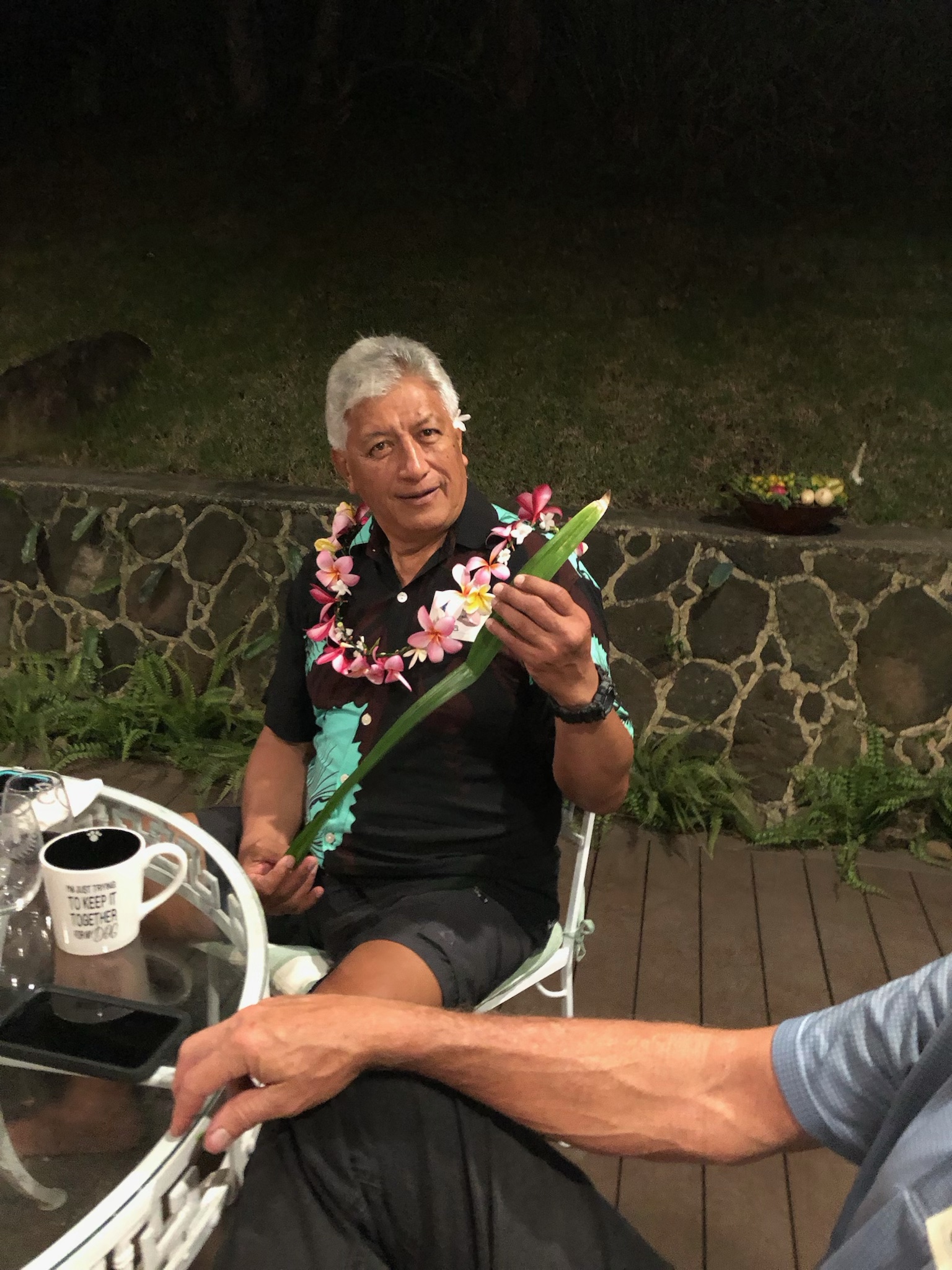
I took some in mixed arrangement as a hostess gift for Lexi Hada and Barney Robinson. One of their guests, Teua from the Cook Islands admired it, drew it out of the arrangement and sniffed it.
As he ran his hands over the glossy thornless leaves, we talked about it. He recognized it as a Pandanus, or HALA relative but NO THORNS! We all wondered how it would be for weaving.
The Latin name, Pandanus amaryllifolius refers to this. The growth is much like a hala, but the leaves are soft and shiny with no thorns.
Besides being ONO, it’s a very attractive garden accent or spotlight plant in your garden.
I also like it as an exciting and exotic foliage element in a Tropical Flower arrangement.
We plan to feature it at a Future Covid 19 safe FOHBG plant sale.
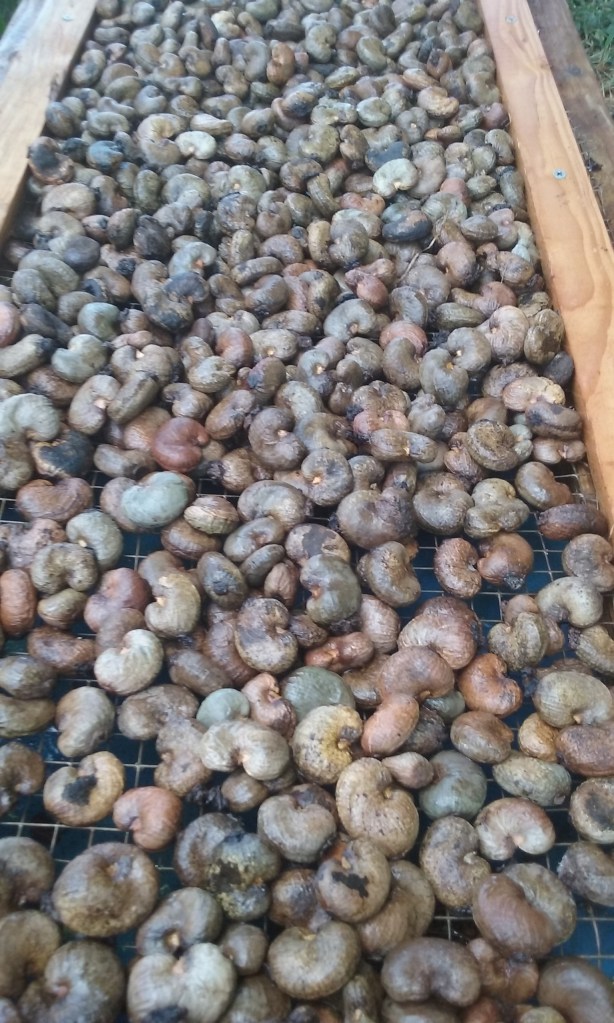
I found out writing this that you can eat the fruit of cashews and its high in vitamin C and good for your teeth and gums.
Linda Neumann who has a farm on Kaua’i helped me learn more.
It would be a pretty, and fun fruit tree to add to our gardens. Lots of other useful and yummy things come from Cashew trees.
For years we had a Cashew tree growing at Foster Botanic Garden. It’s in the Economic section of the garden. In this section we grow plants with various economic value or potential such as herbs, spices, medicines, food, and even poisons.
The main thing we were taught about cashews, is “Handle with extreme care”. If it is not ripe enough, or too ripe Abunai! (Danger in Japanese) It is hard, and possibly toxic to harvest and process the hard-shelled seeds (nuts). You need to harvest at just the right time, and then extract the seed carefully. Juice from the shell around the fruit may burn your skin.
That is why I’m happy to buy this heart healthy nut at the store!
Interestingly the toxic principles in the shell may make a good insecticide! Research continues.
The Latin name is Anacardium occidentale, (“Ana’ means upward, and “Cardium” refers to the heart). Cashew is in the Mango family, Anacardiaceae. Cashews are native to Brazil and Tropical America
Relatives include Fruit trees like Mango, Wi or Otaheite apple, Hog plum (my Honey’s favorite, one grows and Fruits in Foster Garden). Christmas berry tree is related. Poisonous relatives are poison ivy and sumac, and the Marking nut tree.
Flowers are greenish yellow, fragrant and grow in panicles. Bees like to visit and pollinate the flowers. The trees can grow up to 40 feet in ideal conditions, we usually find shorter, wider trees here in Hawaii.
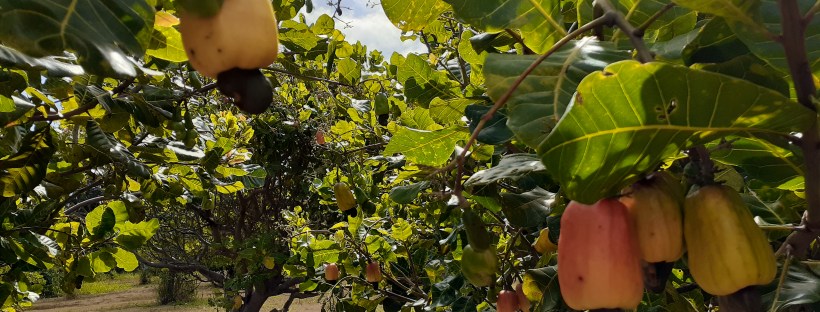
The fruit and nut are very interesting to see. The “fruit” that catches our eye is actually a “false fruit” or pseudocarp. Some call this a “cashew apple” Being Eurocentric they called all kinds of tropical fruits “apples”!
The actual fruit (botanically speaking) of the cashew tree is a yellow or red kidney shaped drupe that grows at the end of the cashew apple. The drupe develops first on the tree, and then the pedicel expands to become the cashew apple. The true fruit contains a single seed, which is generally considered to be a nut.
Aren’t plants wonderful and Complex?!
The attractive colorful and juicy fruit is an adaptation to attract fruit eating animals to aid in seed dispersal.
Although it is perishable, we can eat the fruit and make value added products like wine and fruit roll ups.
Cashew trees favor well drained soils and regular watering to get established. The flowers like it dry, just like mangoes. They benefit from leafy mulch. Keep turf grass well away from the root zone.
Today it is mainly grown commercially in Brazil and India. We do have some intrepid farmers in Hawaii who are growing trees and even selling products. I salute their courage. Farming and marketing etc., is not easy!
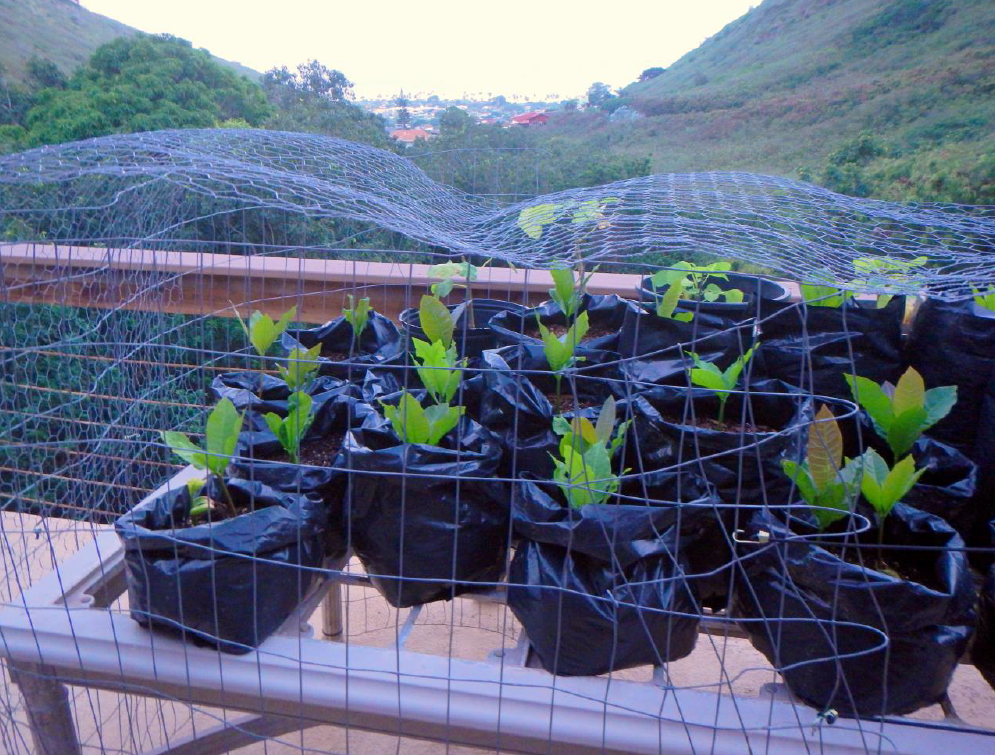
Recently my friend Kaui Lucas, who is a Trained Permaculturist, was talking to me about her Cashew keiki trees. She showed me these cute and vigorous keiki, that she is growing on her sunny lanai, protected with chicken wire.
Lucas got an email from the Department of Agriculture about a seed giveaway from Hinshaw Farms. She said “Frank Hinshaw is the cashew guy. He invited me to go visit, we could make a holoholo day out of that ! Super sweet guy and he was so helpful. The farm is at “Poamoho”.
A few years ago, My Friend Elizabeth Reigels and I went on a kalo and farm kokua, Gourmet Foodie and Educational event and on the Reppun farm. We visited a gorgeous tree that was loaded with ripe fruit. The fruit are very pretty and interesting to see.
This tree was so attractive and productive that it got me thinking cashew might be a viable crop for backyard growers and even for diverse mixed Fruit tree farms.
This would maybe be a good crop to grow more of in Hawaii. Especially if we grew it like old-time Hawaii farmers did, and like Permaculture and Regenerative Agroforestry plant scientists do now.
That is, grow a diversity of tree species, not a single Monoculture or plantation style. Layers of tall and short trees, shrubs, and groundcovers all grown together. Leave the leaves and let them naturally decompose and enliven the soil.
This diversity keeps the plants and soil health and helps capture rainwater and let it percolate down to our aquifer. It’s also more enjoyable to work in the Diverse cool shady spaces, cultivate and harvest than in a Monoculture, plantation, chemical using style of tree farming.
Besides eating cashews raw, roasted or salted, have you ever had cashew cheese? It is a bit labor and time intensive to make but it is so creamy and delicious. And it has less of some of the less healthy parts of yummy cheese: no cholesterol (since it is from a plant) and only healthy nut fats.
There is a farm in Moloa`a on Kauai with more than 200 Cashew trees. Linda and Scott Neuman started in 2002, are learning about which varieties grow best and how to harvest, dry and roast. Check them out online and buy some of their locally grown products. The Farm is called Neu Mana Hui farm.
They have an abundance of other crops too, including figs. Interestingly they used a ‘chicken tractor’, a mobile coop that lets the chicken’s control, and eat weedy grass and fertilize trees and crops too. Akamai, no?!
The oil around the nut is toxic and needs to be handled with care.
As Neumann says: “Our farm has 2 employees: my husband and myself. We do all the planting maintenance and production of our product. I have spent a lot of time trying to educate on the “toxic” product….
People get confused. Old school way is to throw the nuts into a fire and then crack to get inside. That smoke is toxic.
The cashew is fruit where the seed grows outside the fruit. The nut is the seed. The seed itself is covered by testa a covering like you see on a peanut. That protects it from CSL fluid which is in between the exterior shell and the testa. (cashew seed liquid)
That substance is used for many products in paint, brake fluid and other products. Some methods of processing capture the CSL we do not. The CSL will peel the skin on your hands.
We use gloves when handling the shells. A lot of people ask about growing cashew, cashew grow well in most areas of Hawaii, but the equipment is costly and difficult to obtain.”
The CSL fluid, or cashew seed liquid, and it has insecticidal properties (Makes sense no, since it would protect the seed from insects and grazing munching herbivores).
Traditionally the nuts would be thrown on a fire and smoked open. This smoke extremely toxic.
There is now an expensive machine to open the nuts safely. The Neumann’s do this and don’t bother with the seed oil
BUT what a diverse and useful crop for Hawaii’s future as we wean ourselves off toxic tourism. 30,000 visitors a day is way too many. Let us grow some nuts instead, and support local farmers, chefs, and True value-added businesses.
Keiki Cashew trees grown by Kaui Lucas. Wire protects them from pests. And they enjoy an ocean view.
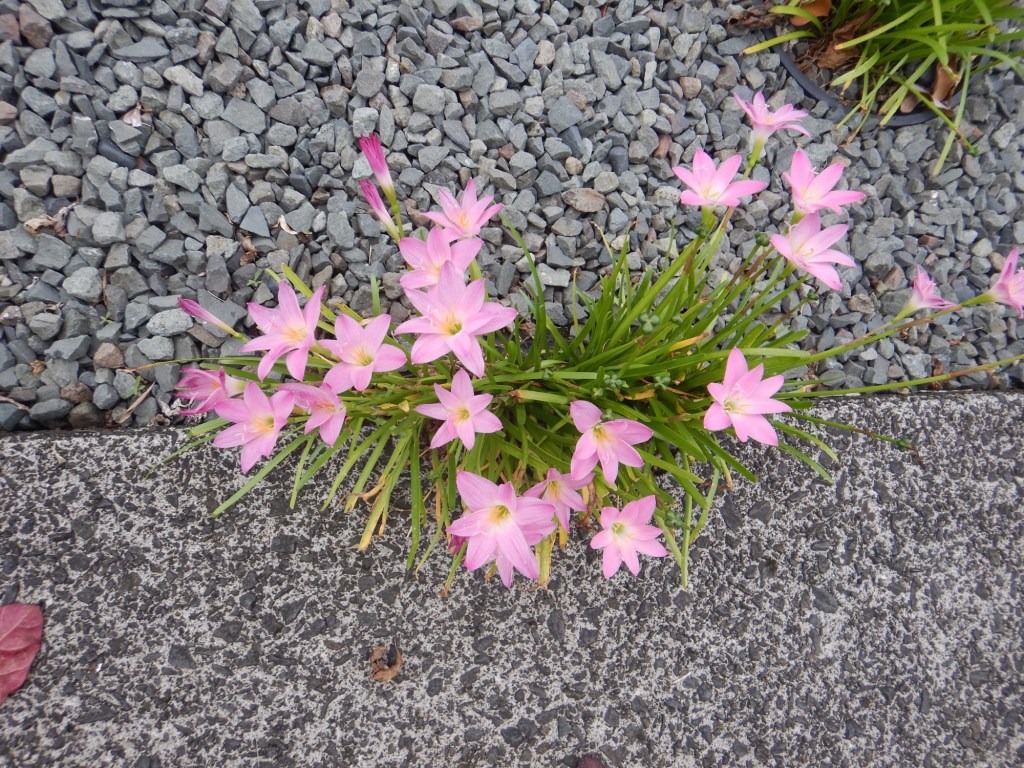
Pink Zephyr lilies in gravel mow curb strip in Manoa
By Heidi Bornhorst
Recent heavy rains have brought on the gorgeous blooming of Rain Lilies. This is an old-fashioned Hawaii garden plant that many of us cherish.
I first learned about them from my Mentor and Hanai Tutu, May Moir. She always encouraged the golden flowered form in her rock garden, and in an old concrete driveway that served as a rustic garden path. She taught me how to collect and grow more from seeds.
Their Latin name is Zephyranthes and we have several color forms that grow well here in Hawaii.
Moir had the yellow and the white flowered ones in her garden. I have the yellow one in my garden and along my mow curb. When they bloom, I think of May Moir and all that she shared with me. What a Friendship garden gift!
We were visiting my Aunty Hilda Kaneshiro in Manoa and I noticed some nice sidewalk mow curbs that had the pink flowered one. Later I stopped to get some pictures of them.
I’ve also been noticing the yellow ones in sidewalk strips along Palolo Avenue and today I stopped to try and get some good pictures of those.
We all want to encourage people not to cover our island with concrete, right?
Concrete and other impermeable surfaces restrict rainwater from trickling down and recharging our aquifers. Excess hard surfaces like roads and walkways, and cement driveways and even the mow curbs, leads to flooding down slope; freshwater runoff into our oceans and prevents the groundwater recharge that is vital to all our future.
We call these impermeable surfaces and they are NOT good ! Our aina needs to drain and keep fresh water on land and going down into our AQUIFER. This is for us and for future generations
On average it takes 25 years for rainwater to land, trickle down through the lava, and past the lava dikes, and down, down to our underground fresh water.
If it all runs off down slope it can cause flooding, and that fresh water is not good for the Ocean and our coral reefs.
Flooding water is not that fresh, its full of junk. Oil gas yard chemicals and more. We really don’t want that in our Moana, our lovely ocean….
The mow curb is public property and homeowners are supposed to maintain a grassy strip that will drain. Some people get tired of maintaining the grass and concrete over this strip.
This is illegal. They city will come and rip out the concrete and restore drainage. And charge the expense back to the owner. So please, keep it draining, gangy !
And it is not neighborly, or pono for our aina. Please everyone, let’s kokua and do the right thing. Water is vital for all of us.
Having a gravel strip with Zephyranthes lilies is a creative landscape solution that is also pretty. It saves the time and energy, gas oil and noise of maintaining, mowing and edging a grass strip.
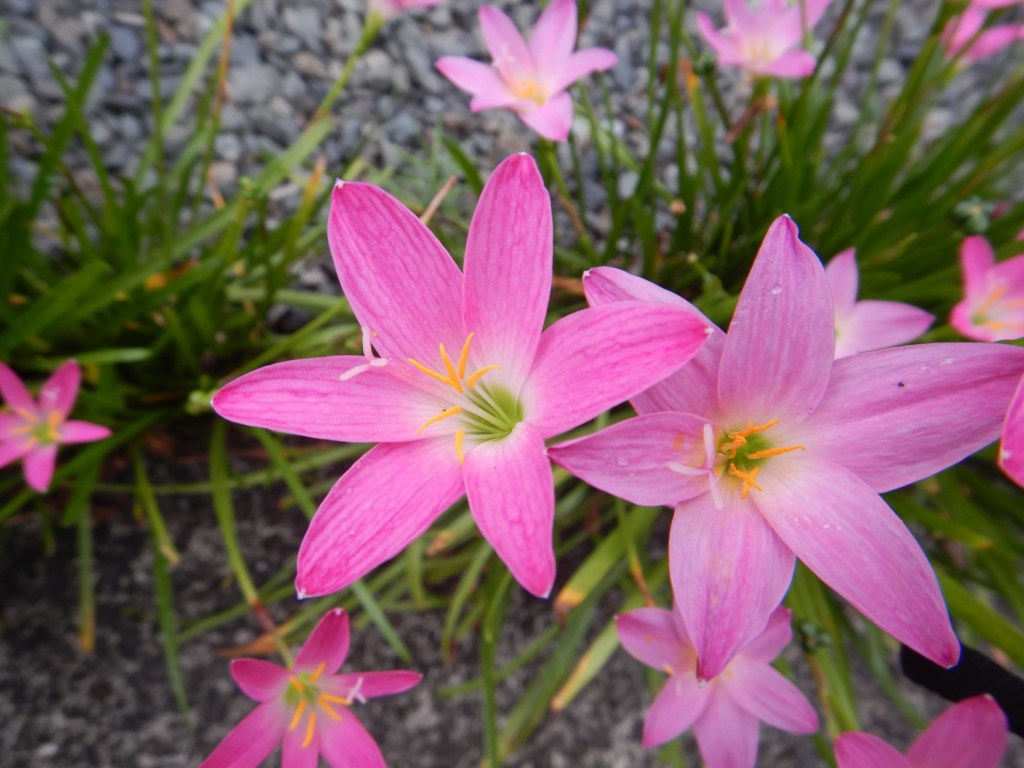
You can choose pink white or yellow flowers. Zephyranthes are a lily and you can grow more from the bulbs. Ask for this nice Xeriscape garden plant at your favorite nursery or garden shop.
If you don’t like the gravel look, you can grow them at the edge of your lawn. This is very pretty with the bright flowers Blooming cheerfully amidst the green grass
Or you can grow them in large pot with well-drained soil.
Golden form of Zephyranthes lilies
HOW TO GROW Zephyr lilies :
After a good rain and mass blooming cycle, some of the flowers develop seed pods. After the three valved seed pods ripen for a bit, they split open, revealing stacks of flat black seeds in each seed pod. You can grow more plants from these seeds.
Or you can dig out the bulbs and grow more that way.
You can also ask for them at your favorite garden shop, such as Ko`olau Farmers.
Call a landscape nursery like the Nii nurseries in Hawaii Kai, or Kobas or Sharon’s Plants in Waimanalo.
Zephyranthes are in the lily family Amaryllidaceae. The Scientific name has Greek origins: “Zephyrus” is the God of the West wind, “Anthos” means flower.
They are native to the Americas, and there are at least 70 species. They do hybridize and breeders opt for different colors and enhanced drought tolerance.
Other common names are Magic lily, Fairy lily, Atamasco, and Zephyr lily.
A funny note, to me is that the strange WEST winds we’ve been having lately, (a very odd wind direction for Hawai`i) coupled with rain, did that all trigger the Zephyr lilies to bloom ? (Note the Latin name !)
Heidi Leianuenue Bornhorst is a landscaping consultant, gardener trainer, and specialty VIP garden guide. She has been a professional horticulturist for more than 33 years. She is also a Certified Arborist. You can contact her via email at heidibornhorst@gmail.com or at 739-5594.



 Pandanus amaryllifolius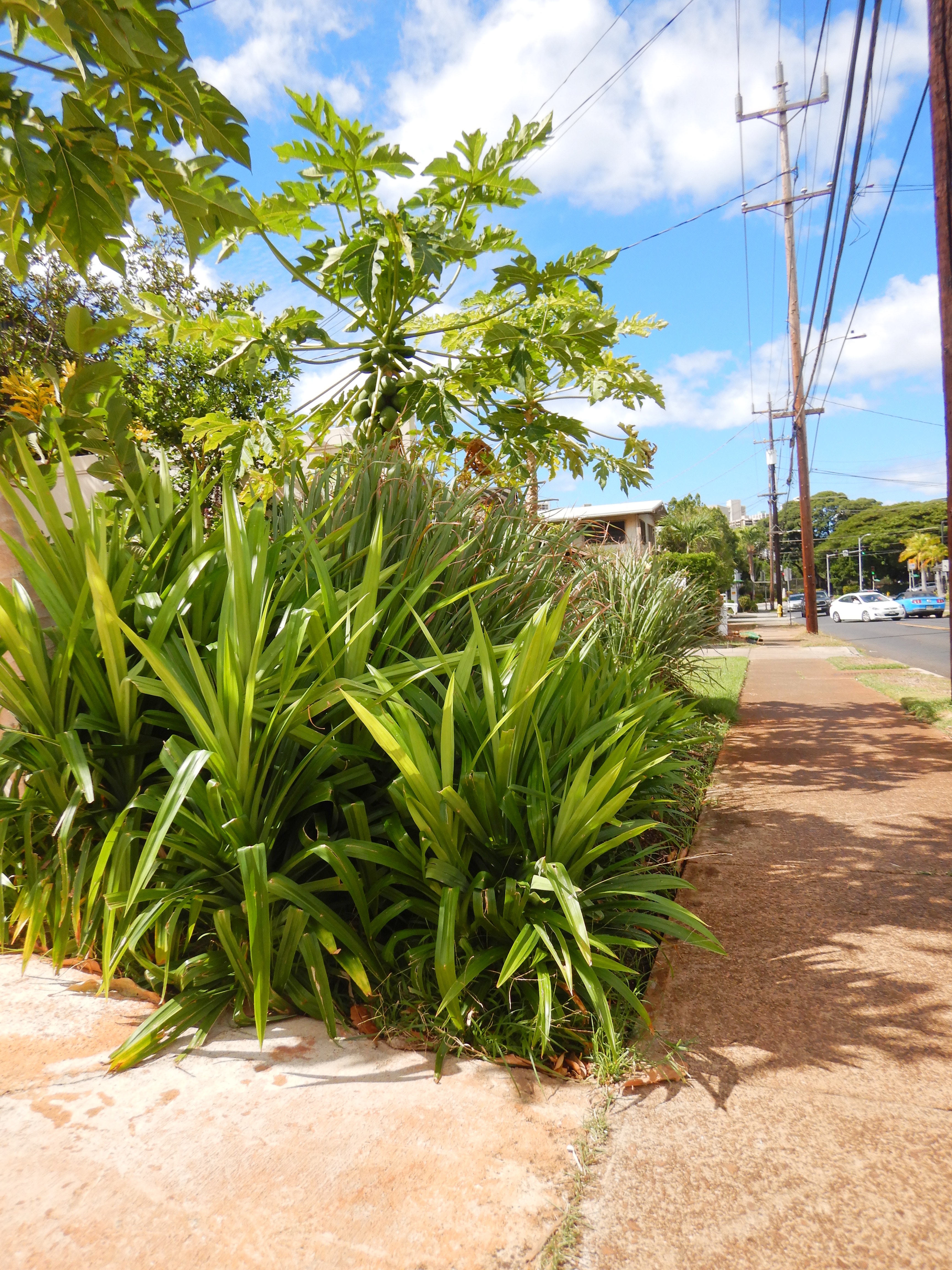


 Heidi Bornhorst