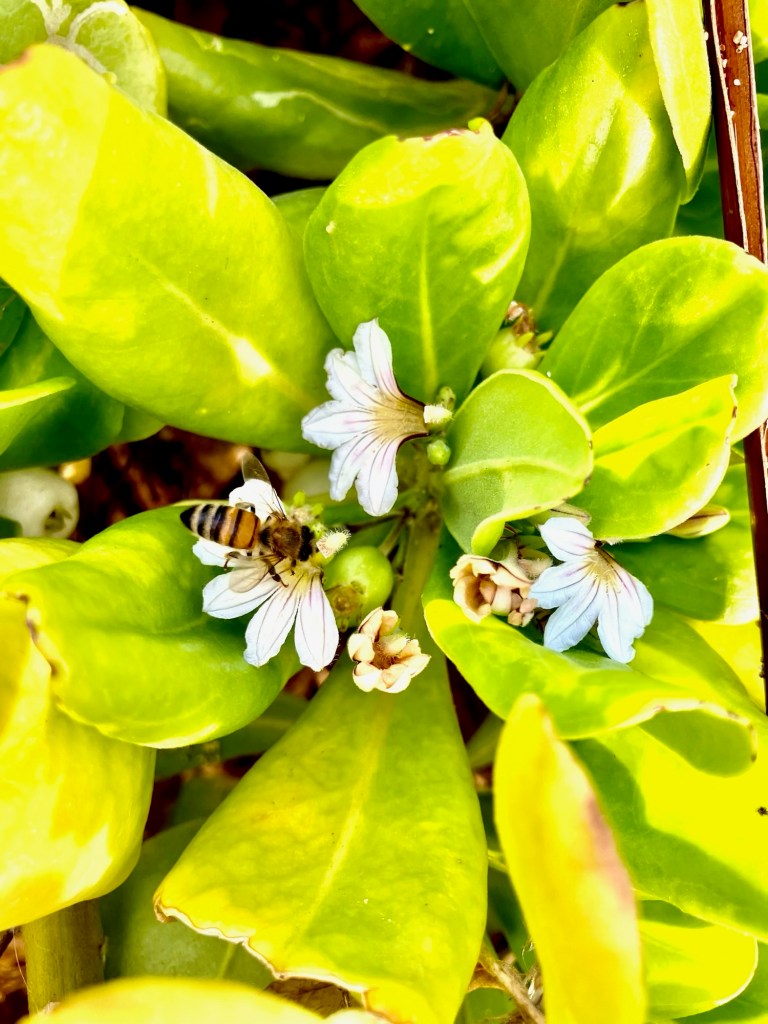
Naupaka is such a simple and elegant native Hawaiian plant to grow in beach gardens, xeriscapes, and to nurture in the wild.
It makes a great hedge, or specimen plant. It protects our coast and holds onto the sand. You can also grow it in large pots.
Naupaka is a less thirsty plant, perfect for your xeriscape garden. It is also salt and wind tolerant.
Grow it from seeds or cuttings or buy some potted ones and support your favorite local nursery.
Strategic landscape designed naupaka hedges can protect beach homes from the strong ehukai, salty winds.
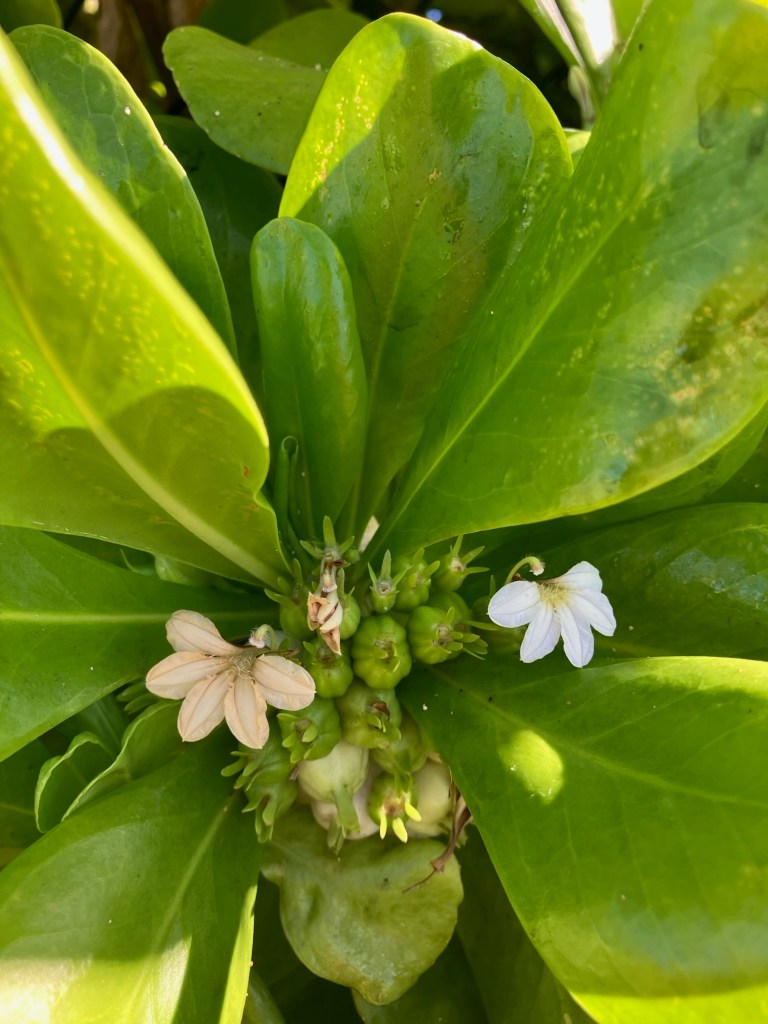
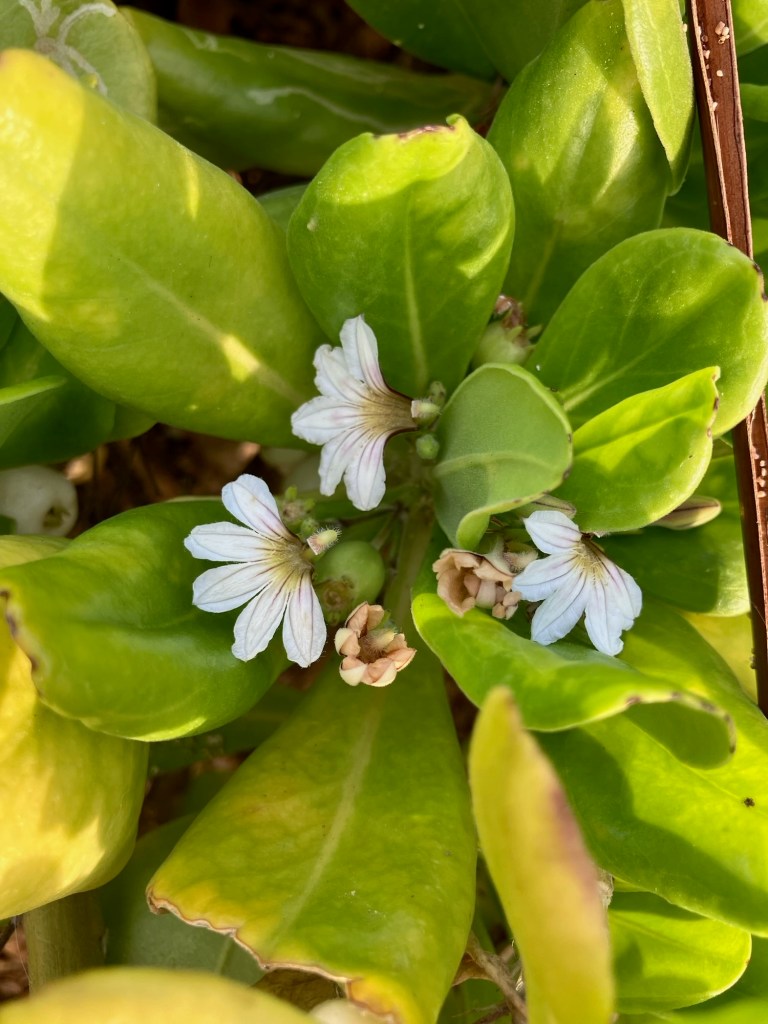
It is beautiful with its soft green leaves and half flowers which are white with a hint of purple. White fruit follow the flowers.
Beach Naupaka, Naupaka kahakai is known as Scaevola taccada to scientists.
It is an indigenous Hawaiian plant, which means it got here on its own, but it grows in other tropical areas too.
We also have native endemic species of Scaevola, Naupaka kuahiwi that inhabit our uplands. They too have a half flower, which features in Hawaiian love legends.
It is the easiest plant to care for if we keep it simple:
• Minimal water once established.
• No fertilizer.
• Keep turf grass away from the root zone.
• Minimal trimming, and only by hand.
As with many of our native Hawaiian plants, modern ‘mow blow and go’ landscape techniques do not agree with naupaka.
The worst is gas powered hedge trimmers, this will mutilate naupaka. Do minimal trimming and shaping with hand clippers or loppers.
Do not TOP naupaka. Prune carefully, and minimally and only when you are in a good mood.
Topping is where you mindlessly cut trees or plants.
The new growth is soft, and the older branches are very woody and tough.
Power equipment trimming shakes up the roots and then makes the branches grow too dense, making habitat for insect and disease pests.
Turf grass should be physically separated from the Naupaka planting area. Use a nice stone, coral, or brick edging to keep grass and naupaka separated.
Hand weed out any invading grass. Grass will compete and rob water, nutrients, light and space from the naupaka.
An edge also makes it easier to mow the lawn.
Thoughtful Landscape design and old fashioned garden maintenance will help you keep your naupaka thriving and Beautiful, as nature designed.
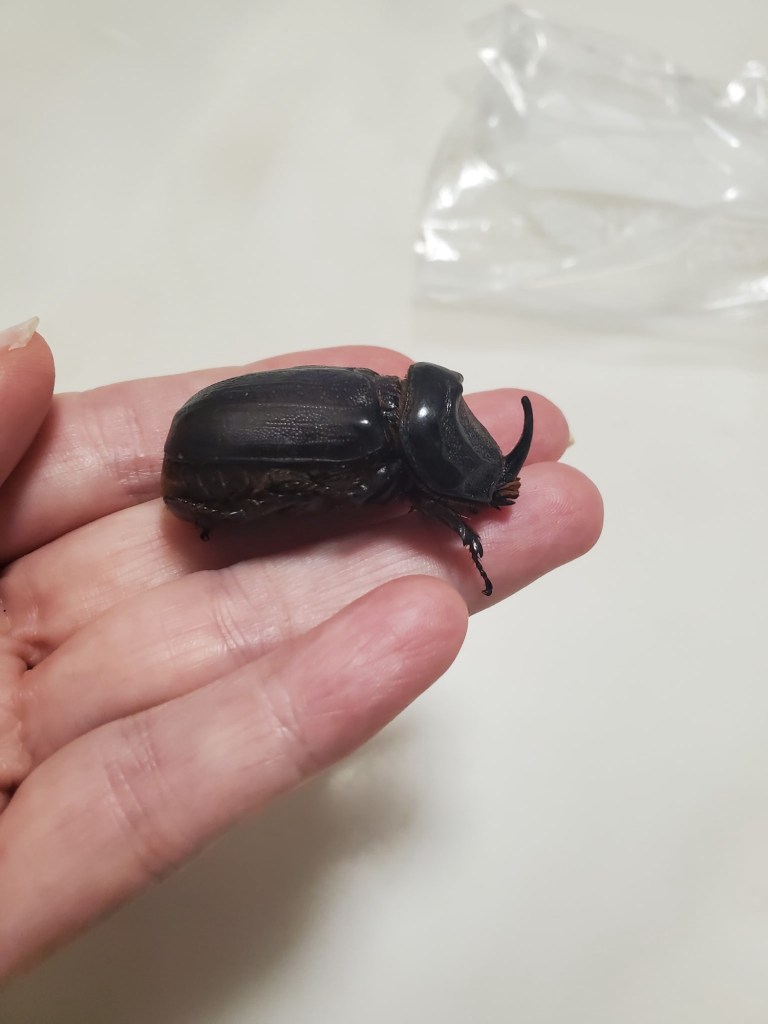
Alien Coconut Rhinoceros Beetles are currently Endangering our Niu (coconut palms), native Hawaiian Loulu palms, hala, banana and more.
Coconut Rhinoceros Beetle
This is an existential threat, not only for beauty, but for life.
Without Niu we may starve.
Imagine Hawaii with no Niu.
Coconut Rhinoceros beetles (CRB) are a serious alien pest. We really need to take this problem seriously and attack / control them on all fronts.
For years, At Every Arborist and landscape conference, we were warned about these chunky hungry beetles and warned to KAPU !! keep them out of Hawaii.
CRB are Major and serious pests in other places such as Polynesia and overall world tropics.
Now they have spread from a Navy site in 2013, to the west side, devastating the north shore and Waialua. They are bad in Waimanalo.
I was at Wahiawa Botanic Garden recently and so devastated to see all of our native Loulu palms being munched and destroyed. This upland Botanic Garden has a collection of rare Loulu palms (CRB love our native Loulu palms even more than Niu or coconuts). They also attack Royal palms.
(We have the famous ET grove of Royals, on Royal palm drive in Wahiawa.)
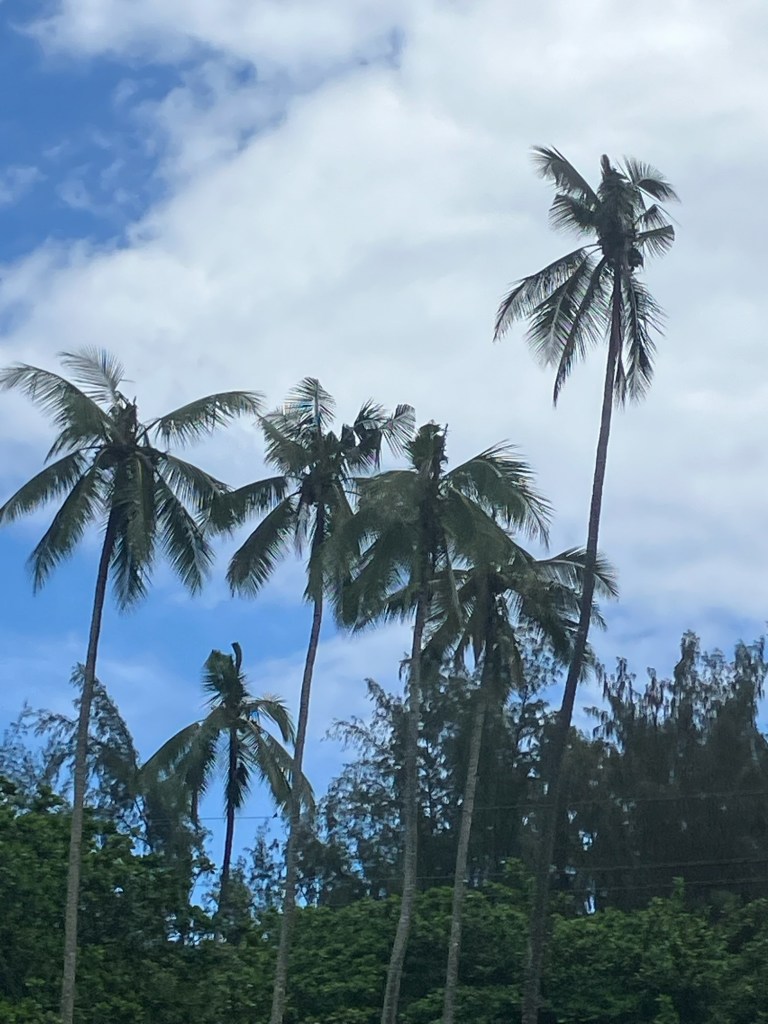
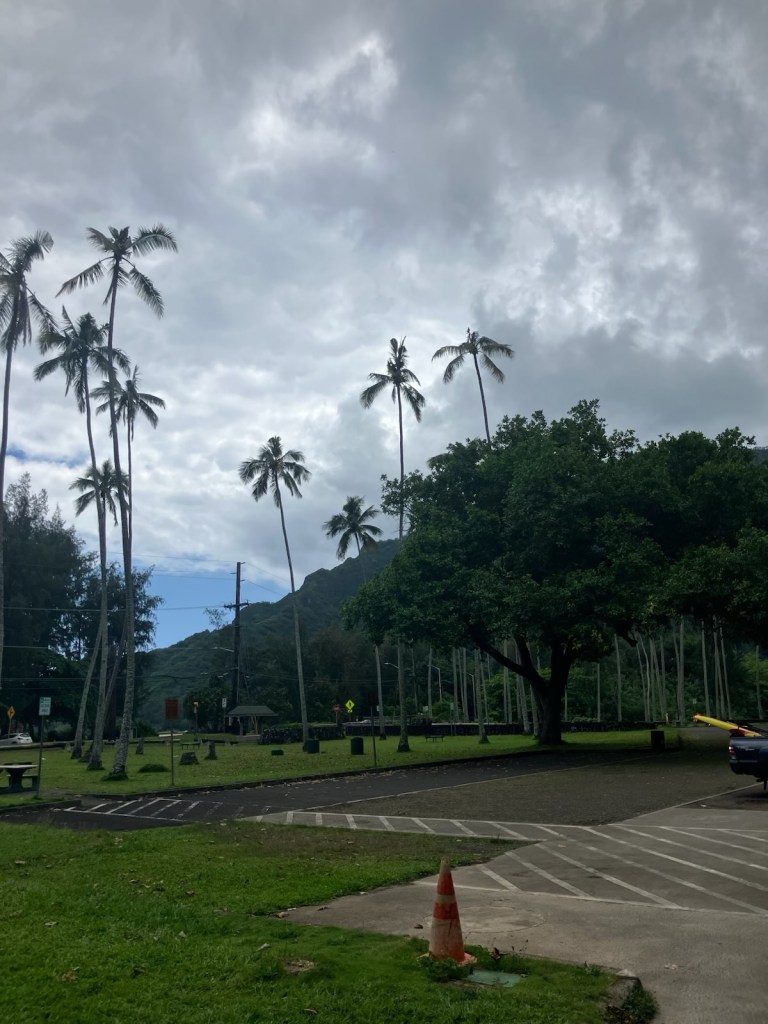
Auwe! we stopped at Kahana state park, where the precious Niu of Mary Mikahala Robinson Foster grow tall and graceful, said to be some of the best nuts for eating and drinking.
Coconuts at Kahana state park, attacked by CRB
I sadly observed the classic cut out fronds, characteristic of CRB feeding on new vulnerable growth. These Niu are iconic and getting munched to death, as I write this.
Coconuts at Kahana state park, attacked by CRB
We need to get everyone to pay attention and help with control. Our Governor Green and Mayor need to get behind these efforts: Education and control.
Neighbor islands are getting hit with CRB too.
Know the life cycle, they spend the bulk of their life feeding on and in, rotting vegetation, compost piles and the like.
It should be on the News every night, along with other crimes affecting Hawaii.
Here are some of the immediate steps we can all take:
No mulch piles
No dead stumps
Netting
Traps with lights and netting
Public awareness and education
Government support and action
Search for Biocontrol
Education
Chemical treatment to save Coconut palms (Must label as treated, and cut off any flower and fruit on treated palms!) A high lift or skilled coconut climber is key for this.
Everybody’s dog, chickens and pigs can find and eat the grubs.
A Gourmet opportunity for an innovative local chef?
Nui/Coconut, Cocos nucifera is the Tree of life for Hawaiians, do we really appreciate and treasure Niu in Hawaii as well as we could?
Can you imagine Hawaii with no Coconuts? CRB also attack Hala, Loulu palms, banana and more.
Let’s get together and scientifically, attack this pest.
Netting all around the vulnerable crown of the palm. Netting of mulch piles. Nets with Lights
As my friend Mari Zane says Ho! Beneficial use for those illegal gill nets! (Her Loulu and Niu on the north shore were early casualties, but there is hope for the shorter ones.)
Wrap the nets around the crown. The nets will get the ones inside coming out of the bore holes, and get any on their way in.
Contemporary Landscaping, a nursery in Waimanalo, uses a low net about four feet tall, lit at night. This attracts and captures beetles.
Trapped beetles attract more beetles to the light, and a chance for more control.
Brown Cannon made a trap using a netted Hula hoop and is capturing them out in Waialua. He sets this hula hoop net (great recycling!) over a barrel of woody mulch.
We can all get smart and do our part!
Just when Hawaiian gardeners, City parks folks and landscapers were convinced to wisely use mulch, we find that mulch piles are endangering NIU.
CRB grubs love rotting vegetation and spend most of their life there.
We can have mulch piles and mulch dishes if we are akamai.
Turn the mulch frequently disrupting the grubs.
HOT mulch will help to kill them.
Turn your mulch and have animal helpers, keiki or your arborist ready to spot and capture the grubs.
(Dogs, pigs and chickens can be trained to eat the grubs of CRB)
Mulch and green waste piles are perfect habitat for these alien pests and their voracious grubs.
Hot mulch is OK: turn it and burn it!
Or spread mulch and compost thinly. Water it and look for CRB grubs.
As always water and nurture your palms, keep them as healthy as possible.
Let’s work together to protect and save this vital part of Hawaii. !!!
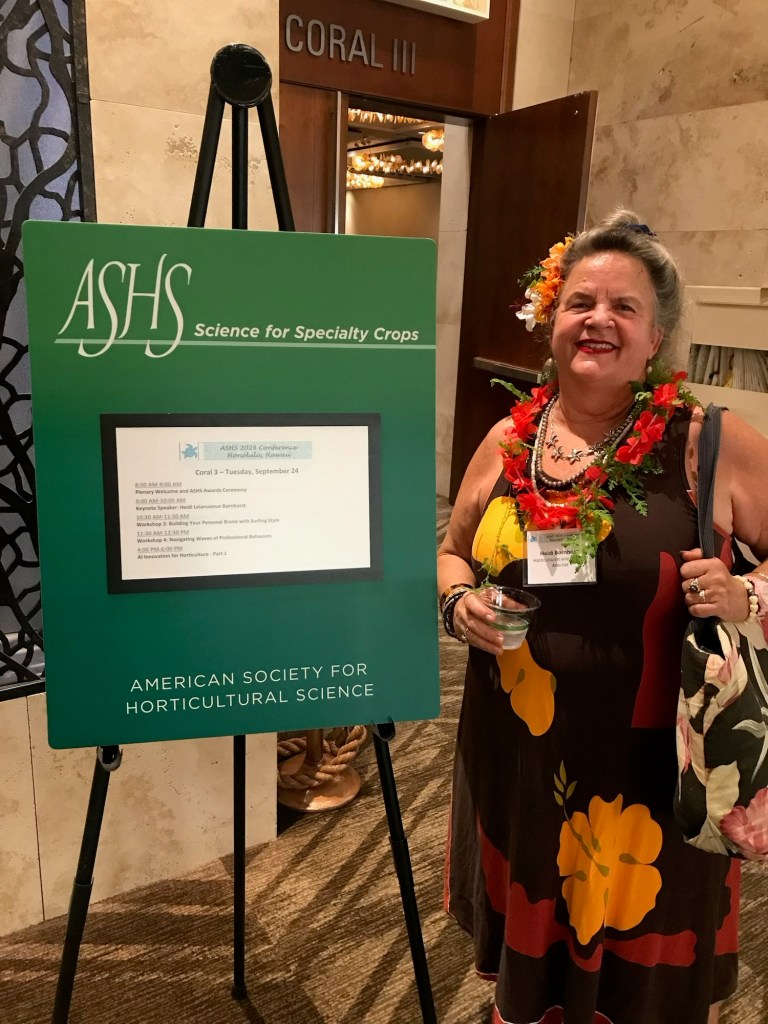
A prestigious Horticulture group is coming to Hawaii for a weeklong conference.
The American Society for Horticulture Science will be here on Oahu for a week long conference beginning Monday September 23, 2024, closing on Friday September 27.
Over one thousand attendees are signed up and registration is still open. (1067) at last count.
This is great for Hawaii gardeners, Horticulturists, Botanists, and plant scientists.
The conference will be held at the Hilton HawaiianVillage hotel, right on the beach in beautiful Waikiki.
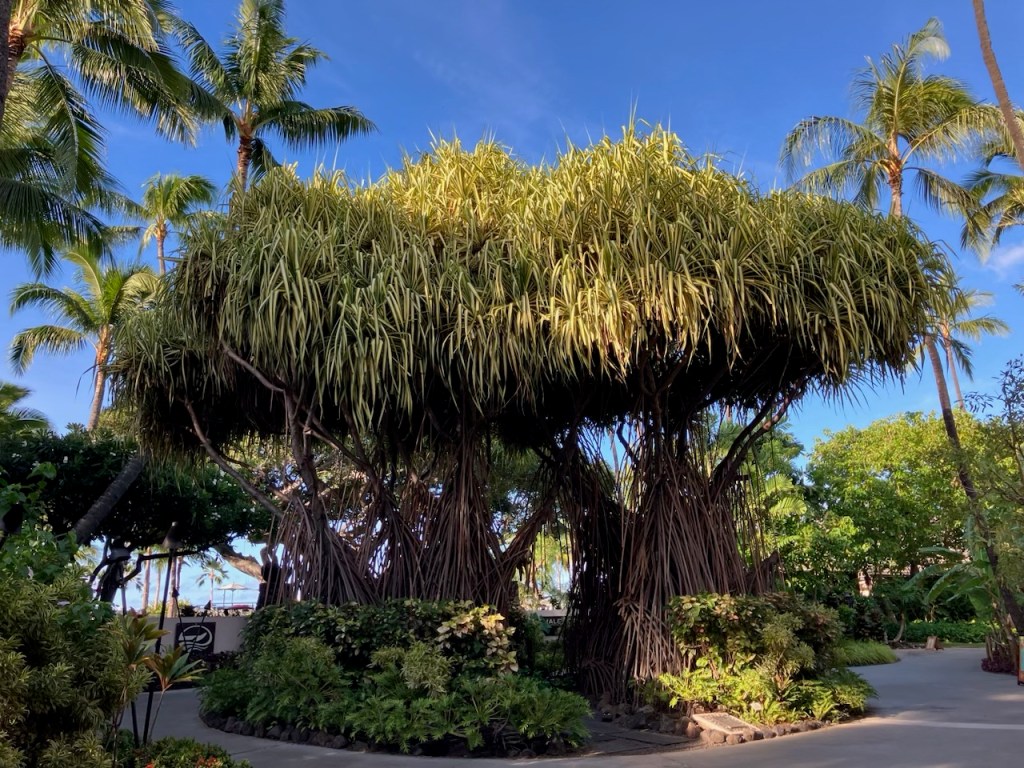
Renowned for its extensive gardens, featuring many native Hawaiian plants, along with canoe plants and tropical exotics, it is a great venue for these plant loving scientists to enjoy.
The Hilton is also right next to the Hale Koa Hotel (where I served for over 10 years as Landscape Director).
The extensive landscaped grounds of the Hale Koa were designed as a botanical garden and the plantings there are very impressive and worth a stroll.
There are many wonderful gardens in Waikiki, amidst all of the hotels and high-rises.
I was very honored to be invited to be the keynote speaker for this conference and I plan to be talking about my favorite: Growing native Hawaiian plants.
There are over one thousand native Hawaiian plant species, and we now are growing about 100 of these Hawaiian plant species. We can grow more!
We have 1367 native Hawaiian plant species. Over 90% of them are endemic, meaning they only grow naturally here in Hawaii. About 9% of them are extinct, and many are rare and endangered.
Some are common and easy to grow, and we see them all around. Examples are: Hala, beach naupaka, `ilima, Hapu`u or Hawaiian tree ferns, and Kou and Milo trees.
Other native plants are less common in our gardens and landscape, but horticulturists are working to change that.
My friend, Dr. Mike Opgenorth, who is the Director of Kahanu Botanic Garden in Hana, Maui will be speaking on Thursday about his PhD work on our endangered native Hawaiian Gardenias
Many more students and graduate student at the U.H. are studying how to grow and perpetuate native Hawaiian plants.
The landscape or “Green industry” here in Hawaii is doing the groundwork with native plants.
Home gardens now feature native Hawaiian plants especially those loved by lei makers such as `Ohi`a lehua, `ilima, Palapalai and Pala`a ferns, and our native fragrant Hawaiian white Hibiscus, Koki`o ke`o ke`o.
Our public parks and urban forests are growing more native plants too.
The first time I saw the real native name, I went no, WAY too hard to say! But learning to spell Latin names is not that much easier. So maybe we should practice using the real name.
Break it down and it’s easier to say. Write it and your brain will remember it.
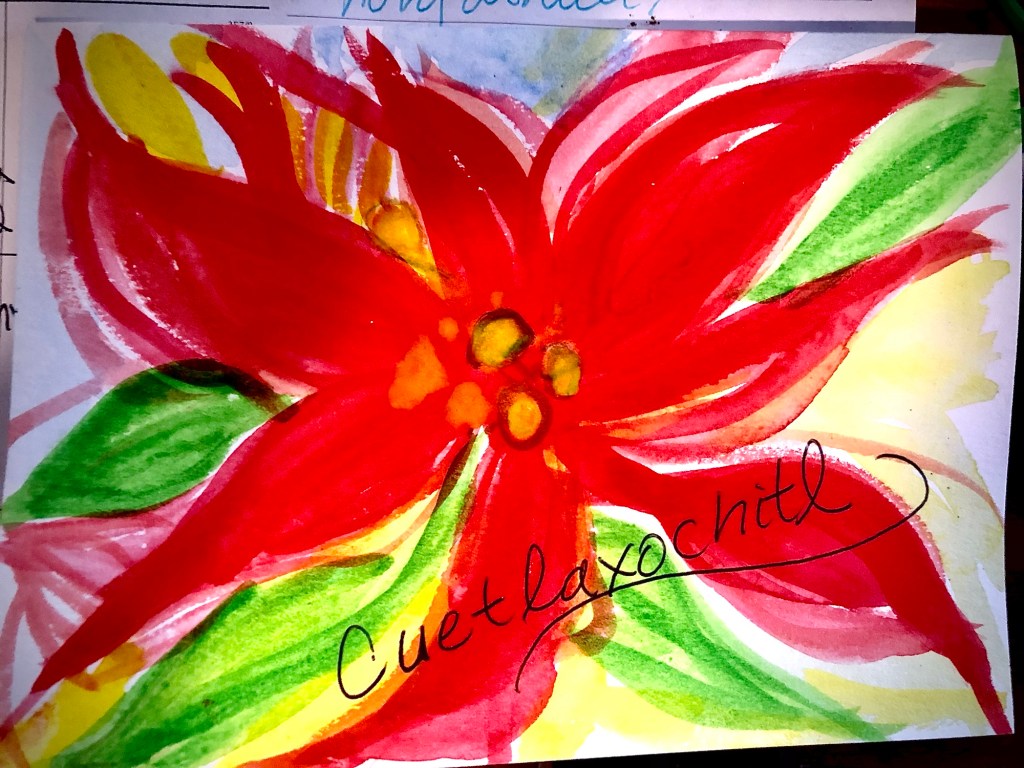
It is pronounced: Kwet La sho Chel
Sing it! Let’s try and remember and use it.
Just like we respectfully use, and properly pronounce ohelo Hawai’i words, we probably shouldlearn to use the real name.
Not only is it a seasonal festive plant for us (and a big production for our nursery growers), starting in Hawaii about June with little plugs, it is a very special and significant plant in its native Mexico and Central America.
Red is original color, and many new variations now exist. I like the new colors for their novelty, but the rich red is so seasonal and joyous.
In Mexico they were symbolic and were also used for medicine (A special recipe induced breast milk). they are not as poisonous as some rumors suggest. Red and purple fabric dyes come from the colorful. bracts.
The “flowers” we see so brightly are actually bracts, modified leaves. The true flowers are yellow and green and are nestled in the center of the bracts.
For the past few years, I have been buying them from the UH Manoa Horticulture club, to help support and encourage students in the fine art of intensely growing and studying plants.
I love going up to Manoa to buy them and then sharing this growing gift with family, friends, and neighbors.
We also have the old-fashioned hedge type of Cuetlaxochitl in some Hawaii gardens. They are becoming a more rare plant to see. In Foster Village, where my husband grew up, we’d love to see all the pretty tall plants growing in gardens as we drove out to visit his folks. A particular house had green walls and it was so striking to see the plants growing there.
If you see one like this, you might ask the gardener for a cutting to grow. This is not among varieties growers produce today. This hedge type one is more of a perennial and will grow and bloom every year.
Who remembers the old hedge that the Board of Water supply grew along the Pali Highway in Nuuanu?
For many of us this was the true sign of the season.
These seasonal flowers can last for months if you treat them right. They like light but not baking sunlight. Water them about once a week. Take off any decorative foil. Fill the pot with water and let it drain all the way out. Then put it back with your other Holiday decorations. They may last and stay red all the way to April!
An old gardener trick is to trim them back in the A months, April, and August. This holds true more for the hedge type.
Although I keep them alive a full year, these newer cultivars don’t look great. Nurseries use all kinds of special fertilizer and lighting to get them looking so pretty and perfect.
Leaves are valuable for our gardens and for living soil. Akamai farmers of old used and valued leaves to create and maintain good soil. Good soil is “alive” with beneficial microorganisms.
Some people rake up and throw away their leaves. To me, leaves are way better for our gardens than chemical fertilizers.
I consider them to be GOLD for the garden. Do you need some exercise at a safe social distance? GO out and rake up some leaves! Raking is good for your arm muscles.
Its fun for keiki and ohana too, just keep your distance from each other, if anyone has been traveling or exposed at work or school.
What is the best kind of leaves?
Monkeypod
Koa
Fine leaved legumes like Kiawe
`Ulu
Whatever you have!
Nitrogen fixers like monkeypod, koa and kiawe are great. The smaller the leaves, the more surface area, and the more rapidly they decompose, releasing nutrients that are available for plants to uptake and use.
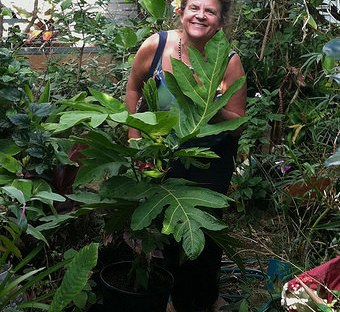
`Ulu or breadfruit leaves make excellent soil building compost and they are so petty too!
Any leaves will work. Bigger leaves like those from Mango, Lychee, mountain apple and Avocado can be cut up or shredded to make them decompose more quickly.
If you grow Anthuriums, these big leaves that don’t break down quickly are useful intact. We grew up using hapu’u, Hawaiian tree fern trunks for Anthuriums and orchid potting medium. But its not sustainable to use hapu`u, it better to let them grow in our gardens and rainforests. SO, a trick I learned from my old Foster Botanical Garden Boss and sensei, Masa Yamauchi: use lychee or mango leaves for potting medium in your anthurium pots.
Cut them up with clippers and soak them in a bucket for a while. If you have a chipper or shredder those make nice fine leaf cuts. You can also run the leaves over with a lawn mower to get them into smaller pieces.
If you trim get your trees trimmed professionally, have them chip the leaves and branches too. This makes excellent mulch and compost. Make sure the chipper has sharp clean blades.
Or mix fine textured and large leaves
I went up to my neighbor Cindy’s and harvested leaves out of her green bin.
She likes a neat yard and does daily raking. And even though she’s my good friend, and a very good tidy gardener, she THROWS THEM AWAY!
Her gardeners (grass cutters) had been there and they dumped a bunch of grass in the bin too. I DON’T want the grass! It might have weedy seeds and has too much nitrogen. So, I had to separate it all and lean down into the bin to get the good leaves. And then the rain and wild winds came too!
All in all, it was quite a workout ! I loaded up the bags, buckets and boxes of leaves and brought them home to my garden.
I had priority plants that I want to give extra nurturing to:
Food plants
Rare Hawaiian banana variety that is struggling
Rare gingers
`Ohi`a lehua
Palapalai ferns
Rare native Hawaiian Hibiscus, koki`o ke`o ke`o, H punaluensis.
I distribute the leaves, and watered them in.
Adding water helps “stick” the leaves in place and starts the decomposition process. With this wild wind I don’t want them blowing all around.
One of our goals for simple sustainability, is a Fruit tree in every yard, even on your apartment lanai. For years Mark and Candy Suiso and their extensive extended ohana, participated in the epic Fruit sharing event known as Mangoes at the Moana.
This was Mark’s simple message for all the ten years we staged this educational and fun, Ono for Mango fruit, local fun foodie event. Remember when every yard had at least one fruit tree, lots of vegetables, all kinds of things for the family to eat and to share?
Share with ohana, gifts for the neighbors, take a generous bag to work, etc.
Kupuna Pua Mendonca of Hawaii island shared some simple wisdom with me at an Aquaponics training conference in Hilo: survival trees to grow are avocado, niu or coconut, and `ulu or breadfruit. Those healthy fats and oils will get you through times of hardship and scarcity.
You’ve heard the scary news that we have one week of food on grocery shelves in Hawaii. Should we get cut off from imports, its handy to have some degree of self-sufficiency.
So, lets grow some survivor supplies in our gardens. I was visiting my great gardener neighbor Joan Takamori and admiring her plush and fruitful garden. She always has something to share and we learn from each other as we talk garden story.
Takamori asked me about a macadamia nut cracker. She had an abundance of macadamias from her mother’s garden.
I laughed, recounting our nutcracker as kids. It was a big pohaku in the dry stack rock wall, that was flat on top and had an almost perfectly sized mac nut puka. We would set in a nut, and hit it “just right” with a small sledge hammer. Sometimes it cracked open perfect, sometimes we smashed too hard and sometime the nut went flying!
This is how I learned (without knowing it) about scarification, a technique to help tough thick shelled seed to germinate and grow. The nuts we nicked that flew down the side sloping yard, were able to grow into seedlings.
Once when we had a cousin swap, I took a big paper bag of macadamia nuts to my Aunty Ruth in California (what a hostess gift, such an elegant bountiful paper bag!)
I told them how we cracked mac nuts at home. But no! Californians have a better plan! And my Uncle Merle was an Engineer. He had a vise in the garage. It was a big thrill for my cousins’ many friends in their neighborhood, to come over and everyone got a turn cracking a nut. (Sort of like Tom Sawyer getting all his pals to paint the fence, I later thought, with a laugh!) Akamai uncle Merle!
My Aunty then roasted the nuts in the oven and covered them with chocolate. Back home we generally just ate them raw.
I told Joan all of this and how my friend Nyna Weisser had researched nut crackers online and found a great one. Not cheap but perfect cracking. Nyna would hand us nuts and the cracker at a party. Fun for all the friends!
Joan Takamori and I also spoke about how macadamia nuts are another tree that more of us should propagate and grow.
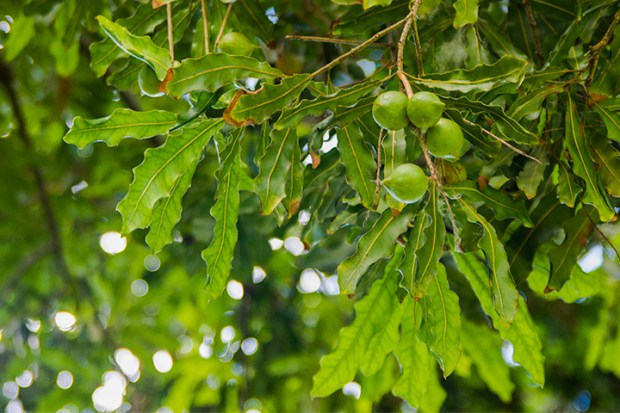
They are a pretty tree with deep green ruffly leaves and very pretty and fragrant flower stalks. If you look closely at the flowers you will see that they look like miniatures of one of our favorite modern-day Florist ornamentals: Proteas.
Mac nuts are in the Proteaceae plant family and they are native to Australia.
I asked Joan about where her folks got their macadamia tree. She didn’t remember it being in the yard forever, and She has a theory.
‘My dad did bonsai my mom didn’t drive; she knew how to catch bus everywhere. I think she stole that tree from him and set it free in the yard’ says Takamori.
We never had it growing up. I think mom planted it, maybe about 10-15 years ago. She wanted to see it flower and fruit, although it would’ve made a kewl bonsai. Its now a very fruitful tree. I want to grow more of them, so I’ve been collecting seedlings, from under her tree to grow and share and plant in my current garden.
Mac nuts need to be scarified to germinate. The thick hard shell is nicked or filed down a bit so water can penetrate and activate the embryo of the seed to grow. Plant them in pots with quality potting mix, and water daily, until they get big enough to go into the ground.
You can also buy them already growing. Ask for them at your favorite garden shop. Or for even more fun, call ahead and visit a fruit tree specialty nursery. Buy some mac nut trees to grow and maybe another fruit tree for a friend or neighbor to grow.
Q: What is deadheading and which Hawaii plants would benefit?
A: Deadheading is where you remove spent flowers to increase blooming and benefit the health of the plant.
Pua Keni Keni comes to mind, as cutting or snapping off the green and orange “balls”, AKA the developing fruit, will increase blooming.
Fruit formation and seed development take a lot of time and energy for the plant, just like a woman being pregnant.
So, if we want more flowers, don’t let the fruit form. In the case of Pua Keni Keni, the fruit on the stems makes for great décor in a flower arrangement. You can even string the “balls” into lei, as my akamai lei making buddy Dede Replinger Sutherland does.
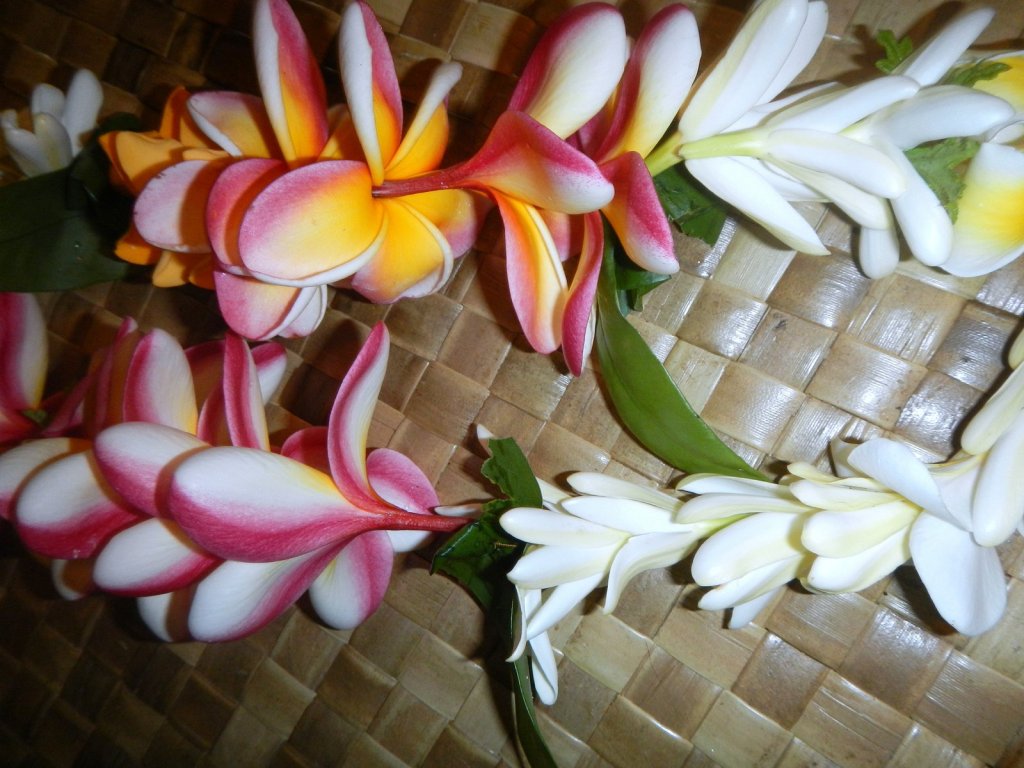
Tiare or Tahitian gardenia nowadays needs deadheading. We didn’t use to have a pollinator for Tiare but now it seems we do, as the old flower calyces (the bottom green part of the flower) don’t fall off after blooming. They now form fruit and it takes about a year to fully develop and form mature seeds inside.
We need to snap off that part on a daily or weekly basis or Tiare plants will have fruit developing and fewer blooms.
Tiare buds make an epic lei, that can last for several days or nights with a most heavenly perfume. When you pick the buds, pick the calyx too and save yourself some time and energy.
My friend Donna Chuck has a prolific and sunny garden with many flowers for lei. She collects the Tiare buds and stores them carefully in a plastic bag with a damp paper towel in the fridge until she has enough for a special lei for a special someone.
We spent some time cleaning up and deadheading her plants and now she gets way more Tiare flowers for her lei creations.
I first learned the word and horticultural practice known as deadheading when I was an apprentice Gardener at Longwood Gardens in Pennsylvania, in my junior year of college.
‘Go deadhead the Rhodies’, I was instructed by the Horticulturist at Longwood.
I wondered if it was something about the Grateful Dead; and had to ask what was deadheading and what are Rhodies?
Rhodies are Rhododendrons, related to the Azaleas that we grow here. They bloomed massively in spring there and general good garden practice was to deadhead them in early summer, to promote lots of blossoms for the following Spring show.
Some use sharp needle-nose clippers for this and some use sharp well-placed fingers and thumbnails to snap off the spent blooms.
Roses are another plant that will bloom better if you deadhead, or you can just harvest and use every flower. Or you can let the fruit develop and you get rose hips which can be made into jam or tea.
Some kinds of Hibiscus, especially our fragrant native white Koki`o ke`o ke`o will form seed pods if you let them. This is how early gardeners made new hybrids as they found the native Hawaiian whites were excellent “mother” plants.
Again, if you want blossoms, pluck off and clean up the old flowers. Another benefit to this is we have lots of recent alien insect pests like scale and mealybugs that love to hide in the developing seed pods and suck sap and juices from the plants.
Deadheading helps you groom your plants, so you can rub off or cut off the pest-infested parts. Get rid of insect eggs and small sap suckers before they form a full-on infestation.
Interesting
to learn something new from my honey Clark, the other day, after all these
years, fresh kewl stories! And about plants and gardens, my fave !!
We were out
at the Uluniu beach house in Laie.
Colleen and Randy asked Clark and I about growing some plant out there.
We discussed
various plants and what would grow in strong salt winds.
Clark mentioned
Uncle Griff and how he grew things out in Waialua, right on the beach. That nobody else could
grow.
Or his
looked and thrived better than others.
Clark said Griff’s
secret was to wash the leaves. Rinse off
the salt water residue on the leaves.
Daily, lovingly.
So
interesting! And to think about. Rinsing my leaves more now too. It gets bugs
and eggs off
Nothing like
a big rainstorm to clean the air and our plants and gardens …..
Why to rinse
and bathe our plants with Fresh water (WAI)
Salt
water has major nutrients
Rinsing
gets wai in the stomates?
Rinsing
cools us all
Washing
off pests
And
potential incipient pests
What did he grow? Clark?
I remember a
nice big lawn, with a view of the surf and beach, a better pa`ina spot than our
sandy front yard with a bit of grass and a big Hau tree.
I think we
have pics with Elaine, Clarks mom and Iliahi, our cutie poi dog, maybe at Griff’s
house.
Hawaiian
wife named …. Aunty Mary, silver hair in a flip, wore mu`u mu`u elegantly.
Last name ?
Panker! We both remember at the same time.
Is Butch their son? Or in-law? Carpenter lived in Wahiawa, daughter swim team …
Clark would go out there and immediately trim down the Hau tree, and do other heavy yard work to help out and hopefully get invited again.
The good
yard at Crozier loop was out by the street but too hot in the day, perfect for
a wedding like Rachel and Peter’s!
Rinse your Gardenias and `ohi`a lehua
We love Gardenias and so do various pests:
Sooty
mold
Aphids
and scales
Ants
which spread and protect the sap suckers
Thrips,
the little black pests in the blossoms
The “cure” for all of these Gardenia attackers? SOAP and water ! Gardenias are the one plant that I also fertilize with liquid Miracle Gro fertilizer. (use Miracid, the one in the blue box if your soil tends to be alkaline)
Gardenias
are acid loving plants, so they like our red dirt soils and leafy compost too.
When I fertilize them, I add some liquid soap to the sprayer. Dish soap like Palmolive or Dr Bronner’s peppermint if I’m feeling rich. I spray this on the leaves and let it drip to the roots too. (if you see pests on the stems and leaves, they are probably attacking the roots too.)
After
spraying wait an hour or so and you can then wipe the sooty mold off the leaves
with a soft rag. Or you can just let the
soap do its job.
Rinse the
leaves well the next time you water.
Dead, sap sucking pests like scale, mealy bugs and aphids will slough
right off if they have been effectively smothered by the soapy water treatment.
MAY is
usually when Gardenias bloom. I had buds
earlier this year, but the cool LOVELY weather of April must have delayed
them. Green buds for a long time.
Now its HOT
and they are blooming gloriously.
How to have epic Gardenia blossoms:
Pick them daily. (if you leave them
on the plant, the pests will love you, they will have a pa`ina <party with
good food> and they will multiply.
Spray them, and the whole plant with
water before you pick
Take the buds and pua inside and
rinse them
If they have thrips, drip soapy water
on them or dunk them in soapy water
Let the bugs get smothered by the soap
for a few minutes
Then rinse them off
Cut or pull off lower leaves
Display them in Deep, cool water in a
vase
Change the water daily
Rinse the stems and recut the base
Put the gardenia flowers back in cool fresh water
Inhale
and enjoy!
Since
hearing this Uncle Griff rinse your plants and gardens story I have been doing
my early morning or evening watering a little differently.
I look at
the plant or tree and wonder if it will benefit from a rinse.
If it’s hot
I don’t mind getting a rinse myself ! I
think like a gentle rainstorm, or sometimes like a rainy windy storm is needed.
I have been rinsing my `Ohi`a lehua which are full of blossoms. I rinse the flowers and know it will benefit the birds and bees that visit and pollinate the flowers. Bees get thirsty too! `Ohi`a are from rain-forests so the more wai the better.
As I rinse and spray off my banana leaves, I visualize the washing away of any leaf hoppers. I also remind friends and neighbors to get rid of their clump thoroughly if it gets this disease. It’s like getting a measles shot, it protects all of our community of banana growers.
Rinse your mock orange and Bougainvillea after a kona storm.
I learned
this one while working as Honolulu Zoo Horticulturist. I forget from who, maybe my working foreman Seiko
Tamashiro, or epic Retiree and Volunteer, Tony Kim?
A nice big
fat thick, and very xeric Mock orange hedge surrounded the whole zoo. Periodically
we would have to trim it, and this was a big process involving the whole crew,
trusted CSSP workers and scaffolds. It
took at least a week.
There was a big drought and we were forced and encouraged to save water. I read the night logs, some of my staff worked at night as security, food prep and irrigators. One guy Bob would turn on the sprinklers for the mock orange hedge and run them for several hours. I told him, “Bob, you are watering the ocean!”
What?
Bob, we have
sandy soil, by running those sprinklers for hours you are wasteful. So please,
just about 20 minutes will be fine for the hedge!
‘OK boss
whatever you say’ he said with some skepticism
(what did a 25-year-old with a nice fresh B.S. degree know, right?!!)
Well, we
reduced our irrigation budget significantly and the zoo gardens were still
green enough and healthier. Someone even wrote a letter to the editor about how
great the grounds looked!
Mock orange
is in the citrus family and it comes from driest India. Super deep and wide spreading, tough roots and shiny leaves help make it
drought tolerant. They also come from monsoon areas so after a big rain we see
fresh growth and fragrant blossoms. This
is how they would respond when the monsoon rains come to India.
Somewhere
along the way in this discussion, came the fact that mock orange is sensitive
to the sometimes strong salty kona winds we would get at the zoo. When those came we deployed the sprinklers to
wash all the leaves.
Same is true
of Bougainvillea. We didn’t have a lot
at the zoo, but I had tons of lovely roof planters of Bougainvillea ‘Miss
Manila’ at the Hale Koa hotel. These we would diligently rinse leaves after
kona wind storms.






 Heidi Bornhorst