Naupaka is such a simple and elegant native Hawaiian plant to grow in beach gardens, xeriscapes, and to nurture in the wild.
It makes a great hedge, or specimen plant. It protects our coast and holds onto the sand. You can also grow it in large pots.
Naupaka is a less thirsty plant, perfect for your xeriscape garden. It is also salt and wind tolerant.
Grow it from seeds or cuttings or buy some potted ones and support your favorite local nursery.
Strategic landscape designed naupaka hedges can protect beach homes from the strong ehukai, salty winds.
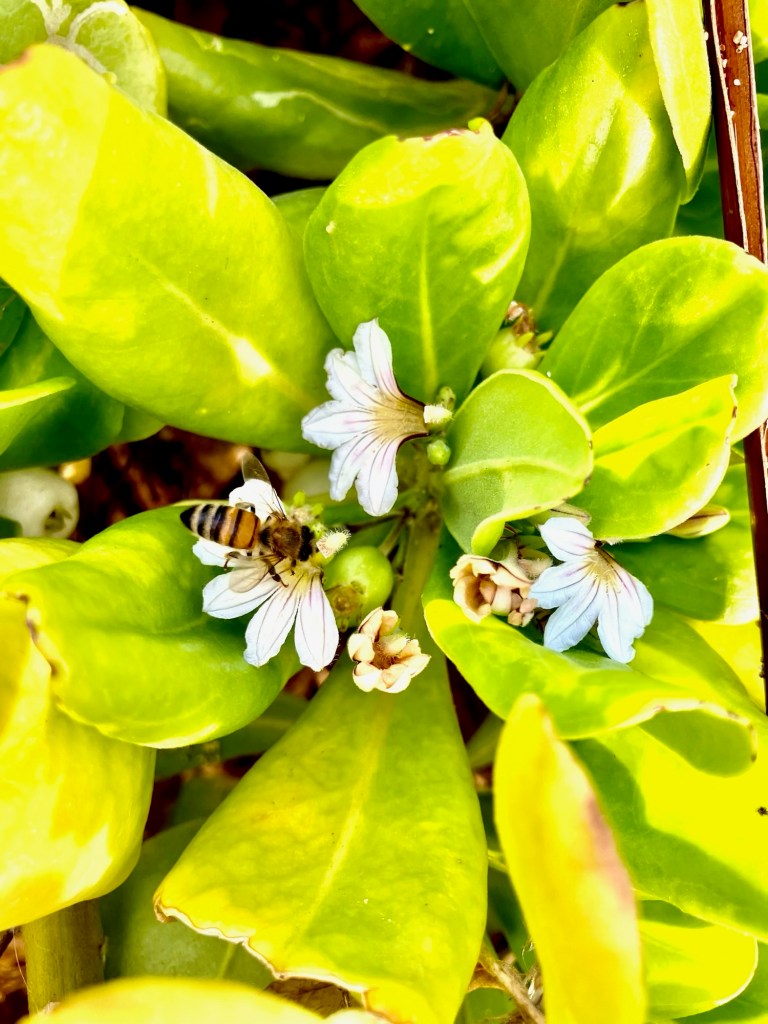
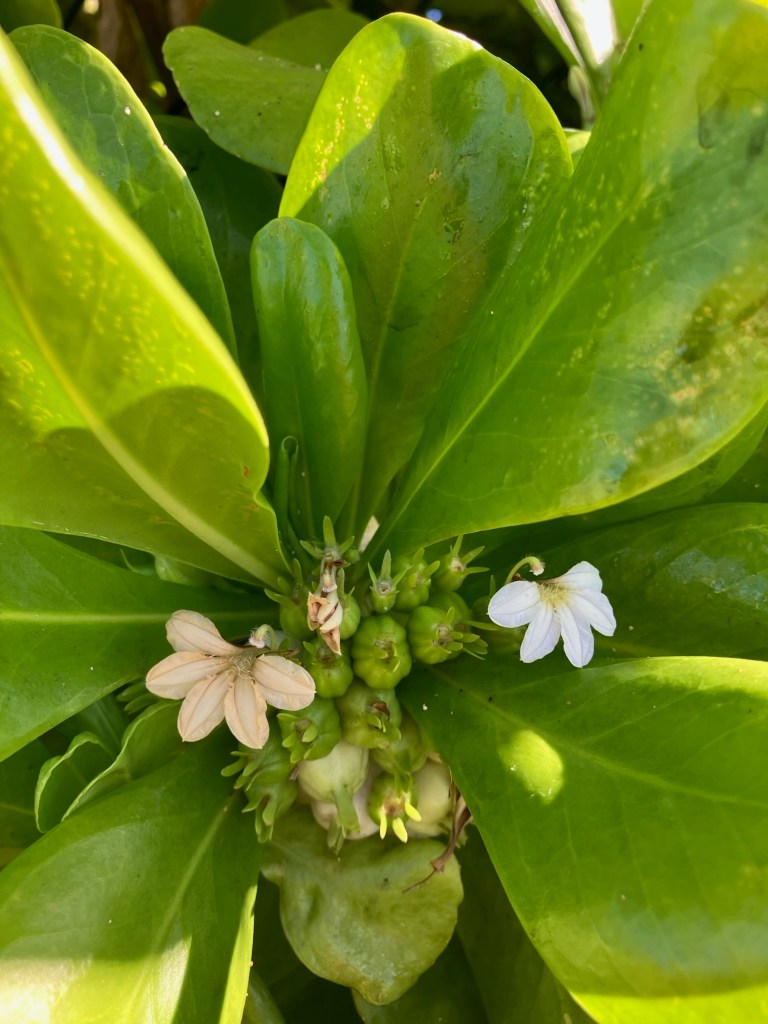
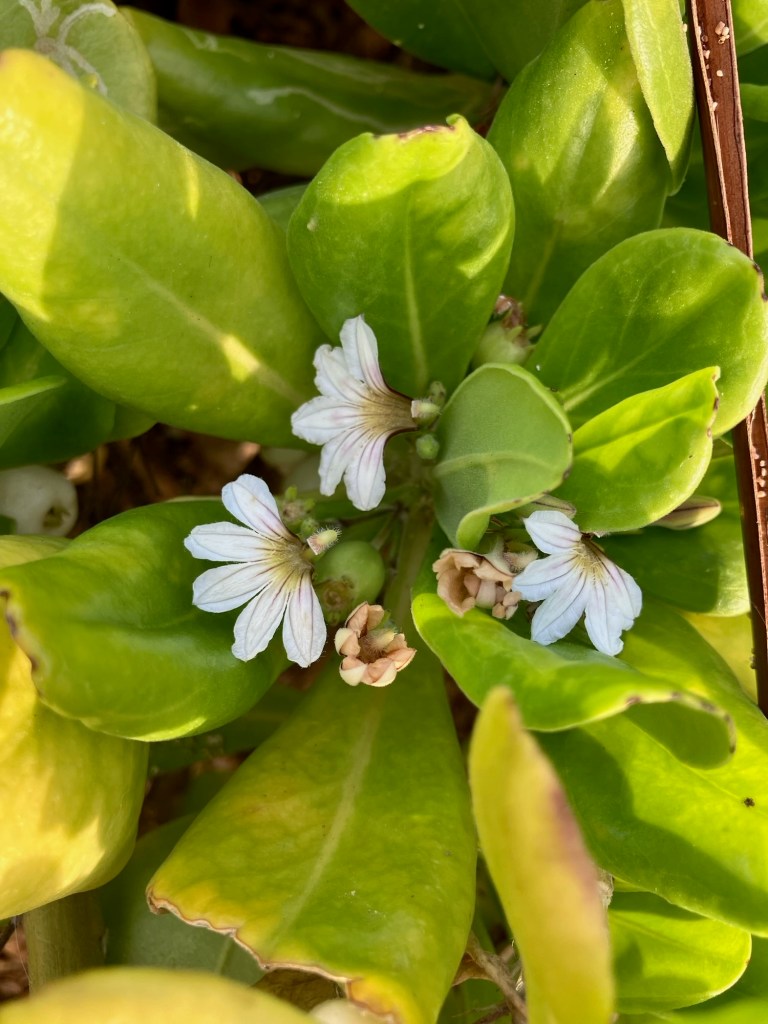
It is beautiful with its soft green leaves and half flowers which are white with a hint of purple. White fruit follow the flowers.
Beach Naupaka, Naupaka kahakai is known as Scaevola taccada to scientists.
It is an indigenous Hawaiian plant, which means it got here on its own, but it grows in other tropical areas too.
We also have native endemic species of Scaevola, Naupaka kuahiwi that inhabit our uplands. They too have a half flower, which features in Hawaiian love legends.
It is the easiest plant to care for if we keep it simple:
• Minimal water once established.
• No fertilizer.
• Keep turf grass away from the root zone.
• Minimal trimming, and only by hand.
As with many of our native Hawaiian plants, modern ‘mow blow and go’ landscape techniques do not agree with naupaka.
The worst is gas powered hedge trimmers, this will mutilate naupaka. Do minimal trimming and shaping with hand clippers or loppers.
Do not TOP naupaka. Prune carefully, and minimally and only when you are in a good mood.
Topping is where you mindlessly cut trees or plants.
The new growth is soft, and the older branches are very woody and tough.
Power equipment trimming shakes up the roots and then makes the branches grow too dense, making habitat for insect and disease pests.
Turf grass should be physically separated from the Naupaka planting area. Use a nice stone, coral, or brick edging to keep grass and naupaka separated.
Hand weed out any invading grass. Grass will compete and rob water, nutrients, light and space from the naupaka.
An edge also makes it easier to mow the lawn.
Thoughtful Landscape design and old fashioned garden maintenance will help you keep your naupaka thriving and Beautiful, as nature designed.
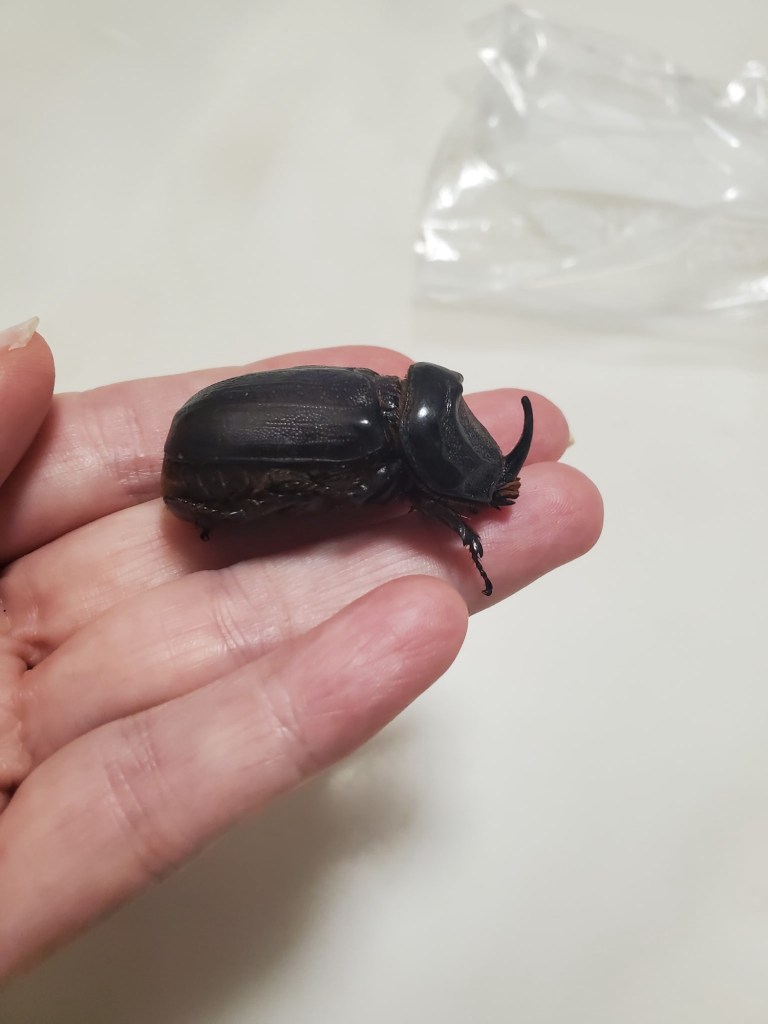
Alien Coconut Rhinoceros Beetles are currently Endangering our Niu (coconut palms), native Hawaiian Loulu palms, hala, banana and more.
Coconut Rhinoceros Beetle
This is an existential threat, not only for beauty, but for life.
Without Niu we may starve.
Imagine Hawaii with no Niu.
Coconut Rhinoceros beetles (CRB) are a serious alien pest. We really need to take this problem seriously and attack / control them on all fronts.
For years, At Every Arborist and landscape conference, we were warned about these chunky hungry beetles and warned to KAPU !! keep them out of Hawaii.
CRB are Major and serious pests in other places such as Polynesia and overall world tropics.
Now they have spread from a Navy site in 2013, to the west side, devastating the north shore and Waialua. They are bad in Waimanalo.
I was at Wahiawa Botanic Garden recently and so devastated to see all of our native Loulu palms being munched and destroyed. This upland Botanic Garden has a collection of rare Loulu palms (CRB love our native Loulu palms even more than Niu or coconuts). They also attack Royal palms.
(We have the famous ET grove of Royals, on Royal palm drive in Wahiawa.)
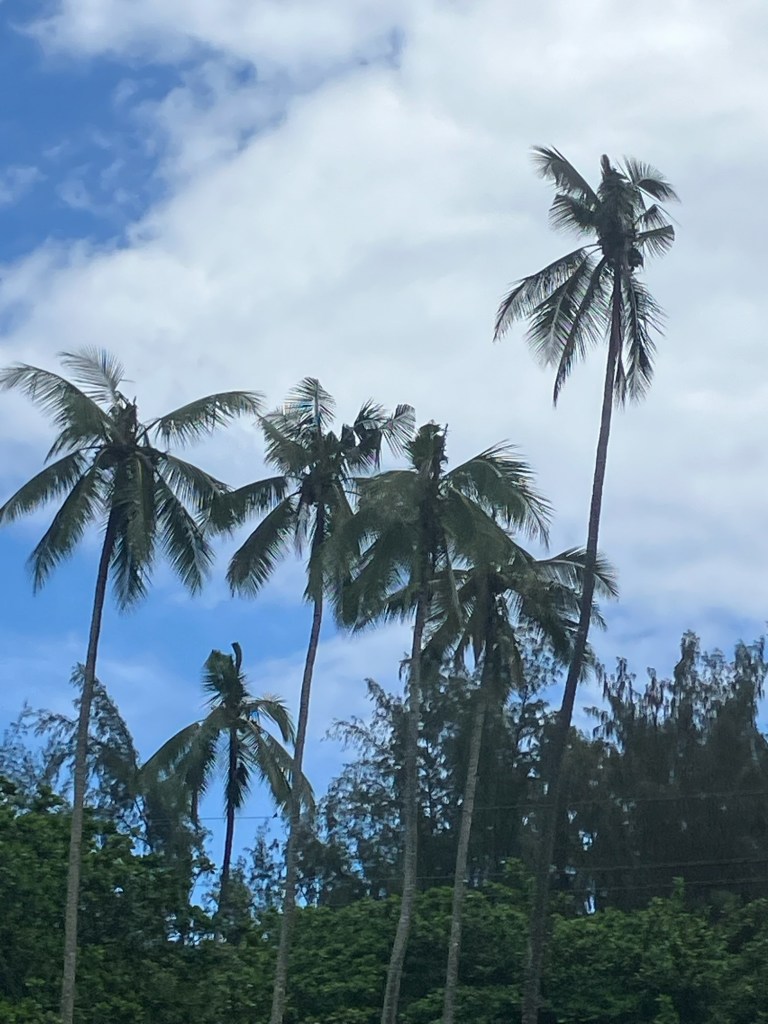
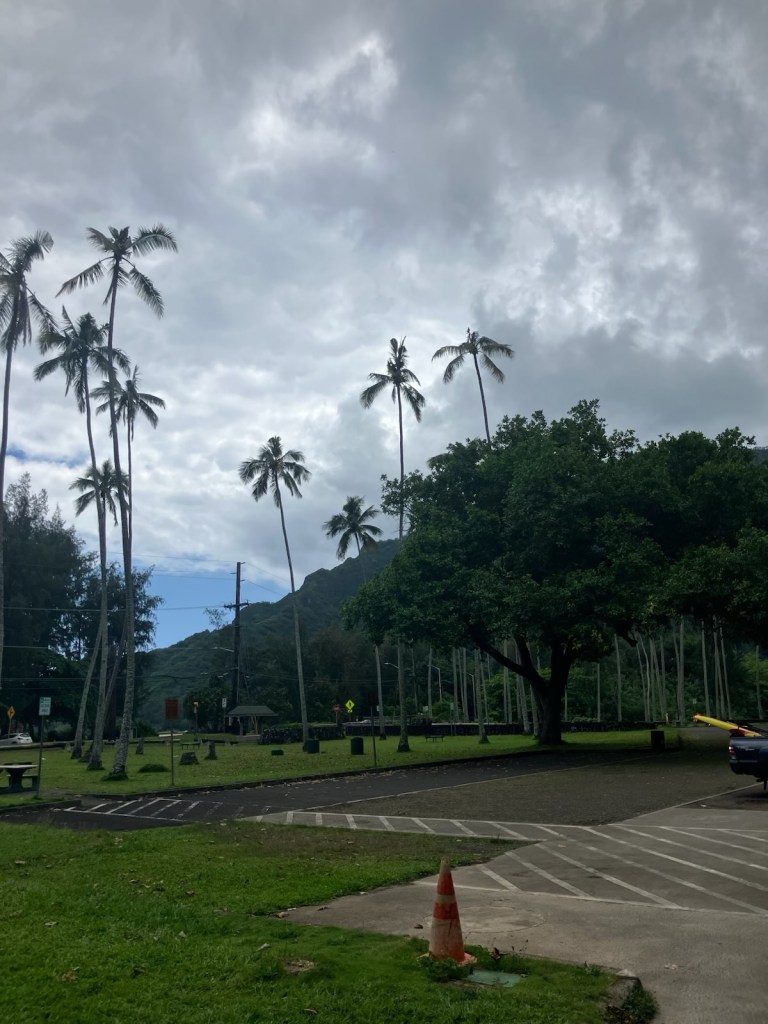
Auwe! we stopped at Kahana state park, where the precious Niu of Mary Mikahala Robinson Foster grow tall and graceful, said to be some of the best nuts for eating and drinking.
Coconuts at Kahana state park, attacked by CRB
I sadly observed the classic cut out fronds, characteristic of CRB feeding on new vulnerable growth. These Niu are iconic and getting munched to death, as I write this.
Coconuts at Kahana state park, attacked by CRB
We need to get everyone to pay attention and help with control. Our Governor Green and Mayor need to get behind these efforts: Education and control.
Neighbor islands are getting hit with CRB too.
Know the life cycle, they spend the bulk of their life feeding on and in, rotting vegetation, compost piles and the like.
It should be on the News every night, along with other crimes affecting Hawaii.
Here are some of the immediate steps we can all take:
No mulch piles
No dead stumps
Netting
Traps with lights and netting
Public awareness and education
Government support and action
Search for Biocontrol
Education
Chemical treatment to save Coconut palms (Must label as treated, and cut off any flower and fruit on treated palms!) A high lift or skilled coconut climber is key for this.
Everybody’s dog, chickens and pigs can find and eat the grubs.
A Gourmet opportunity for an innovative local chef?
Nui/Coconut, Cocos nucifera is the Tree of life for Hawaiians, do we really appreciate and treasure Niu in Hawaii as well as we could?
Can you imagine Hawaii with no Coconuts? CRB also attack Hala, Loulu palms, banana and more.
Let’s get together and scientifically, attack this pest.
Netting all around the vulnerable crown of the palm. Netting of mulch piles. Nets with Lights
As my friend Mari Zane says Ho! Beneficial use for those illegal gill nets! (Her Loulu and Niu on the north shore were early casualties, but there is hope for the shorter ones.)
Wrap the nets around the crown. The nets will get the ones inside coming out of the bore holes, and get any on their way in.
Contemporary Landscaping, a nursery in Waimanalo, uses a low net about four feet tall, lit at night. This attracts and captures beetles.
Trapped beetles attract more beetles to the light, and a chance for more control.
Brown Cannon made a trap using a netted Hula hoop and is capturing them out in Waialua. He sets this hula hoop net (great recycling!) over a barrel of woody mulch.
We can all get smart and do our part!
Just when Hawaiian gardeners, City parks folks and landscapers were convinced to wisely use mulch, we find that mulch piles are endangering NIU.
CRB grubs love rotting vegetation and spend most of their life there.
We can have mulch piles and mulch dishes if we are akamai.
Turn the mulch frequently disrupting the grubs.
HOT mulch will help to kill them.
Turn your mulch and have animal helpers, keiki or your arborist ready to spot and capture the grubs.
(Dogs, pigs and chickens can be trained to eat the grubs of CRB)
Mulch and green waste piles are perfect habitat for these alien pests and their voracious grubs.
Hot mulch is OK: turn it and burn it!
Or spread mulch and compost thinly. Water it and look for CRB grubs.
As always water and nurture your palms, keep them as healthy as possible.
Let’s work together to protect and save this vital part of Hawaii. !!!
A prestigious Horticulture group is coming to Hawaii for a weeklong conference.
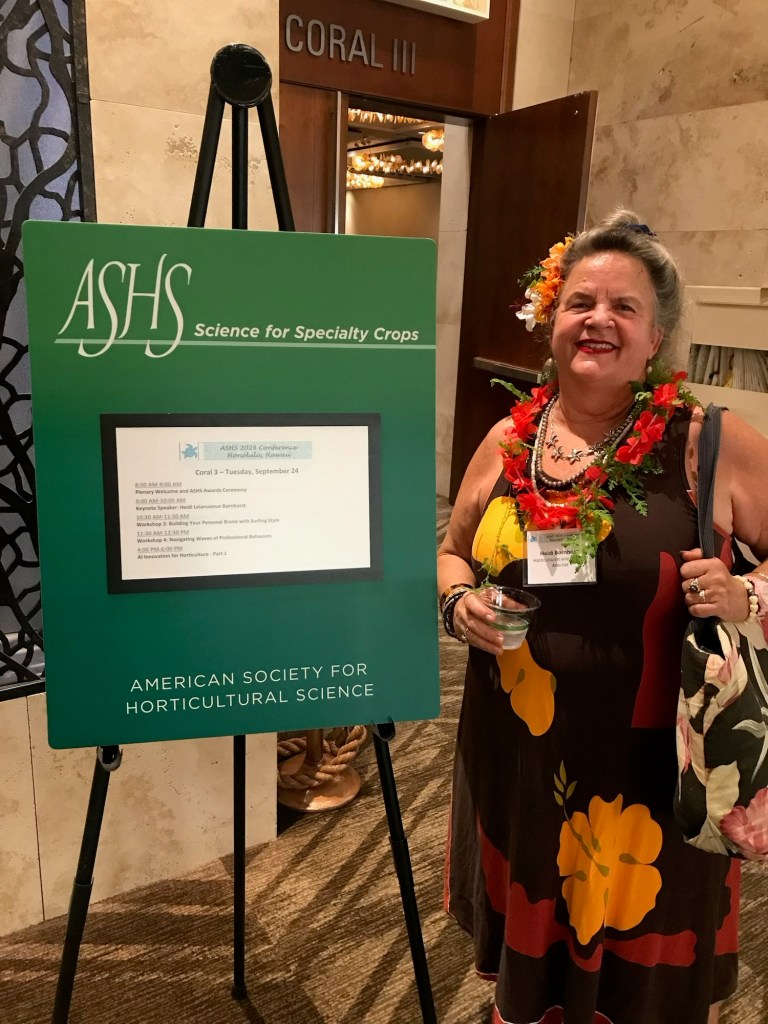
The American Society for Horticulture Science will be here on Oahu for a week long conference beginning Monday September 23, 2024, closing on Friday September 27.
Over one thousand attendees are signed up and registration is still open. (1067) at last count.
This is great for Hawaii gardeners, Horticulturists, Botanists, and plant scientists.
The conference will be held at the Hilton HawaiianVillage hotel, right on the beach in beautiful Waikiki.
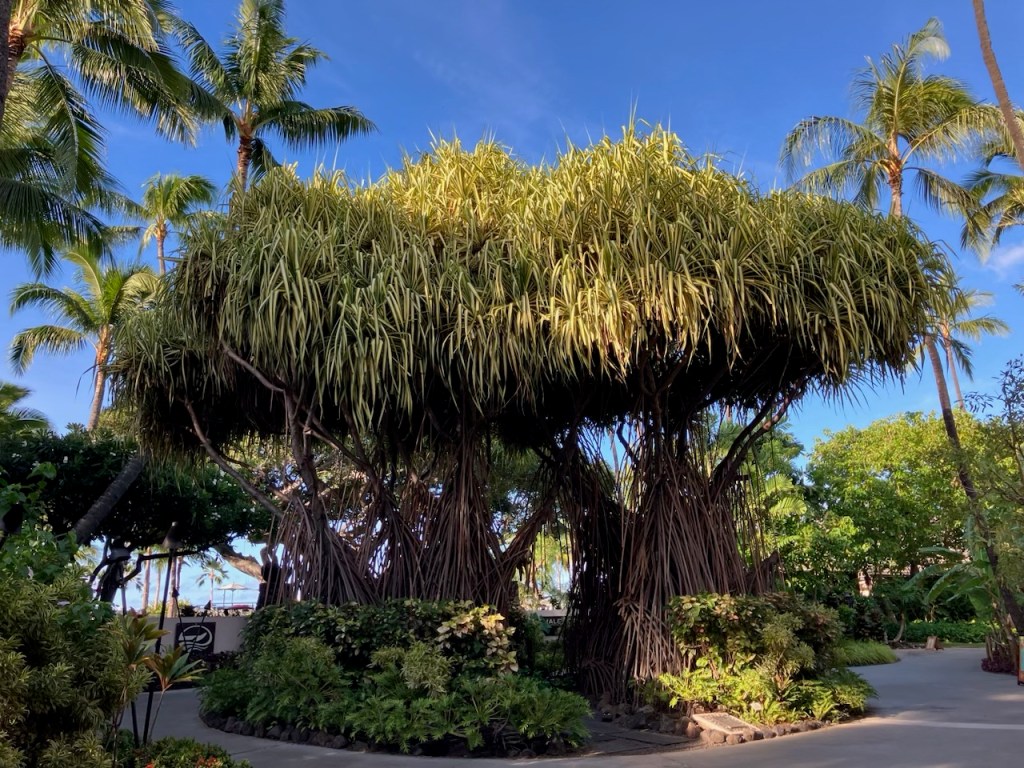
Renowned for its extensive gardens, featuring many native Hawaiian plants, along with canoe plants and tropical exotics, it is a great venue for these plant loving scientists to enjoy.
The Hilton is also right next to the Hale Koa Hotel (where I served for over 10 years as Landscape Director).
The extensive landscaped grounds of the Hale Koa were designed as a botanical garden and the plantings there are very impressive and worth a stroll.
There are many wonderful gardens in Waikiki, amidst all of the hotels and high-rises.
I was very honored to be invited to be the keynote speaker for this conference and I plan to be talking about my favorite: Growing native Hawaiian plants.
There are over one thousand native Hawaiian plant species, and we now are growing about 100 of these Hawaiian plant species. We can grow more!
We have 1367 native Hawaiian plant species. Over 90% of them are endemic, meaning they only grow naturally here in Hawaii. About 9% of them are extinct, and many are rare and endangered.
Some are common and easy to grow, and we see them all around. Examples are: Hala, beach naupaka, `ilima, Hapu`u or Hawaiian tree ferns, and Kou and Milo trees.
Other native plants are less common in our gardens and landscape, but horticulturists are working to change that.
My friend, Dr. Mike Opgenorth, who is the Director of Kahanu Botanic Garden in Hana, Maui will be speaking on Thursday about his PhD work on our endangered native Hawaiian Gardenias
Many more students and graduate student at the U.H. are studying how to grow and perpetuate native Hawaiian plants.
The landscape or “Green industry” here in Hawaii is doing the groundwork with native plants.
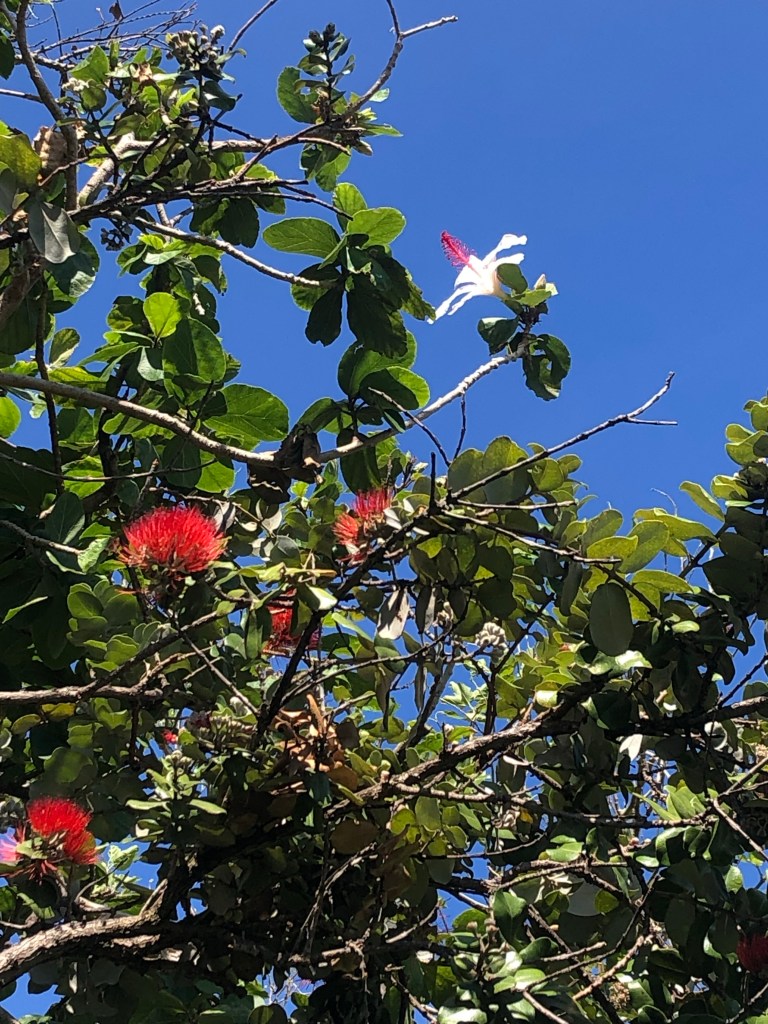
Home gardens now feature native Hawaiian plants especially those loved by lei makers such as `Ohi`a lehua, `ilima, Palapalai and Pala`a ferns, and our native fragrant Hawaiian white Hibiscus, Koki`o ke`o ke`o.
Our public parks and urban forests are growing more native plants too.
Ren MacDonald-Balasia of RENKO did a Floral demo with the GCH on Wed March 13, 2024.
She likes to use wild, weird and foraged florals, and rare, strange fruit from gardens or Chinatown.
RENKO Floral dragon
This was such an inspiration! We can all gather florals and foliage from our own gardens, from friends and even from wild weeds. Weeds can be beautiful.
We don’t have to import florals. Imported materials have a Carbon footprint big time. They also can be the source of harmful alien pests and diseases.
Many imported florals (e.g. roses without perfume) can last a long time, yet they are substantially dosed with chemical poisons insecticides and fungicides. Since they are not a food crop, they are not heavily regulated.
Some countries which grow imported florals don’t have the chemical safety regulations that we do, and this poisons the growers and us the consumers.
Read the Book Floral Confidential, if you really want to be informed (and Scared!) by this overuse of toxic chemicals.
And as we say: Buy Local! Or even better, Forage Locally. Glean from Local gardens.
The Floral event was at the Halekulani, and I invited my siter Mimi Bornhorst Gaddis.
As we were getting ready to go, my honey Clark Leavitt said, ‘set me up with a lei needle?’
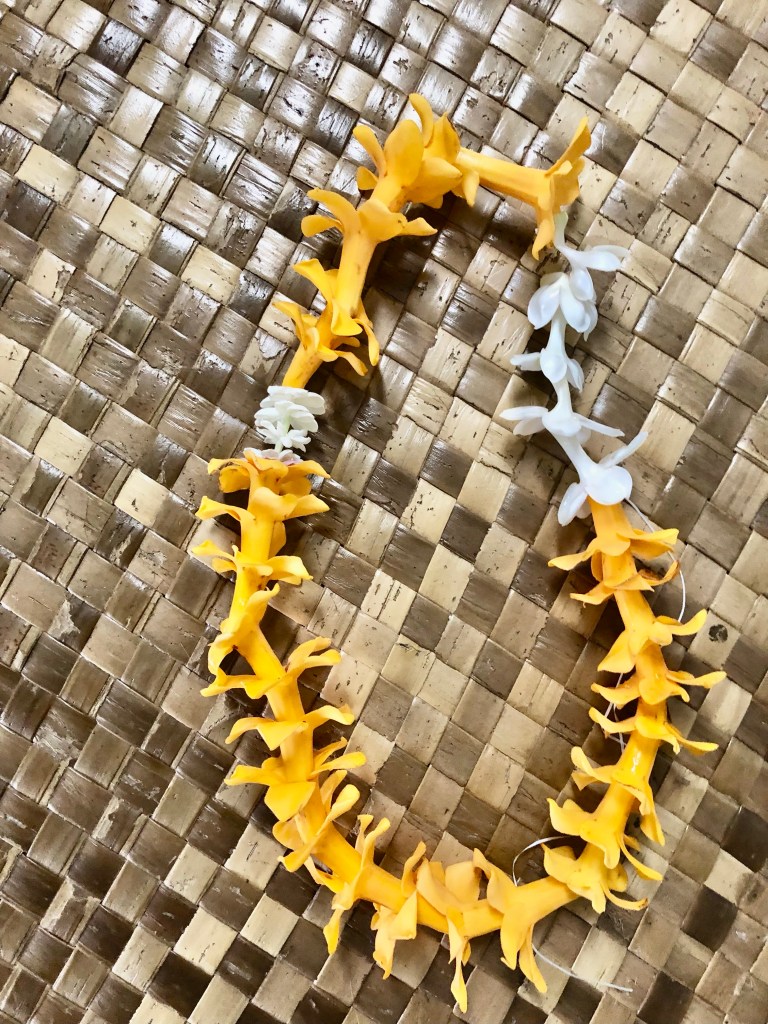
He had gone on the roof and foraged for pua keni keni. So romantic. Our anniversary was the day before and he took his nephew Mark to lunch at Kailua Nico’s.
Mimi and I used the valet service at the Halekulani and walked through the flower filled lobby.
Two women were sitting in an alcove stringing Blue jade lei. “Wow kewl Blue jade!’ I remarked as we walked by (it turned out that these women were our speaker and her helper!)
We went to check in at the Garden Club desk, and as there was no usual flowers on second floor lobby, we walked around.
There was a woman sitting on a bench. Mimi and I introduced out selves and I gave her a tiare li`I li`i.
Her name was Pam and turns out she’s Ren’s mother, just home to care for her 97-year-oldmother who was a journalist for the star Bulletin.
The first AJA writer in Hawaii!
Soon the floral fun begins.
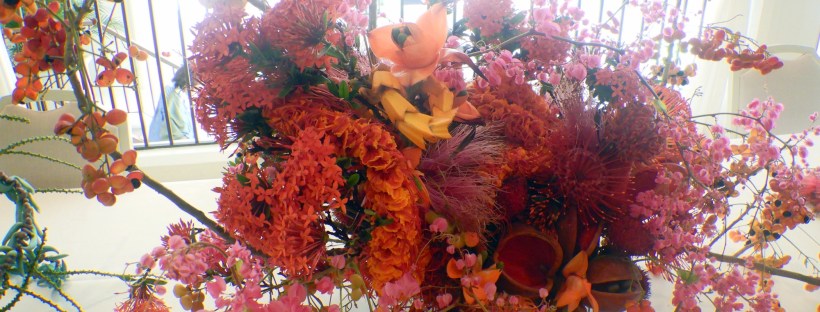
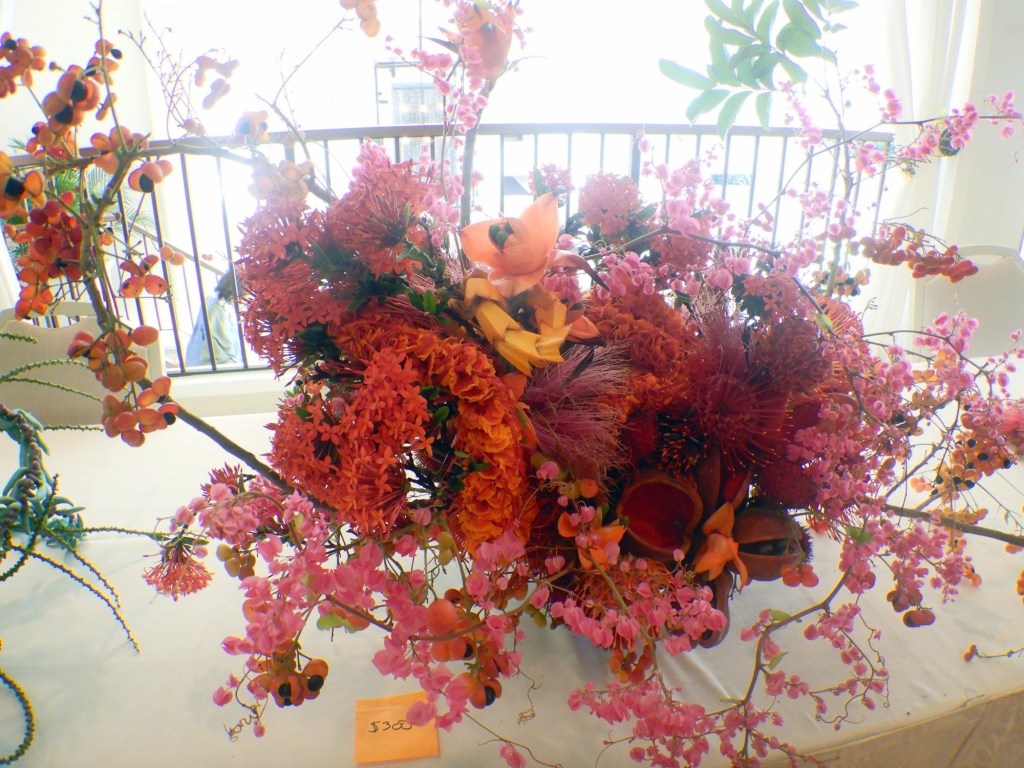
The first arrangement is in a wide tall bowl. She puts in what she called sea tamarind. We were in back and it was hard to see but I’m thinking that doesn’t look like tamarind. I kept trying to figure out what the orange bouncy floral might be. (Turnsout Harpulia, a common street tree in the Lychee family, Sapindaceae.
sterculia Mexican creeper lei Ohai Ali`i Harpulia AKA sea tamarind
She anchors the branches into folded up chicken wire set in the bowl. (Oasis is environmentally out. Mimi and I both have some stashed, just in case)
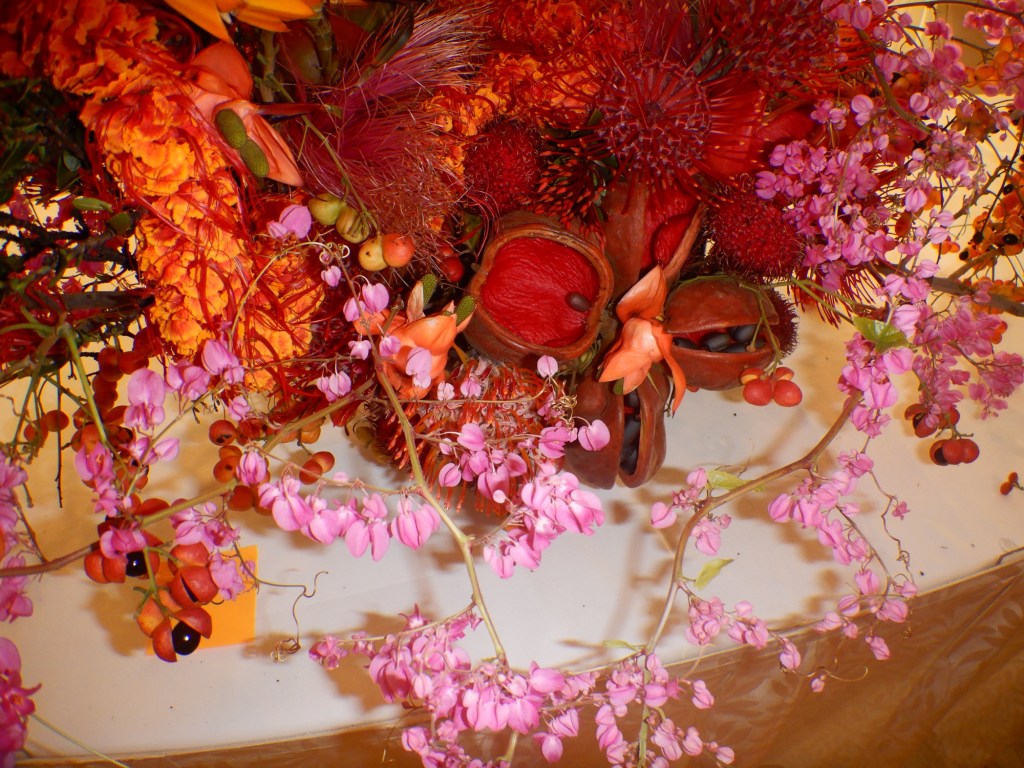
She then added Sterculia, Skunk tree pods, these are heavy and help to weight the other materials down.
Ixora is added. We got these at a gas station, Ren remarks.
Mexican creeper, which used to grow in our Makiki garden is draped all around. She calls it coral vine.
Bombax or shaving brush tree flowers like big puffs of pink added to the flora mix, next the lei she bought at Cindy’s Lei in Chinatown are added, ohai alii and a golden hala. She cuts and drapes and winds them into the arrangement.
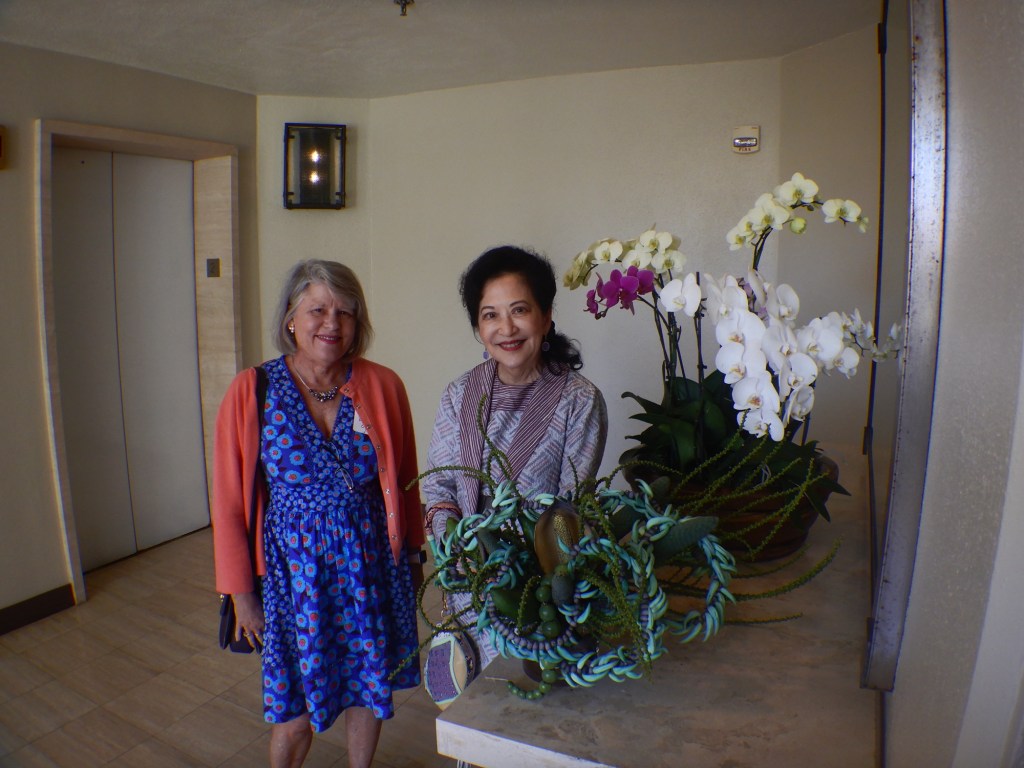
Blue jade lei were added and draped over the arrangement. Such a lovely seasonal Spring beauty from Hawaii gardens!
blue jade and tita Mimi
She scouted for wonderful and strange fruit in Chinatown markets:
Fruiting Clusters of Longan, rambutan and Salak palm. Mimi said that they call it SALAT in SE Asia and it’s really ono. Pretty and scaly in an arrangement.
She had some nice blooming orchid plants that she bought from Kawamoto orchids in Palolo Valley. We kind of gasped when she cut the floral stems and put them in the arrangement. (they would last for a month or more on the plant). But this is what florists do for that wonderful Ephemeral special occasion.
CONSERVATION: instead of imported, chemically laden treated florals these were gathered in gardens in wild places and in local lei shops.
Such a good message we can get so much from our own Hawaii GARDENS!
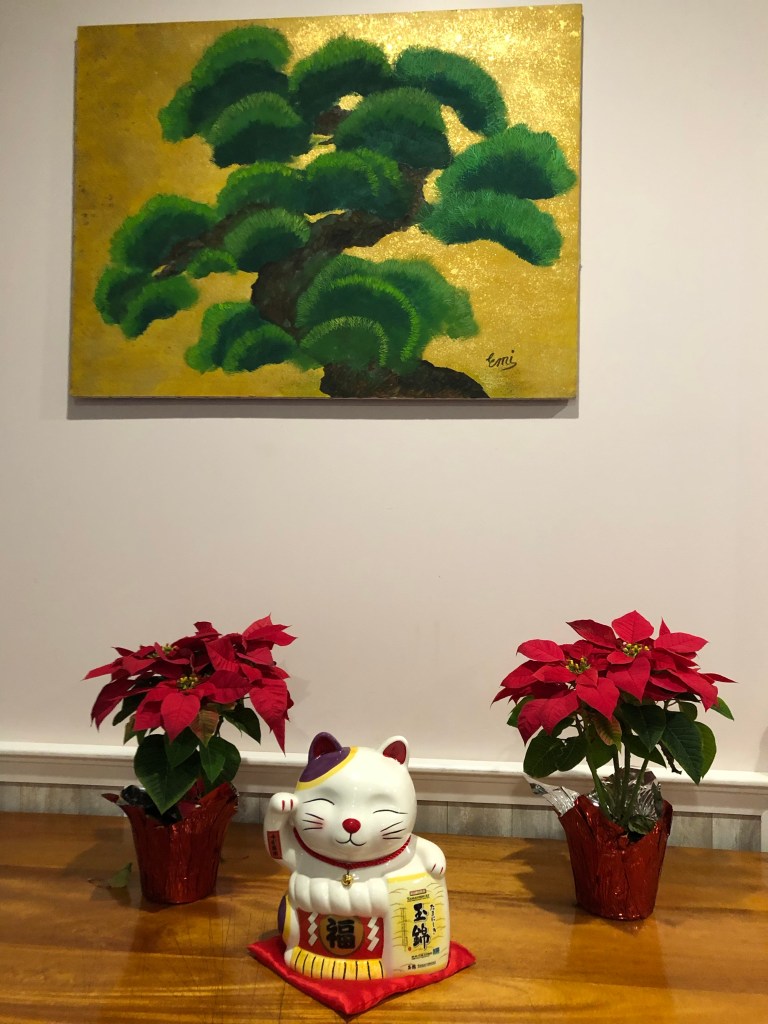
DÉCOR! Brightens up a gloomy rainy day. Lights, trees, poinsettias it’s as simple or as complex as you want to make it.
Decorating with, and gifting plants and flowers is fun for gardeners and the plant lovers on our lists. I started looking around my garden for what I can give to whom and totally “Shop Local”. I Love to check out local garden shops for living plant gifts.
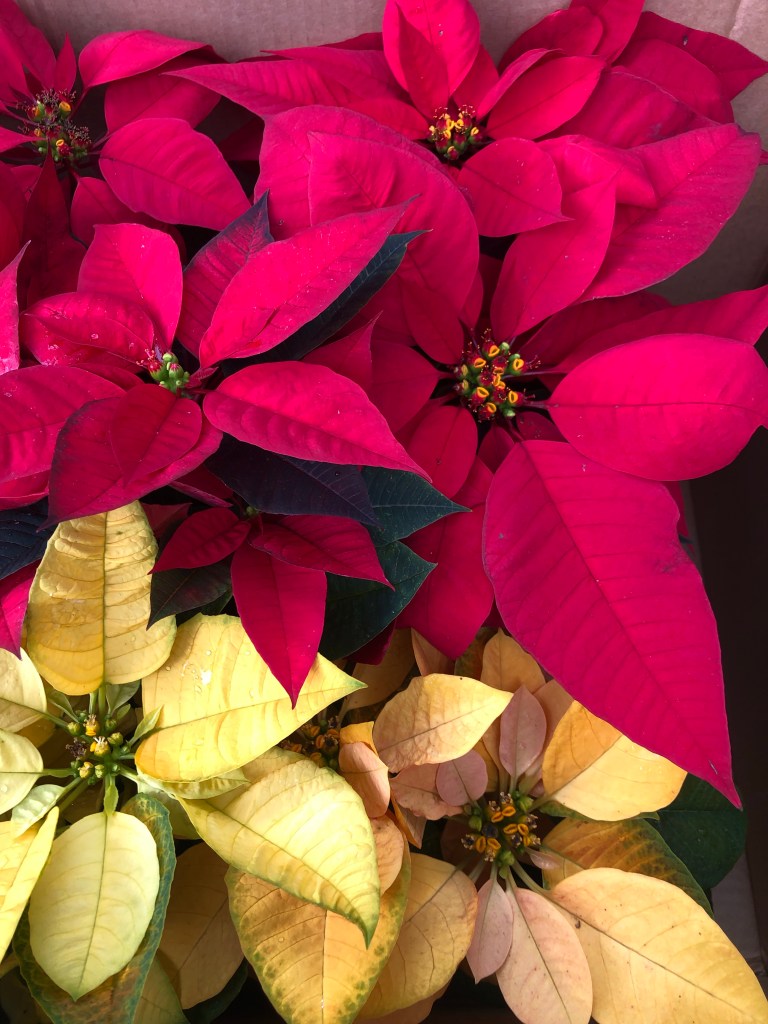
POINSETTIAS can last a long time in a pot if you water them correctly. Once a week carry the pot to the sink (take off the foil) run water and soak the planting media, let it drain and then put it back in its decorative spot.
If you have the old fashioned hedge type Poinsettia growing outside KEEP it! Grow it, and share it, so can perpetuate this kama’aina classic. These are different from the ones the nurseries grow today.
WHITE POINSETTIEA or Euphorbia leucocephala is another outdoor hedge plant that is gorgeous and fragrant! It has many fun common names like Snow on the mountain, Puno puno, Flor de Nino, White-laced Euphorbia, Snowflake Euphorbia, Pascuita, Snows of Kilimanjaro, and Little Christmas Flower. Sometimes you can find this in pots as well, but it really is most glorious grown in the ground.
LIPSTICK PLANT OR ACHIOTE this old fashioned kama’aina favorite comes in at least three colors: red, super bright red (my fave) and yellow. The fuzzy pods are attractive when fairly young and they keep well as a cut flower arrangement. The more mature ones are good in a dry arrangement, and most fun of all are the red coated seeds. You can make achiote oil for making true Spanish rice and other gourmet treats. Rather than red food coloring or other dyes, grow and use the real thing. Easy to grow from seeds, cuttings or buy a plant at your favorite nursery. You can see all of the colors at Ho’omaluhia Botanic Garden; they grown on the trail heading down to the lake, Waimaluhia, from the visitors’ center.
KALAMANSI AND TANGERINES both fruit at this time of year and the trees are so pretty and festive. I especially love kalamansi for smaller gardens and for versatility in cooking, from drinks, to fish marinades to that special acidic citric touch in salad dressings.
NORFOLK or Cook pines can be grown in pots or in your yard. They don’t smell like the mainland ones but they don’t risk importing any new noxious alien pests either and you can get them for free. They also stay green for months and you can treat them like a houseplant for months (if you like!) and as my Mom says, “No needles on the floor!”
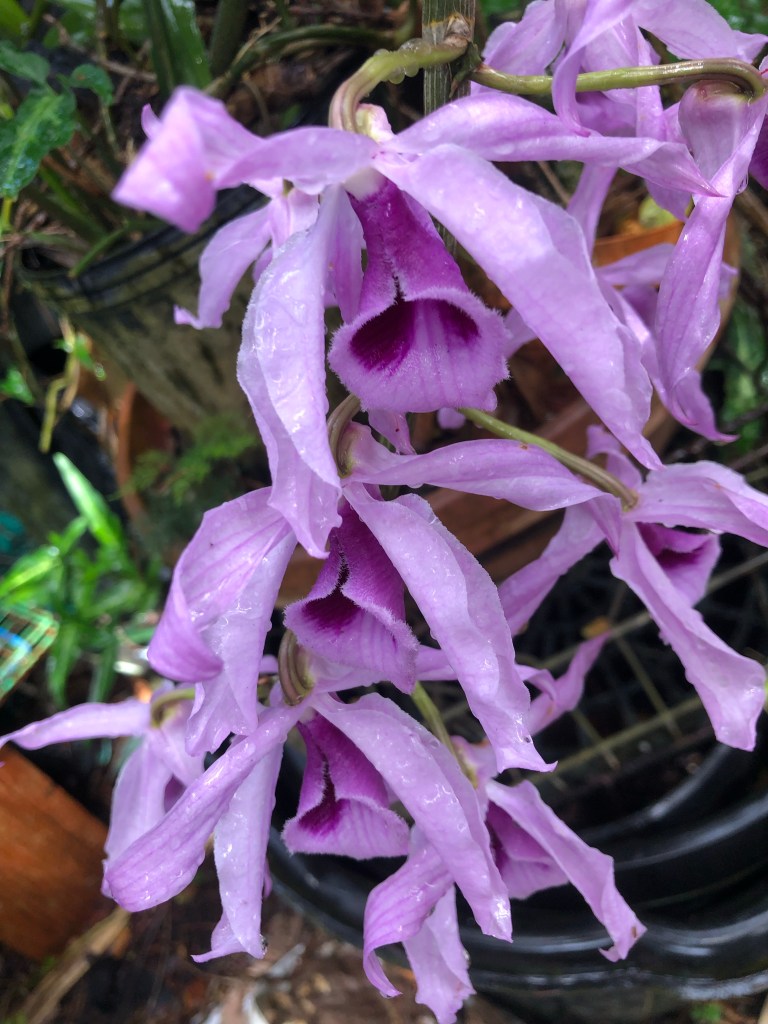
Orchids are so decorative and make the best gifts. Water them like you do Poinsettias.
We had such a weird windstorm with those super strong and gusty west winds! So different then normal.
Up in our valley we lost power twice to the wind and HECO did not restore power until 9:30 p.m. on Wednesday 3/8/2023.
Mangoes and avocados were full of blossoms, Honohono orchids were in bud and some in bloom.
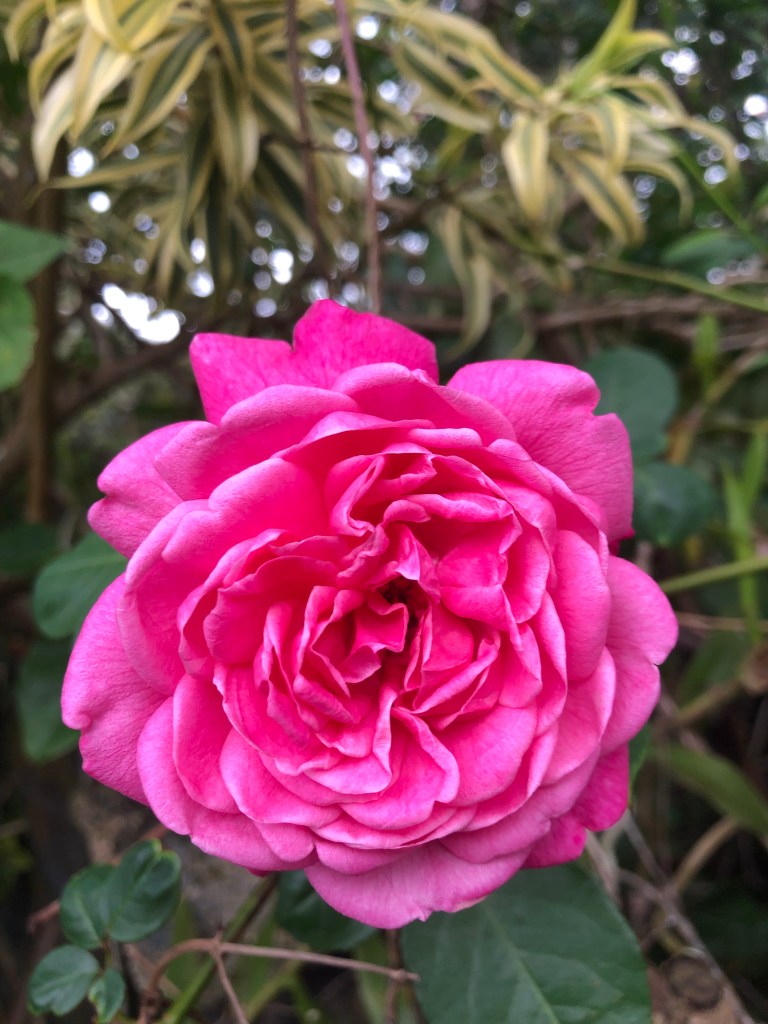
My Portuguese Madeira roses, and native Hawaiian gardenia Na`u have been blooming well, loving the cool and rainy winter were are finally having.
As I clean up the storm debris, (Mahalo for nature’s Arboriculture) including blown down dead twigs and branches, and lots of leaves, some I notice are from my mauka neighbors.
One of the tenets of true Horticulture is to OBSERVE nature and plants, to track the moon, winds, rain and other weather phenomena as see how the plants respond.
I am still reflecting on how the plants would respond.
What do you see? How are your plants after the winds?
Did you have any big tree failures? Or just small or dead branches?
The leaves are whipped on my gingers, Surinam cherries, mulberries, and ohia shed a few flowering branches. A young popolo plant got totally blasted on one side, it was just coming into fruit.
So, we shall see!
Honohono orchids had been in full glorious fragrant bloom as they budded and bloomed early this year. Originally I thought the orchids stood the wind storm but after a few days those in the main wind tunnel area of my garden wilted and withered prematurely.
Went to a neighborhood watch potluck pa`ina and a nice lady, Lokelani, that I always say hi to on my walks was there, with a gorgeous papale lauhala. She admired my honohono and said she caught a whiff of fragrance, from way across the yard, and she looked for the source of this favorite old time Hawaii fragrance, and from where? My hair!
Since she admired the orchids, I had to give them to her, along with maire ferns!
Now a couple weeks after the winds, I’m observing some of my favorite flowers and fruit trees in my garden and neighborhood:
• ‘Ohi’a lehua Blooming profusely, some dead wood branches and twigs broke in the winds
• Native White Hibiscus wind whipped leaves, a few blooms at the very top of the tree
• Tahitian mountain apples were blooming before, still many flowers and now small fruit.
• Gardenias surprise early blooms two on one stem, but no other apparent buds yet. (they usually bloom for me in May).
• Na`u, native Hawaiian Gardenia lots of flowers and buds (also triggered by abundant soft rains before the winds)
• Madeira roses Blooming profusely.
• Mangoes my Friend Dawn Shim from Makakilo brought me a gift of Haden mangoes, super early for this to fruit.
• Mulberries wind whipped leaves, lots of young fruit
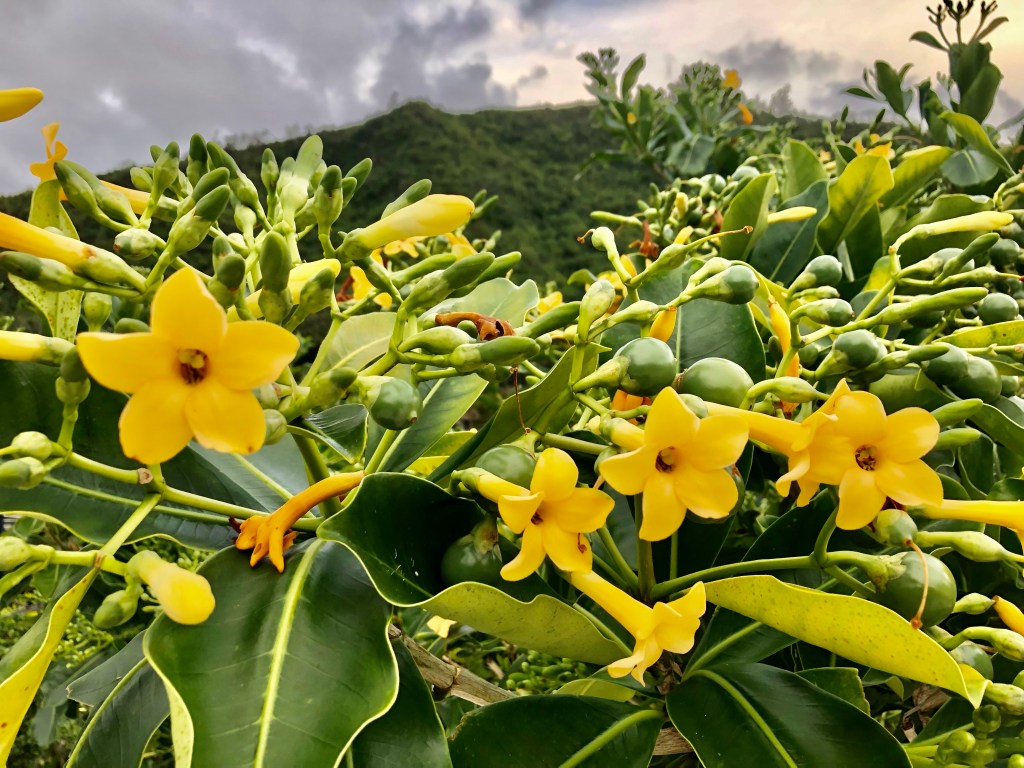
• Pua Keni keni usually Bloom less in winter, BUT after the storm mine are full of Buds, flowers and lots of developing green “ball” fruit. I made some lei for a fundraiser, and plucked and cut off all the young fruit, to encourage more blooms from the tree
What are YOU observing, in your garden in your unique microclimate? I would love to hear back from my Gardening Readers …..
My friend Lexi Hada contacted me about a volunteer opportunity. When Lexi calls you know it’s going to be a FUN and interesting time!
We joined some fellow volunteers, including some famous Lei makers at 9:00 a.m. at Linekona.
Lexi and Kaylee
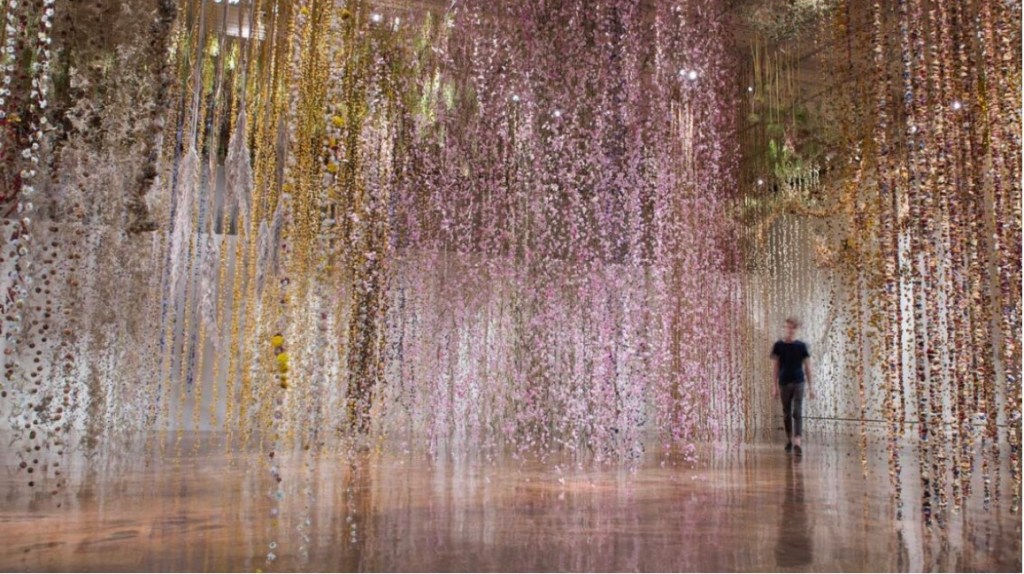
I was so impressed with the Volunteers and staff joining with the Artist Rebecca Loise Law and her bouncy fun entertaining husband Andy.
Just being in Linekona is a gift and it brings back memories of other art projects, Classes in Art, wood shows, teaching and learning moments with art and our Honolulu Community.
Rebecca and Andy had asked for flowers which they would dry (in an upstairs room with newspapers spreadout on the floor)
We had brought big bags of floral gifts, tasty treats, and lei that we made to share from our gardens.
The Laws and HoMA worked with the Honolulu Botanical Gardens for a collection of great florals from Foster and Koko Crater Botanical gardens, including Quipo, which is a huge, stout trunked tree from South America, and is related to the African Baobab. The big, winged seeds of the Quipo which we’ve used as intriguing decorations over the years were strung into giant lei for the Awakening art show.
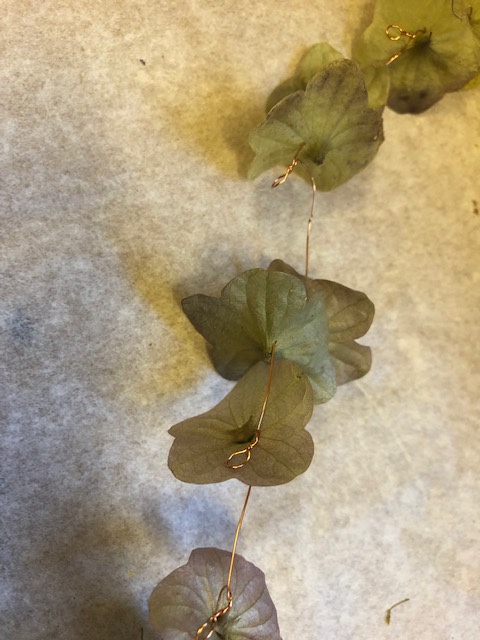
Cup and saucer plant on copper wire for exciting art show Awakening
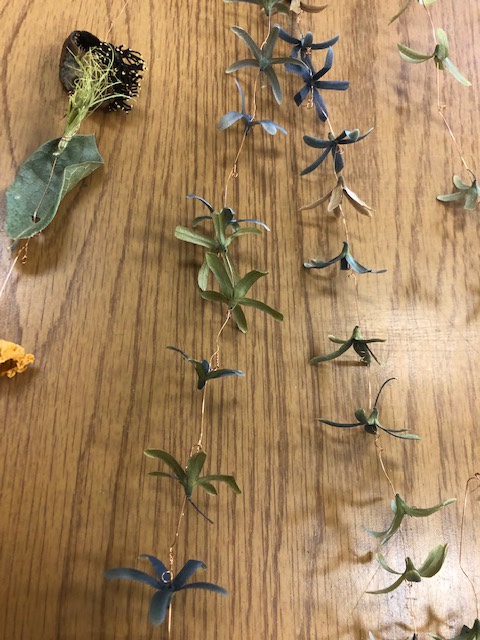
We were given various dried flowers to work with:
Phalaenopsis orchids
RAINBOW SHOWER flowers
Cup and saucer
Cook pine needles
Sandpaper vine
Strands of super fine copper wire is used for stringing. We would carefully poke through the flower, like using a lei needle, or wrap the plant material with the fine wire. We spaced out the flowers by making an artful twist in the wire.
Sandpaper Vine
It sounds tedious but the time passed quickly, it was fun to learn a new style, which I likened to Lei making. Andy Law (husband of the artist) came bouncing into the room, and talked to us about the process, Life and gardens in England, Wales, and Scotland.
Three hours sounded like a long time to volunteer but Andy kept us entertained and the process was fascinating. I was so busy crafting and learning, visiting with the other volunteers and seeing their workmanship, that time flew by.
I congratulate the Honolulu Museum of Art staff for nurturing us volunteers; from free parking, snacks, and working together on such an engaging Floral Art project. There were several staffers to greet and orient us volunteers and Volunteer coordinator Kaylee Clark stayed with us in our lei making session, encouraging us, and sharing about art exhibits and other events at the Museum.
Clark stayed with us in our lei making session, encouraging us, and sharing about art exhibits and other events at the Museum.
Awakening is a year long exhibit in the upstairs L-wing. The Laws have produced these kinds of floral exhibits and art work previously but this is the first time in Hawaii. They brought dried materials and continued the process of gathering and drying flowers from Hawaii.
The main volunteer tasks for this project were cutting and bending of wire along with stinging of flowers. Flower donations came from volunteers. Flowers used each day varied on availability. The process was collecting, drying, and then a 3-day freeze. HoMA tried to keep each day different, as there were a lot of repeat volunteers and they wanted to keep the experience new and interesting. Approximately 250 Volunteers helped from August 16- September 16, 2022.
Andy and Rebecca arrived in Hawaii in early August 2022 and will stay and coordinate the assembly and opening of the art exhibit, which will be up for a year to enjoy.
They have had similar floral exhibits all over the world, including England.
Artful friends Marin Philipson, Debbie Choo, and Patty Mowat joined Lexi and me.
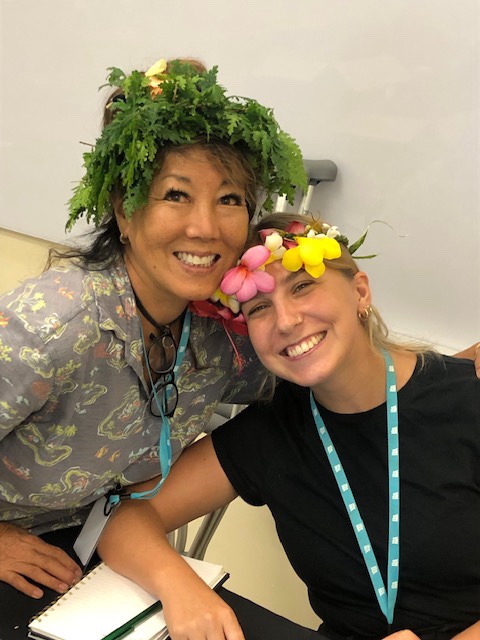
Amazing long time and Awesome lei makers Joyce Spoehr a HBG Retiree and active volunteer, Iris Fukunaga who still works at HBG (Honolulu Botanic gardens) and Dyanne Taylor a Master lei maker, famous for her tiare bud lei, is another City Parks and Recreation retiree(and fellow surfer) who Volunteers at all the fun plant and lei events. My Friend and great gardener Rosemary was there too. It was so fun to have the master craftswomen there, as we all learned this new technique.
I had so much fun making my lei, first with Phaleonopsis or Butterfly Orchids, then one with red cup and saucer and then with the Lavender cup and saucer. I had never noticed before, working with this as a fresh floral, the different shapes of the dried petals.
Loved the garlic vine flowers for a strand too. This is an old fashioned kama`aina plant that we do not see too often these days. I love the striking lavender color when it is fresh, and it dries very nicely. Seems like the petals are tough enough to hold up
As we completed each long strand (sixty inches measured by the length of our worktables), the lei strands were gently laid into big, long floral boxes, with the layers separated by tissue paper.
The process, of drying the flowers first was something like how botanists and taxonomists, like at the Bishop Museum or National Tropical Botanical Gardens, or even Kew Gardens in the U.K. make dried Herbarium specimens of plants to document and study.
Such a process and so many Na lima Kokua (helping hands) putting the art exhibit together.
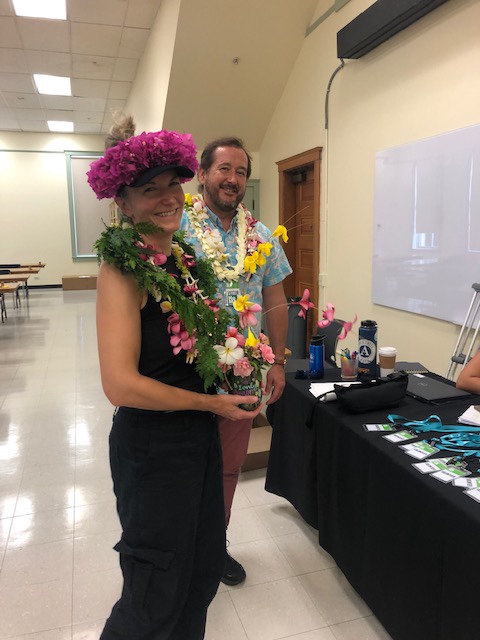
As we were wrapping up, the artist herself joined us and we bedecked her with lei and floral gifts. Slender and dressed in black, Rebecca Louise Law looked amazing and happy with our floral adornments. She spoke a few quiet words thanking us.
Rebecca Louise and Andy Law
I thought about what a wonderful team she and her husband Andy make, him warm and bouncy and super enthusiastic, and she reserved and artistic.
Another amazing thing that happened was that the Director of the museum, Halona Norton-Westbrook, joined us to say mahalo, and spoke briefly with us volunteers.
I was talking with my neighbors on their sunset stroll and found that Julia Weiting was also volunteering. Every time she went, they gave her different florals to work with.
I was so inspired after about what I could make next! I also thought a lot about the process and which other flowers or foliage we might incorporate. A fresh style of lei making! A quick and fun one to teach keiki, a way to decorate homes or papale!
I am so excited to see the completed exhibit, called “Awakening.” Its opens to the public on Saturday September 17, 2022, and continues to be on display until September 2023.
One of our goals for simple sustainability, is a Fruit tree in every yard, even on your apartment lanai. For years Mark and Candy Suiso and their extensive extended ohana, participated in the epic Fruit sharing event known as Mangoes at the Moana.
This was Mark’s simple message for all the ten years we staged this educational and fun, Ono for Mango fruit, local fun foodie event. Remember when every yard had at least one fruit tree, lots of vegetables, all kinds of things for the family to eat and to share?
Share with ohana, gifts for the neighbors, take a generous bag to work, etc.
Kupuna Pua Mendonca of Hawaii island shared some simple wisdom with me at an Aquaponics training conference in Hilo: survival trees to grow are avocado, niu or coconut, and `ulu or breadfruit. Those healthy fats and oils will get you through times of hardship and scarcity.
You’ve heard the scary news that we have one week of food on grocery shelves in Hawaii. Should we get cut off from imports, its handy to have some degree of self-sufficiency.
So, lets grow some survivor supplies in our gardens. I was visiting my great gardener neighbor Joan Takamori and admiring her plush and fruitful garden. She always has something to share and we learn from each other as we talk garden story.
Takamori asked me about a macadamia nut cracker. She had an abundance of macadamias from her mother’s garden.
I laughed, recounting our nutcracker as kids. It was a big pohaku in the dry stack rock wall, that was flat on top and had an almost perfectly sized mac nut puka. We would set in a nut, and hit it “just right” with a small sledge hammer. Sometimes it cracked open perfect, sometimes we smashed too hard and sometime the nut went flying!
This is how I learned (without knowing it) about scarification, a technique to help tough thick shelled seed to germinate and grow. The nuts we nicked that flew down the side sloping yard, were able to grow into seedlings.
Once when we had a cousin swap, I took a big paper bag of macadamia nuts to my Aunty Ruth in California (what a hostess gift, such an elegant bountiful paper bag!)
I told them how we cracked mac nuts at home. But no! Californians have a better plan! And my Uncle Merle was an Engineer. He had a vise in the garage. It was a big thrill for my cousins’ many friends in their neighborhood, to come over and everyone got a turn cracking a nut. (Sort of like Tom Sawyer getting all his pals to paint the fence, I later thought, with a laugh!) Akamai uncle Merle!
My Aunty then roasted the nuts in the oven and covered them with chocolate. Back home we generally just ate them raw.
I told Joan all of this and how my friend Nyna Weisser had researched nut crackers online and found a great one. Not cheap but perfect cracking. Nyna would hand us nuts and the cracker at a party. Fun for all the friends!
Joan Takamori and I also spoke about how macadamia nuts are another tree that more of us should propagate and grow.
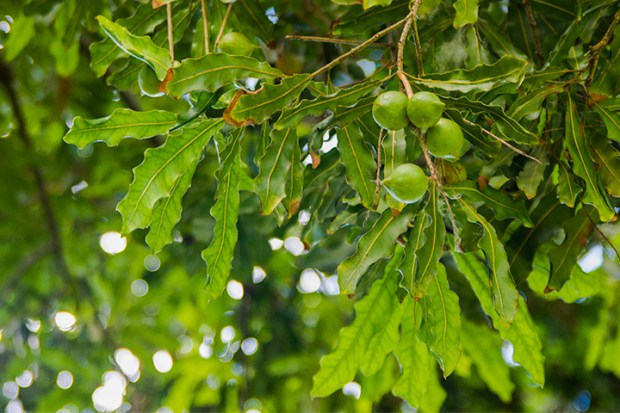
They are a pretty tree with deep green ruffly leaves and very pretty and fragrant flower stalks. If you look closely at the flowers you will see that they look like miniatures of one of our favorite modern-day Florist ornamentals: Proteas.
Mac nuts are in the Proteaceae plant family and they are native to Australia.
I asked Joan about where her folks got their macadamia tree. She didn’t remember it being in the yard forever, and She has a theory.
‘My dad did bonsai my mom didn’t drive; she knew how to catch bus everywhere. I think she stole that tree from him and set it free in the yard’ says Takamori.
We never had it growing up. I think mom planted it, maybe about 10-15 years ago. She wanted to see it flower and fruit, although it would’ve made a kewl bonsai. Its now a very fruitful tree. I want to grow more of them, so I’ve been collecting seedlings, from under her tree to grow and share and plant in my current garden.
Mac nuts need to be scarified to germinate. The thick hard shell is nicked or filed down a bit so water can penetrate and activate the embryo of the seed to grow. Plant them in pots with quality potting mix, and water daily, until they get big enough to go into the ground.
You can also buy them already growing. Ask for them at your favorite garden shop. Or for even more fun, call ahead and visit a fruit tree specialty nursery. Buy some mac nut trees to grow and maybe another fruit tree for a friend or neighbor to grow.



 Heidi Bornhorst