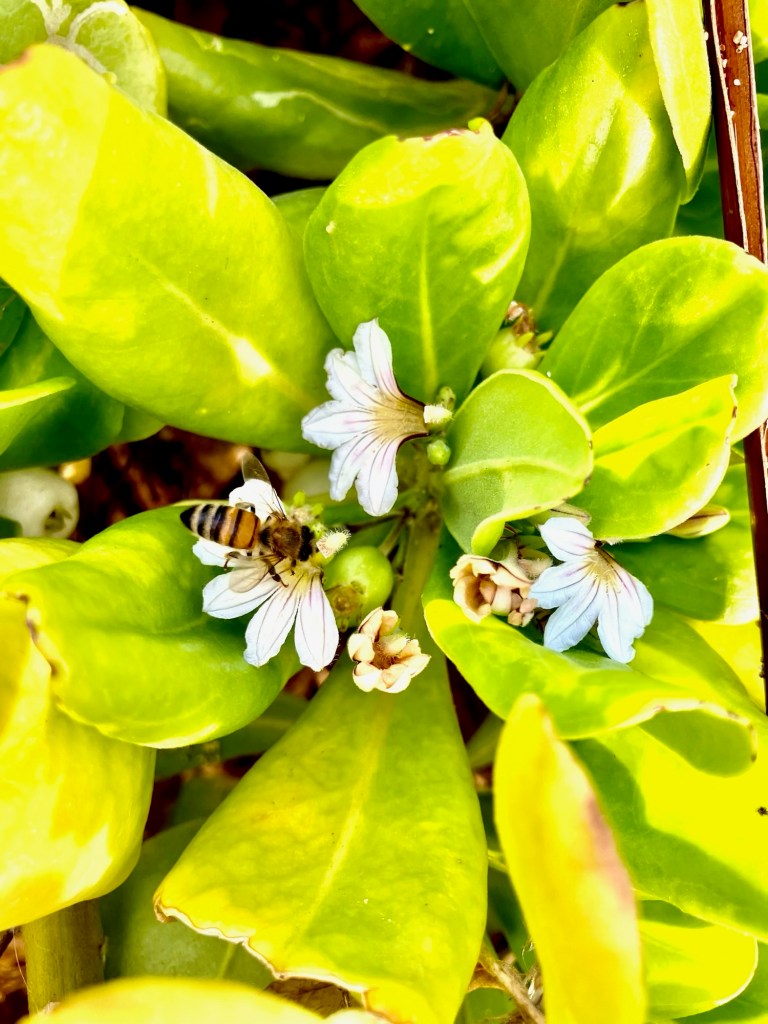
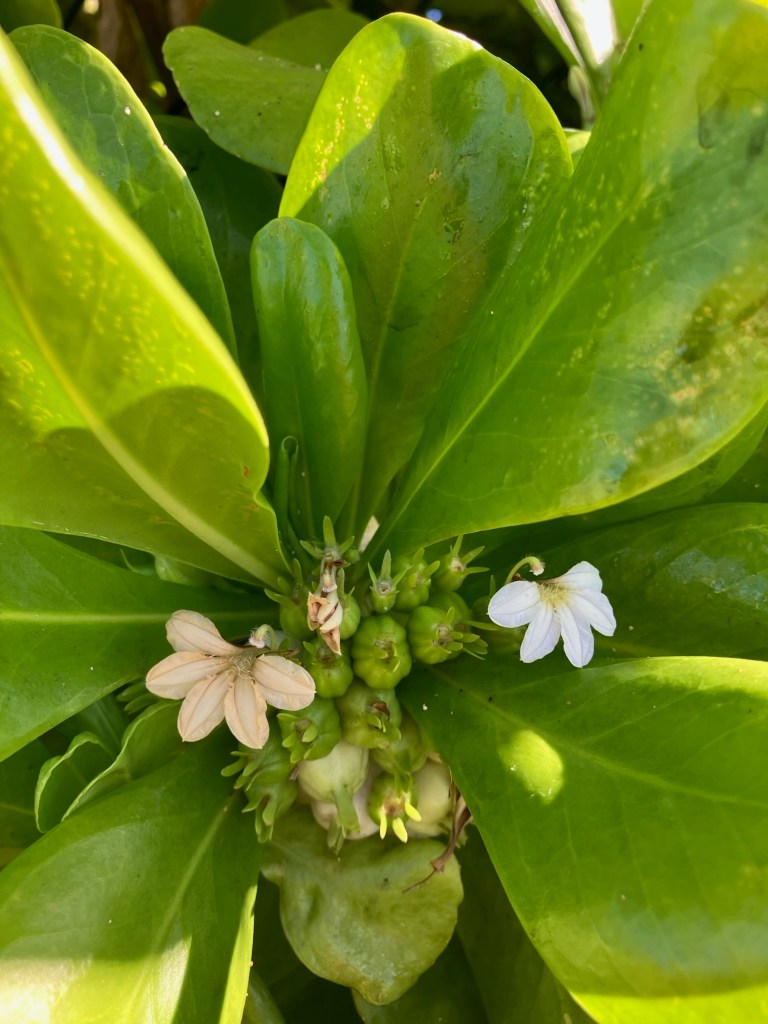
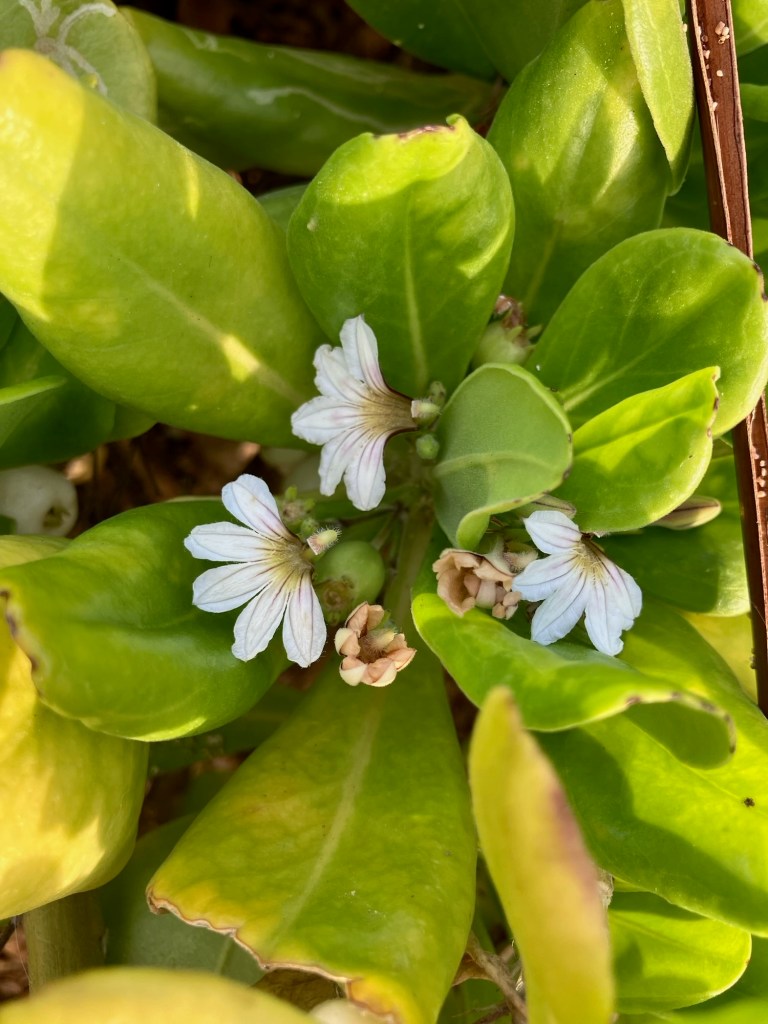
Naupaka is such a simple and elegant native Hawaiian plant to grow in beach gardens, xeriscapes, and to nurture in the wild.
It makes a great hedge, or specimen plant. It protects our coast and holds onto the sand. You can also grow it in large pots.
Naupaka is a less thirsty plant, perfect for your xeriscape garden. It is also salt and wind tolerant.
Grow it from seeds or cuttings or buy some potted ones and support your favorite local nursery.
Strategic landscape designed naupaka hedges can protect beach homes from the strong ehukai, salty winds.
It is beautiful with its soft green leaves and half flowers which are white with a hint of purple. White fruit follow the flowers.
Beach Naupaka, Naupaka kahakai is known as Scaevola taccada to scientists.
It is an indigenous Hawaiian plant, which means it got here on its own, but it grows in other tropical areas too.
We also have native endemic species of Scaevola, Naupaka kuahiwi that inhabit our uplands. They too have a half flower, which features in Hawaiian love legends.
It is the easiest plant to care for if we keep it simple:
• Minimal water once established.
• No fertilizer.
• Keep turf grass away from the root zone.
• Minimal trimming, and only by hand.
As with many of our native Hawaiian plants, modern ‘mow blow and go’ landscape techniques do not agree with naupaka.
The worst is gas powered hedge trimmers, this will mutilate naupaka. Do minimal trimming and shaping with hand clippers or loppers.
Do not TOP naupaka. Prune carefully, and minimally and only when you are in a good mood.
Topping is where you mindlessly cut trees or plants.
The new growth is soft, and the older branches are very woody and tough.
Power equipment trimming shakes up the roots and then makes the branches grow too dense, making habitat for insect and disease pests.
Turf grass should be physically separated from the Naupaka planting area. Use a nice stone, coral, or brick edging to keep grass and naupaka separated.
Hand weed out any invading grass. Grass will compete and rob water, nutrients, light and space from the naupaka.
An edge also makes it easier to mow the lawn.
Thoughtful Landscape design and old fashioned garden maintenance will help you keep your naupaka thriving and Beautiful, as nature designed.
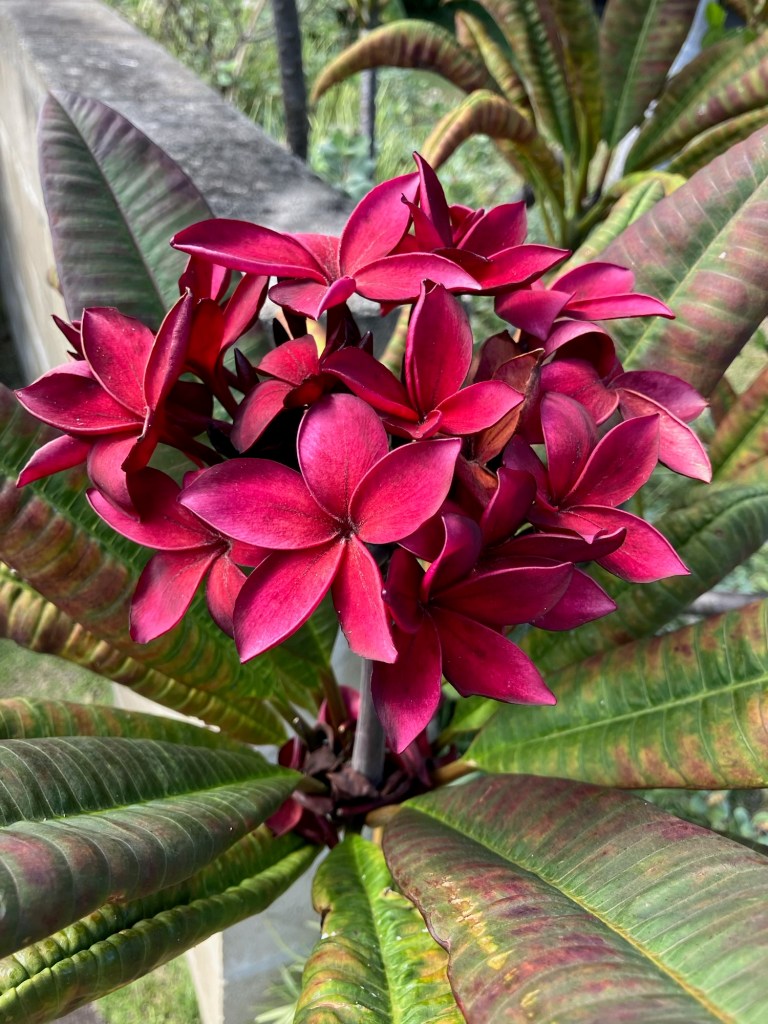
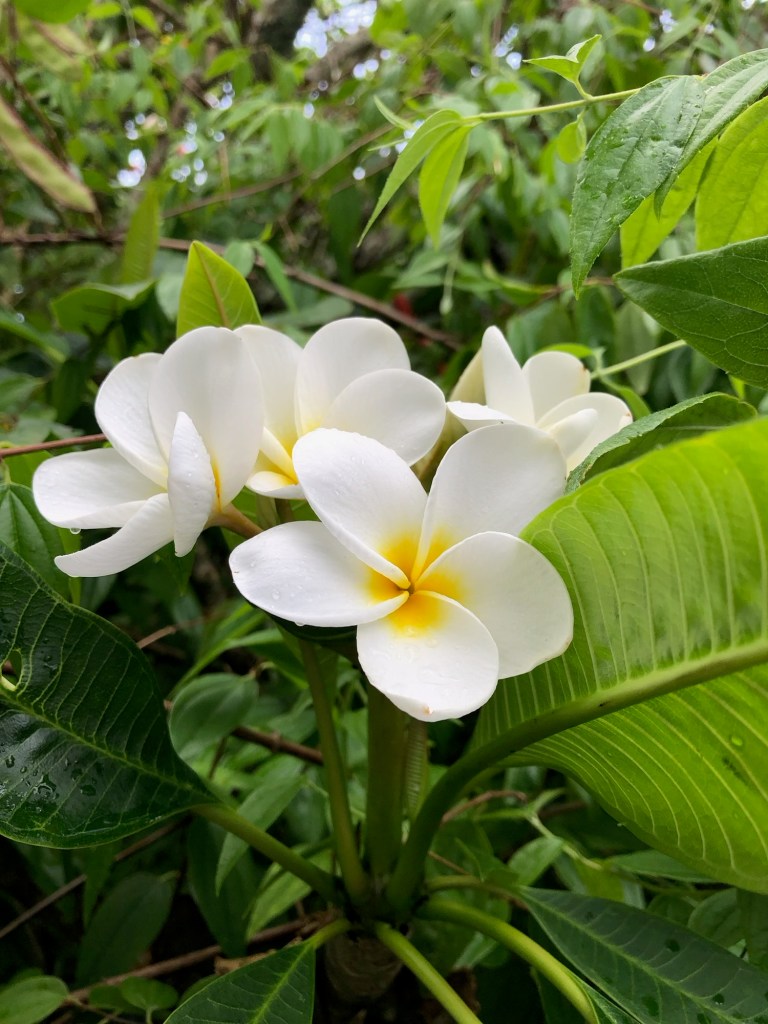
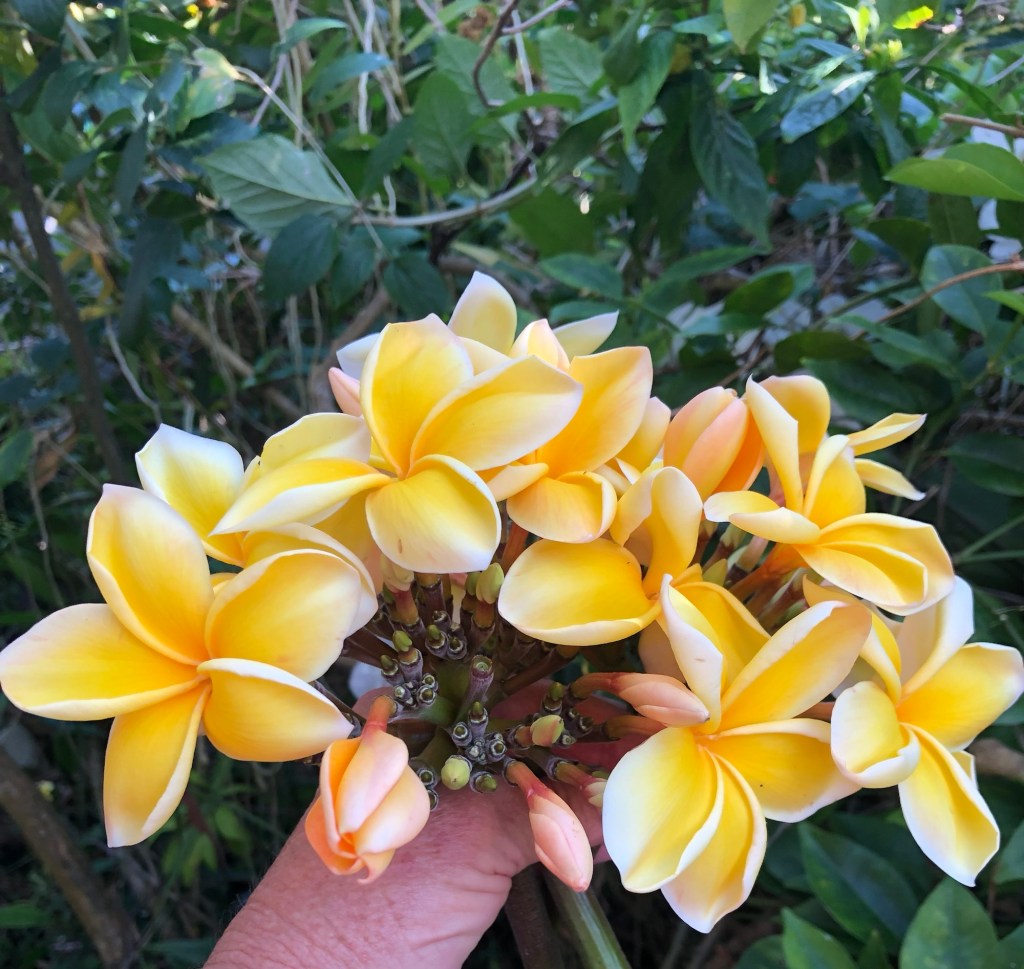
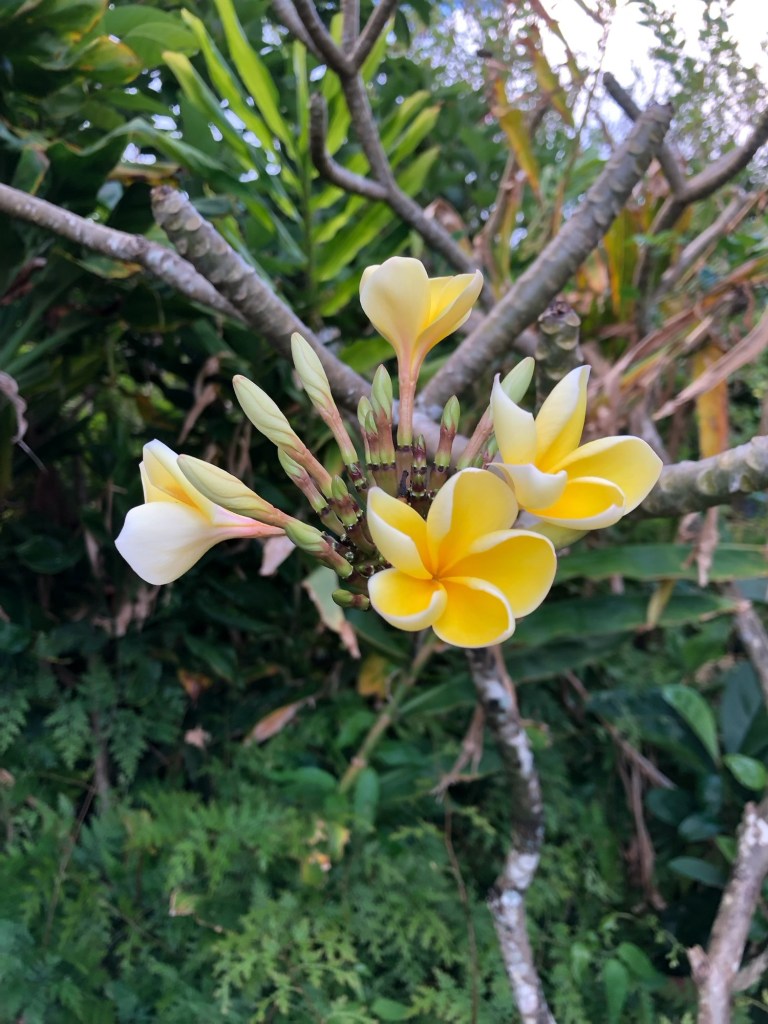
My tita, Mimi, was incensed when two women drove up and just helped themselves to her Plumeria flowers. This was not casual ‘one for my hair, one for my sister’s hair,’ but full on taking of a lot of blossoms, she said they even had fancy flower picking baskets!
When she confronted them, they said they thought it was ok because the tree was adjacent to the street. After a bit of discussion, they told her that if she didn’t want anyone to pick the flowers, she should put up a sign.
A few days later a neighbor she casually knew came up the street, reminded her that our mother and her grandmother had been friends and nicely asked if she could pick some flowers so she could make a lei. Mimi invited her into the yard and happily shared the pua.
She explained the ones on the inside are nicer and less sun and wind burnt. As they chatted Mimi went and picked a bag of her famous Tahitian limes to give to the neighbor.
What a difference! We love to share if asked nicely.
I remember back when we lived up Wahiawa, I heard some noises and came outside. There was a man, instructing his kid to not only pick my front flowers, but also to CUT some pink gingers.
Without thinking too much (gotta be careful these flower thieves know where you live!) Tita mode came out and I chastised the man, saying my flowers were not just randomly growing and teaching his kid to steal flowers is not pono!
On another occasion I heard some women admiring my Madeira, Portuguese roses, they were so nice that I carefully clipped them a bouquet, and shared propagation advice. We all became friends because they asked nicely when admiring my flowers.
Gardeners and Horticulturists love to share and talk story with fellow plant lovers.
One thing I always knew, which was reinforced when I worked at Foster Botanic Gardens and Honolulu Botanical gardens, is to share plants and to keep records of garden specimens.
With good records if you lose a plant, your plant friends or cooperating botanic garden will have backup. It can be as simple as a note on a calendar, or full on in your garden diary.
My friend Lexi Hada contacted me about a volunteer opportunity. When Lexi calls you know it’s going to be a FUN and interesting time!
We joined some fellow volunteers, including some famous Lei makers at 9:00 a.m. at Linekona.
Lexi and Kaylee
I was so impressed with the Volunteers and staff joining with the Artist Rebecca Loise Law and her bouncy fun entertaining husband Andy.
Just being in Linekona is a gift and it brings back memories of other art projects, Classes in Art, wood shows, teaching and learning moments with art and our Honolulu Community.
Rebecca and Andy had asked for flowers which they would dry (in an upstairs room with newspapers spreadout on the floor)
We had brought big bags of floral gifts, tasty treats, and lei that we made to share from our gardens.
The Laws and HoMA worked with the Honolulu Botanical Gardens for a collection of great florals from Foster and Koko Crater Botanical gardens, including Quipo, which is a huge, stout trunked tree from South America, and is related to the African Baobab. The big, winged seeds of the Quipo which we’ve used as intriguing decorations over the years were strung into giant lei for the Awakening art show.
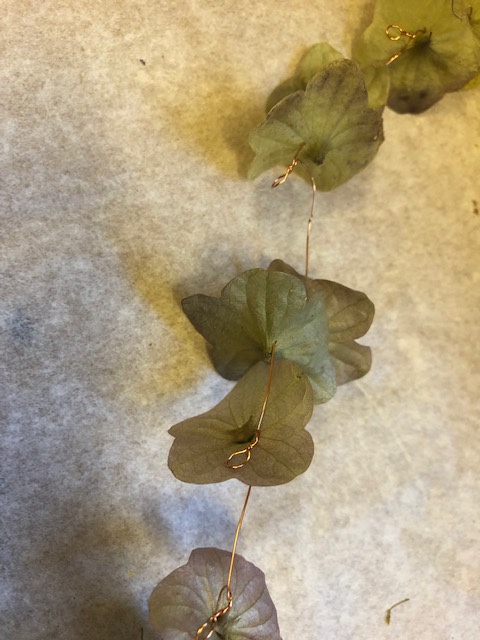
Cup and saucer plant on copper wire for exciting art show Awakening
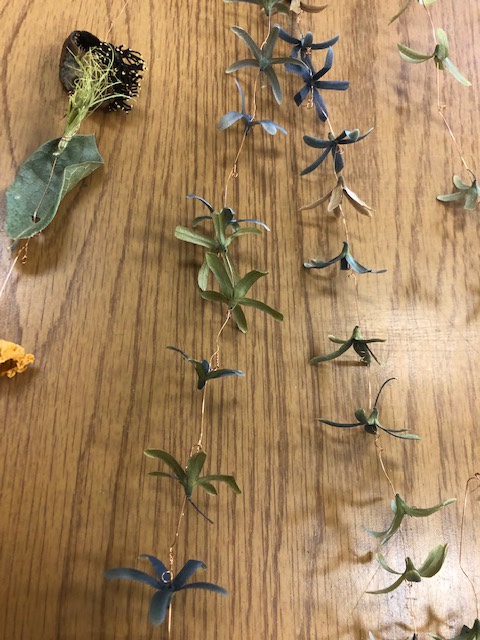
We were given various dried flowers to work with:
Phalaenopsis orchids
RAINBOW SHOWER flowers
Cup and saucer
Cook pine needles
Sandpaper vine
Strands of super fine copper wire is used for stringing. We would carefully poke through the flower, like using a lei needle, or wrap the plant material with the fine wire. We spaced out the flowers by making an artful twist in the wire.
Sandpaper Vine
It sounds tedious but the time passed quickly, it was fun to learn a new style, which I likened to Lei making. Andy Law (husband of the artist) came bouncing into the room, and talked to us about the process, Life and gardens in England, Wales, and Scotland.
Three hours sounded like a long time to volunteer but Andy kept us entertained and the process was fascinating. I was so busy crafting and learning, visiting with the other volunteers and seeing their workmanship, that time flew by.
I congratulate the Honolulu Museum of Art staff for nurturing us volunteers; from free parking, snacks, and working together on such an engaging Floral Art project. There were several staffers to greet and orient us volunteers and Volunteer coordinator Kaylee Clark stayed with us in our lei making session, encouraging us, and sharing about art exhibits and other events at the Museum.
Clark stayed with us in our lei making session, encouraging us, and sharing about art exhibits and other events at the Museum.
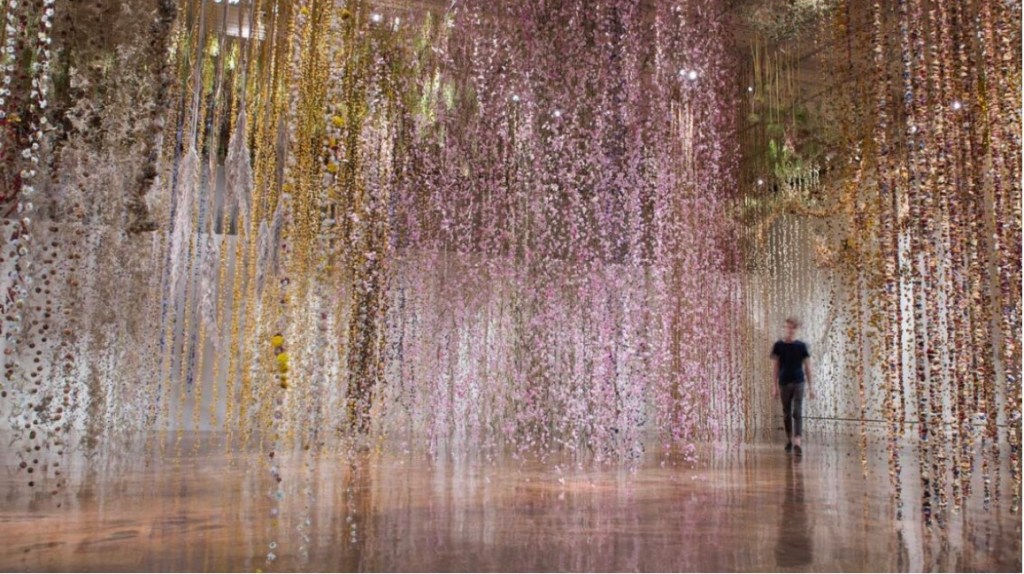
Awakening is a year long exhibit in the upstairs L-wing. The Laws have produced these kinds of floral exhibits and art work previously but this is the first time in Hawaii. They brought dried materials and continued the process of gathering and drying flowers from Hawaii.
The main volunteer tasks for this project were cutting and bending of wire along with stinging of flowers. Flower donations came from volunteers. Flowers used each day varied on availability. The process was collecting, drying, and then a 3-day freeze. HoMA tried to keep each day different, as there were a lot of repeat volunteers and they wanted to keep the experience new and interesting. Approximately 250 Volunteers helped from August 16- September 16, 2022.
Andy and Rebecca arrived in Hawaii in early August 2022 and will stay and coordinate the assembly and opening of the art exhibit, which will be up for a year to enjoy.
They have had similar floral exhibits all over the world, including England.
Artful friends Marin Philipson, Debbie Choo, and Patty Mowat joined Lexi and me.
Amazing long time and Awesome lei makers Joyce Spoehr a HBG Retiree and active volunteer, Iris Fukunaga who still works at HBG (Honolulu Botanic gardens) and Dyanne Taylor a Master lei maker, famous for her tiare bud lei, is another City Parks and Recreation retiree(and fellow surfer) who Volunteers at all the fun plant and lei events. My Friend and great gardener Rosemary was there too. It was so fun to have the master craftswomen there, as we all learned this new technique.
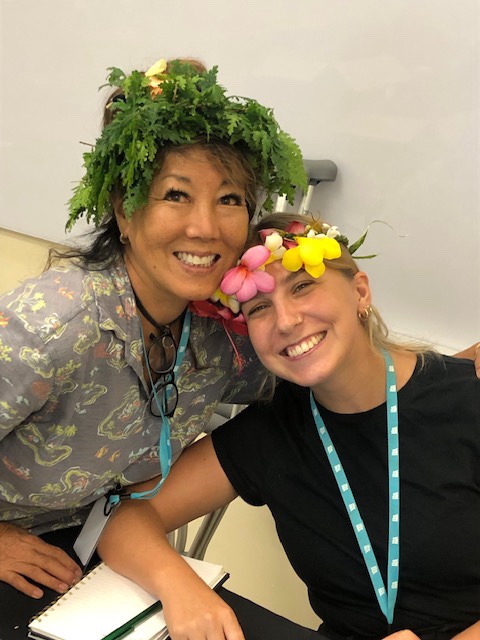
I had so much fun making my lei, first with Phaleonopsis or Butterfly Orchids, then one with red cup and saucer and then with the Lavender cup and saucer. I had never noticed before, working with this as a fresh floral, the different shapes of the dried petals.
Loved the garlic vine flowers for a strand too. This is an old fashioned kama`aina plant that we do not see too often these days. I love the striking lavender color when it is fresh, and it dries very nicely. Seems like the petals are tough enough to hold up
As we completed each long strand (sixty inches measured by the length of our worktables), the lei strands were gently laid into big, long floral boxes, with the layers separated by tissue paper.
The process, of drying the flowers first was something like how botanists and taxonomists, like at the Bishop Museum or National Tropical Botanical Gardens, or even Kew Gardens in the U.K. make dried Herbarium specimens of plants to document and study.
Such a process and so many Na lima Kokua (helping hands) putting the art exhibit together.
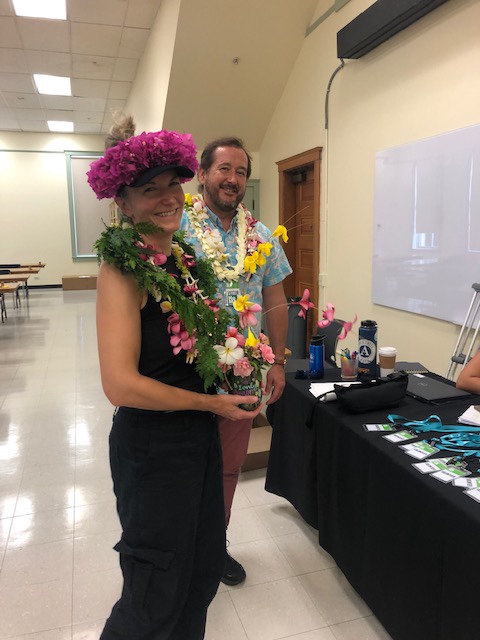
As we were wrapping up, the artist herself joined us and we bedecked her with lei and floral gifts. Slender and dressed in black, Rebecca Louise Law looked amazing and happy with our floral adornments. She spoke a few quiet words thanking us.
Rebecca Louise and Andy Law
I thought about what a wonderful team she and her husband Andy make, him warm and bouncy and super enthusiastic, and she reserved and artistic.
Another amazing thing that happened was that the Director of the museum, Halona Norton-Westbrook, joined us to say mahalo, and spoke briefly with us volunteers.
I was talking with my neighbors on their sunset stroll and found that Julia Weiting was also volunteering. Every time she went, they gave her different florals to work with.
I was so inspired after about what I could make next! I also thought a lot about the process and which other flowers or foliage we might incorporate. A fresh style of lei making! A quick and fun one to teach keiki, a way to decorate homes or papale!
I am so excited to see the completed exhibit, called “Awakening.” Its opens to the public on Saturday September 17, 2022, and continues to be on display until September 2023.


 Heidi Bornhorst