Naupaka

By Heidi Leianuenue Bornhorst

Naupaka is such a simple and elegant native Hawaiian plant to grow in beach gardens, xeriscapes, and to nurture in the wild.

It makes a great hedge, or specimen plant.  It protects our coast and holds onto the sand.  You can also grow it in large pots.  
Naupaka is a less thirsty plant, perfect for your xeriscape garden. It is also salt and wind tolerant.

Grow it from seeds or cuttings or buy some potted ones and support your favorite local nursery.

Strategic landscape designed naupaka hedges can protect beach homes from the strong ehukai, salty winds. 

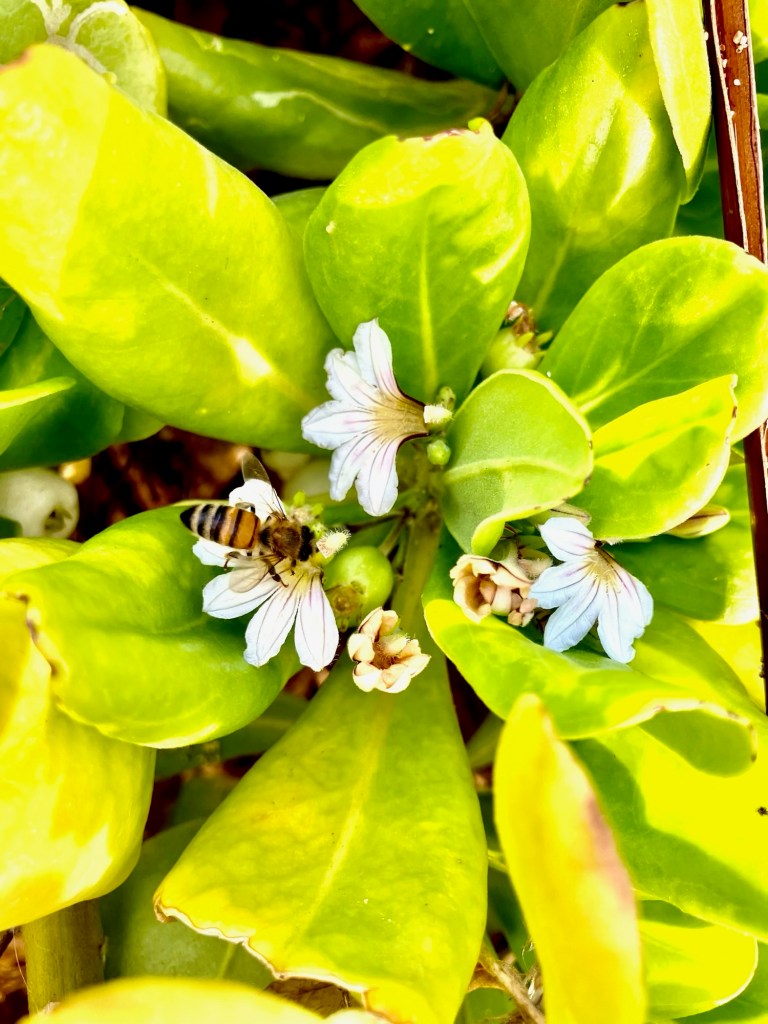
It is beautiful with its soft green leaves and half flowers which are white with a hint of purple. White fruit follow the flowers.
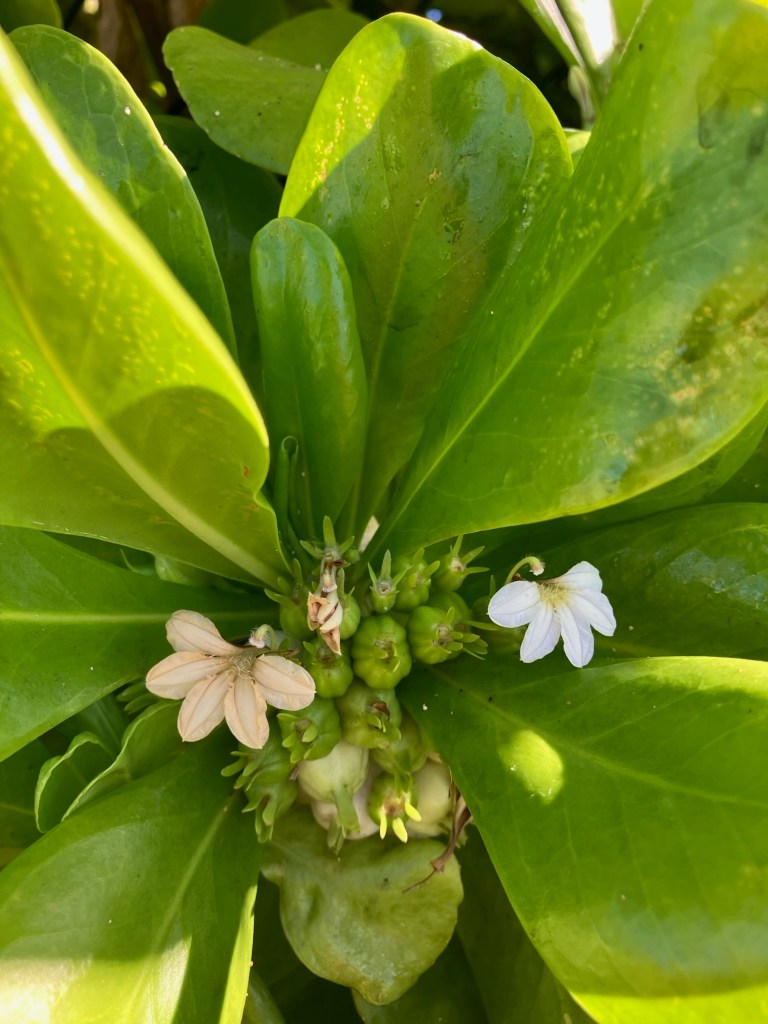
Beach Naupaka, Naupaka kahakai is known as Scaevola taccada to scientists.

It is an indigenous Hawaiian plant, which means it got here on its own, but it grows in other tropical areas too.

We also have native endemic species of Scaevola, Naupaka kuahiwi that inhabit our uplands. They too have a half flower, which features in Hawaiian love legends. 

It is the easiest plant to care for if we keep it simple:

• Minimal water once established.

• No fertilizer.

• Keep turf grass away from the root zone.

• Minimal trimming, and only by hand.

As with many of our native Hawaiian plants, modern ‘mow blow and go’ landscape techniques do not agree with naupaka.

The worst is gas powered hedge trimmers, this will mutilate naupaka. Do minimal trimming and shaping with hand clippers or loppers.

Do not TOP naupaka.  Prune carefully, and minimally and only when you are in a good mood. 

​Topping is where you mindlessly cut trees or plants.

The new growth is soft, and the older branches are very woody and tough.  

Power equipment trimming shakes up the roots and then makes the branches grow too dense, making habitat for insect and disease pests.

Turf grass should be physically separated from the Naupaka planting area.  Use a nice stone, coral, or brick edging to keep grass and naupaka separated.

Hand weed out any invading grass. Grass will compete and rob water, nutrients, light and space from the naupaka.

An edge also makes it easier to mow the lawn.

Thoughtful Landscape design and old fashioned garden maintenance will help you keep your naupaka thriving and Beautiful, as nature designed.
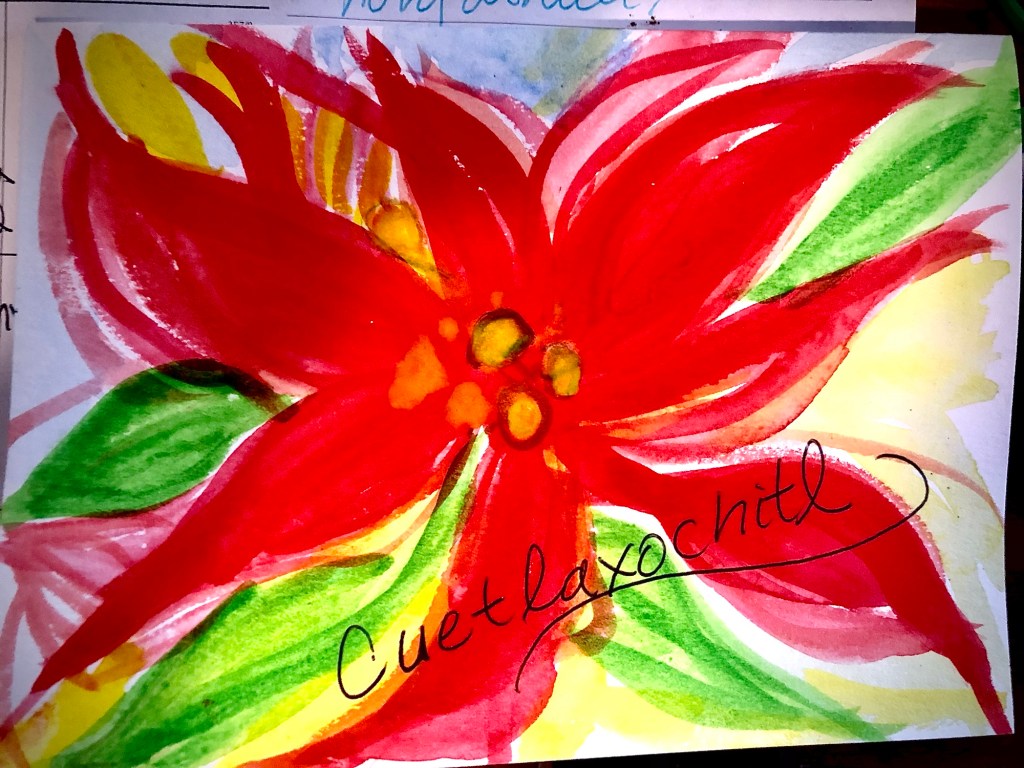
Should we use the REAL name of Poinsettias? CUETLAXOCHITL

By Heidi Bornhorst

The first time I saw the real native name, I went no, WAY too hard to say!  But learning to spell Latin names is not that much easier. So maybe we should practice using the real name.

Break it down and it’s easier to say.  Write it and your brain will remember it.

It is pronounced: Kwet La sho Chel

Sing it! Let’s try and remember and use it.

Just like we respectfully use, and properly pronounce ohelo Hawai’i words, we probably shouldlearn to use the real name.

Not only is it a seasonal festive plant for us (and a big production for our nursery growers), starting in Hawaii about June with little plugs, it is a very special and significant plant in its native Mexico and Central America.

Red is original color, and many new variations now exist. I like the new colors for their novelty, but the rich red is so seasonal and joyous.

In Mexico they were symbolic and were also used for medicine (A special recipe induced breast milk). they are not as poisonous as some rumors suggest. Red and purple fabric dyes come from the colorful. bracts.

The “flowers” we see so brightly are actually bracts, modified leaves. The true flowers are yellow and green and are nestled in the center of the bracts.

For the past few years, I have been buying them from the UH Manoa Horticulture club, to help support and encourage students in the fine art of intensely growing and studying plants.

I love going up to Manoa to buy them and then sharing this growing gift with family, friends, and neighbors.

We also have the old-fashioned hedge type of Cuetlaxochitl in some Hawaii gardens. They are becoming a more rare plant to see. In Foster Village, where my husband grew up, we’d love to see all the pretty tall plants growing in gardens as we drove out to visit his folks. A particular house had green walls and it was so striking to see the plants growing there.

If you see one like this, you might ask the gardener for a cutting to grow. This is not among varieties growers produce today. This hedge type one is more of a perennial and will grow and bloom every year.

Who remembers the old hedge that the Board of Water supply grew along the Pali Highway in Nuuanu?

For many of us this was the true sign of the season.

​These seasonal flowers can last for months if you treat them right. They like light but not baking sunlight. Water them about once a week. Take off any decorative foil. Fill the pot with water and let it drain all the way out. Then put it back with your other Holiday decorations. They may last and stay red all the way to April!

An old gardener trick is to trim them back in the A months, April, and August. This holds true more for the hedge type.

Although I keep them alive a full year, these newer cultivars don’t look great. Nurseries use all kinds of special fertilizer and lighting to get them looking so pretty and perfect.

Gardenias: Blooming in May in Hawai’i Gardens

by Heidi Leianuenue Bornhorst

Q: my Gardenias are blooming a lot right now! I even put some of the dead brown flowers back around the plant, like mulch.

That’s the right thing to do, right Heidi?

Mahalo Debbie Azama Park

(Our fave Yoga teacher)

A; Brief answer: the spent flowers are good for mulch if they are pest free. Leafy mulch is also greatly beneficial for Gardenias.

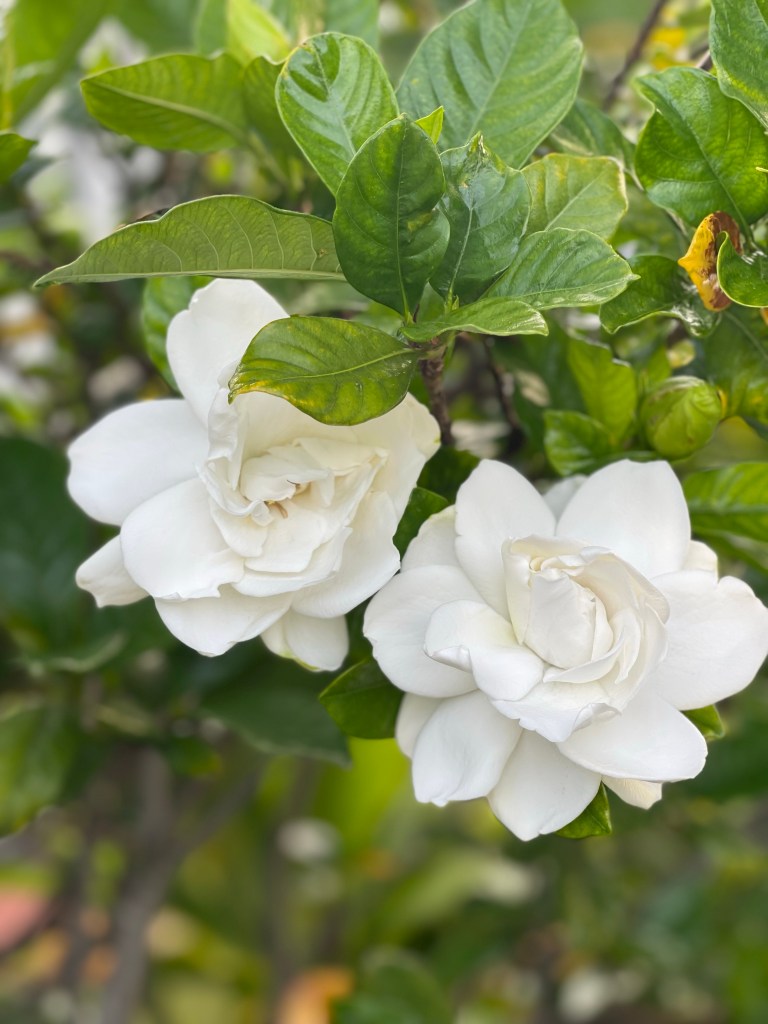
Gardenias are called KIELE in Hawaiian.

They came to us from tropical China. The scientific name is Gardenia chinensis. They are in the RUBIACEAE plant family.

Did you know that there are over 200 species of Gardenias in the world?

Gardenias are easy to grow and bloom if you follow a few basics:

• Grow them in full sun.

• Pick every flower.

• Use soapy water to control ants and other insect pests.

• Cut long stems with blossoms if your plant is tall and flourishing!

• Cut the stems in the right place!

• Water!

• Shoot the undersides of the leaves to rinse off pests.

• Foliar fertilizer

• MirAcid 

The more sun the better, for Gardenias and most flowering plants. Study your sun and shade patterns and try to find the sunniest spot. Wind is good too. Air circulation helps get CO2 to the leaves of the plants and helps reduce insect pests.

You will have way fewer pest insects: thrips, aphids, scale, if you pick every blossom, look for a swirl of white on the green fat kiele bud, that’s the time to get your clippers and cut the bud and some stem.

Put that bud with stem, right into a vase of cool water.

If you see any pests on the buds or flowers, rinse them gently at the sink. If the pests are stubborn or plentiful, squirt some dish soap (1-2 drops) in some water and swirl it around, rinse off the pests.

Soapy water for the plant pests outside one tablespoon per gallon.

You can use a pump sprayer or handheld spray bottle. Spray the soapy solution onto the leaves and young stems, get the undersides of leaves, as that is often where the pests seek shelter and hide.

Leave the soap to sit on the leaves for at least an hour.

You can then rinse the leaves and shoot off the now smothered and dead pests and rinse the sooty mold off of the leaves.  Or you can just leave the soapy residue on the plants.

If you really want clean shiny Gardenia leaves, take a soft rag, dip that in the soapy solution and rub off the sooty mold and any insects or their eggs.

Watering and rinsing, like a strong windy rainstorm would do, is a great way to keep your plants healthy and pest free.

Observing while watering is also good; look for any buds coming along, and think about the best place to cut the stem to enjoy the blooms (and Fragrance!) inside your home.

GARDENIA Basics: THEY LIKE RICH, ACID SOIL, RED DIRT MIXED WITH GOOD LEAFY COMPOST. DIG OUT THE GRASS AND TOPDRESS WITH GOOD SOIL, MAKE AN EDGE TO THE PLANTER BED LIKE FLUSH BRICKS OR STONE, AND THEN JUST MOW AROUND THE BIG EDGE. KEEP THE GARDENIAS WEED FREE.No grass next to the stem.

Make a good soil zone area for the Gardenia roots with no competition from turf grass.

Gardenias also will bloom more if you fertilize with MirAcid. It’s the miracle gro in a blue box. If you fertilize with this each time you water, or at least a month or two before the main blooming season in May in Hawaii, you will get lots of lovely gardenia blossoms.


Tuberoses for our friendship garden

By Heidi Bornhorst

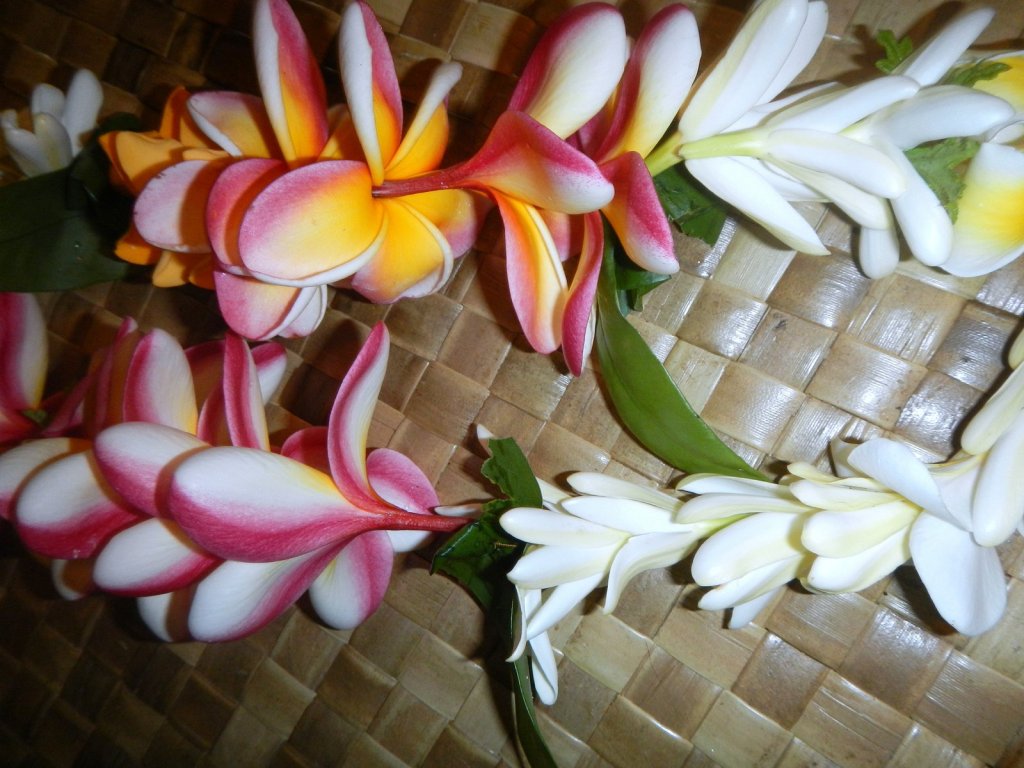
The fragrance of tuberose! One of my Mother’s favorites, as a lei of tuberose and yellow roses are what my dad got her for their simple wedding ceremony. She also loved the smell of pineapple, because my dad gifted her with those too!

I like them in a lei, combined with other flowers like roses, carnations or orchids.

Florists carry this fragrant lei and if you grow your own, imagine what flowers from your garden you can combine with tuberose?

It’s an old-fashioned flower.

We used to grow a lot of them here in Hawaii. When I worked at Evergreen nurseries in Waimanalo, in 1978, one of my friends there, was working a second job, harvesting tuberose.

Her name was Estralita, and she was from the PI and recently married.  I think her new family really made her work hard!  At two jobs and at home.  She said they harvested in the dark using headlamps.

She told me that her named meant “star” and how appropriate that she worked at night when the stars came out!

She taught me the saying ‘Mabuhay las Philippinas !!’  Long life to Filipino women!

I wonder what happened to her, as she was kind, nice FUN and hardworking.

Tuberoses remind me of her, and I say a special prayer for her happiness. 

I got some from Estralita back then and grew it in our family garden in Makiki.  It did well for a while and even sent up a flower spike.  But then it got a very bad infestation of mealy bugs.  I treated it but they were too severe, and the plant died. I was sad.

Maybe tuberose does not like Makiki black sand as a potting media? Or it needs cooler conditions. Time to do some research and find out!

​The other day I got an email from my friend Ruth Fujita, another great gardener.

She was offering us, her Budleys, tuberose bulbs. She had a big plant and dug it up, dried out the bulbs a bit and had some to share with da girls.

So, Rachel Morton and I went up there, after a visit to Foster garden to see the Triennial art exhibit.

Ruth shared how she got the tuberose bulbs:

Our niece Tia C. had gone traveling.  She needed omiyage for her epic Aunt Ruth and so in the airport she bought a bulb in a package.

Ruth grew them and was now sharing them with Lynne, Cheryl, Doris Susan Young, Annie, and me and Rachel.

Such an epitome of the Friendship Garden: Grow something with love (and good horticulture!) and then share it with your friends.

With rare plants, this is a Botanic Gardenconcept: Share it and keep good records. If yours dies, you know right where you can get a replacement.

With plants of sentiment like this tuberose, its mainly sharing the wealth and the stories.  But it will be epic for us all to see them grow and Bloom!

People call it a bulb but the roots are actually a rhizome (just like our fragrant gingers)

Fragrant, showy flowers in the late, HOT summertime lead many to plant tuberose bulbs. The scientific name is Polianthes tuberosa, and it also called the Polyanthus lily. It is in the Lily family, LILIACEAE.

Florists and nurseries sometimes “force” tuberose to bloom year round with artificial lighting.  

Tuberose has a strong and enticing fragrance makes it a popular plant in our Hawaii gardens. Clusters of large white blooms form on stalks that can reach 4 feet (1 m.) in height and rise from grass-like clumps.

Tuberose was discovered by explorers in Mexico as early as the 1500’s.  It was one of the first flowers to be imported to Europe, where it was very popular in Spain. 

It likes well drained, compost enriched soil.  It likes FULL SUN especially hot afternoon sun (which not all plants do) 

Plant them 2-3” deep.

In cold regions they dig out the roots in winter.  In Hawaii we can dig them out hand let them rest but not for too long or they will dry out.

There are single and double flowered varieties and now we are seeing them in different colors like yellow and pale pink.

Deadheading Benefits for Hawaii Plants

Tiare benefit greatly from deadheading

By Heidi Bornhorst

Q: What is deadheading and which Hawaii plants would benefit?

A: Deadheading is where you remove spent flowers to increase blooming and benefit the health of the plant.

Pua Keni Keni comes to mind, as cutting or snapping off the green and orange “balls”, AKA the developing fruit, will increase blooming.

Fruit formation and seed development take a lot of time and energy for the plant, just like a woman being pregnant.

So, if we want more flowers, don’t let the fruit form.  In the case of Pua Keni Keni, the fruit on the stems makes for great décor in a flower arrangement.  You can even string the “balls” into lei, as my akamai lei making buddy Dede Replinger Sutherland does.

Tiare or Tahitian gardenia nowadays needs deadheading.  We didn’t use to have a pollinator for Tiare but now it seems we do, as the old flower calyces (the bottom green part of the flower) don’t fall off after blooming. They now form fruit and it takes about a year to fully develop and form mature seeds inside.

We need to snap off that part on a daily or weekly basis or Tiare plants will have fruit developing and fewer blooms.

Tiare buds make an epic lei, that can last for several days or nights with a most heavenly perfume.  When you pick the buds, pick the calyx too and save yourself some time and energy.

My friend Donna Chuck has a prolific and sunny garden with many flowers for lei. She collects the Tiare buds and stores them carefully in a plastic bag with a damp paper towel in the fridge until she has enough for a special lei for a special someone.

We spent some time cleaning up and deadheading her plants and now she gets way more Tiare flowers for her lei creations.

I first learned the word and horticultural practice known as deadheading when I was an apprentice Gardener at Longwood Gardens in Pennsylvania, in my junior year of college.

‘Go deadhead the Rhodies’, I was instructed by the Horticulturist at Longwood.

I wondered if it was something about the Grateful Dead; and had to ask what was deadheading and what are Rhodies?

Rhodies are Rhododendrons, related to the Azaleas that we grow here. They bloomed massively in spring there and general good garden practice was to deadhead them in early summer, to promote lots of blossoms for the following Spring show.

Some use sharp needle-nose clippers for this and some use sharp well-placed fingers and thumbnails to snap off the spent blooms.

Roses are another plant that will bloom better if you deadhead, or you can just harvest and use every flower.  Or you can let the fruit develop and you get rose hips which can be made into jam or tea.

Some kinds of Hibiscus, especially our fragrant native white Koki`o ke`o ke`o will form seed pods if you let them.  This is how early gardeners made new hybrids as they found the native Hawaiian whites were excellent “mother” plants.

Again, if you want blossoms, pluck off and clean up the old flowers.  Another benefit to this is we have lots of recent alien insect pests like scale and mealybugs that love to hide in the developing seed pods and suck sap and juices from the plants.

Deadheading helps you groom your plants, so you can rub off or cut off the pest-infested parts. Get rid of insect eggs and small sap suckers before they form a full-on infestation.

Lei rainbow pua melia tiare buds

Silver Buttonwood trees – Horticultural Legacy at our Botanical gardensHawaii


Q: What are those gorgeous silvery street and park trees?  Some are at Sandys Beach, some Giant ones are on Pa`alea street in Palolo Valley, and some are at Ala Moana beach park.  Please inform us about these

Mahalo, M. Silva, Palolo

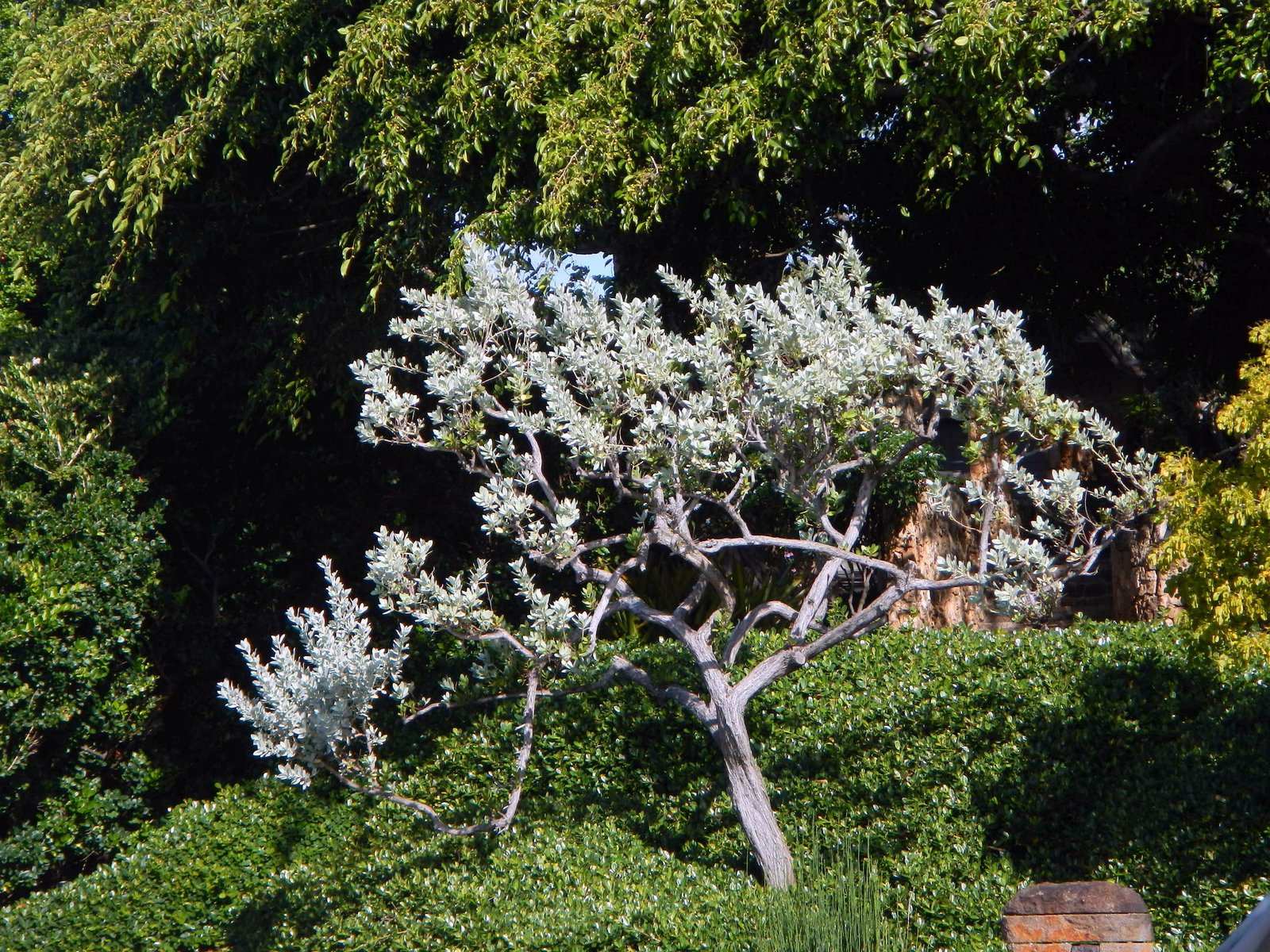
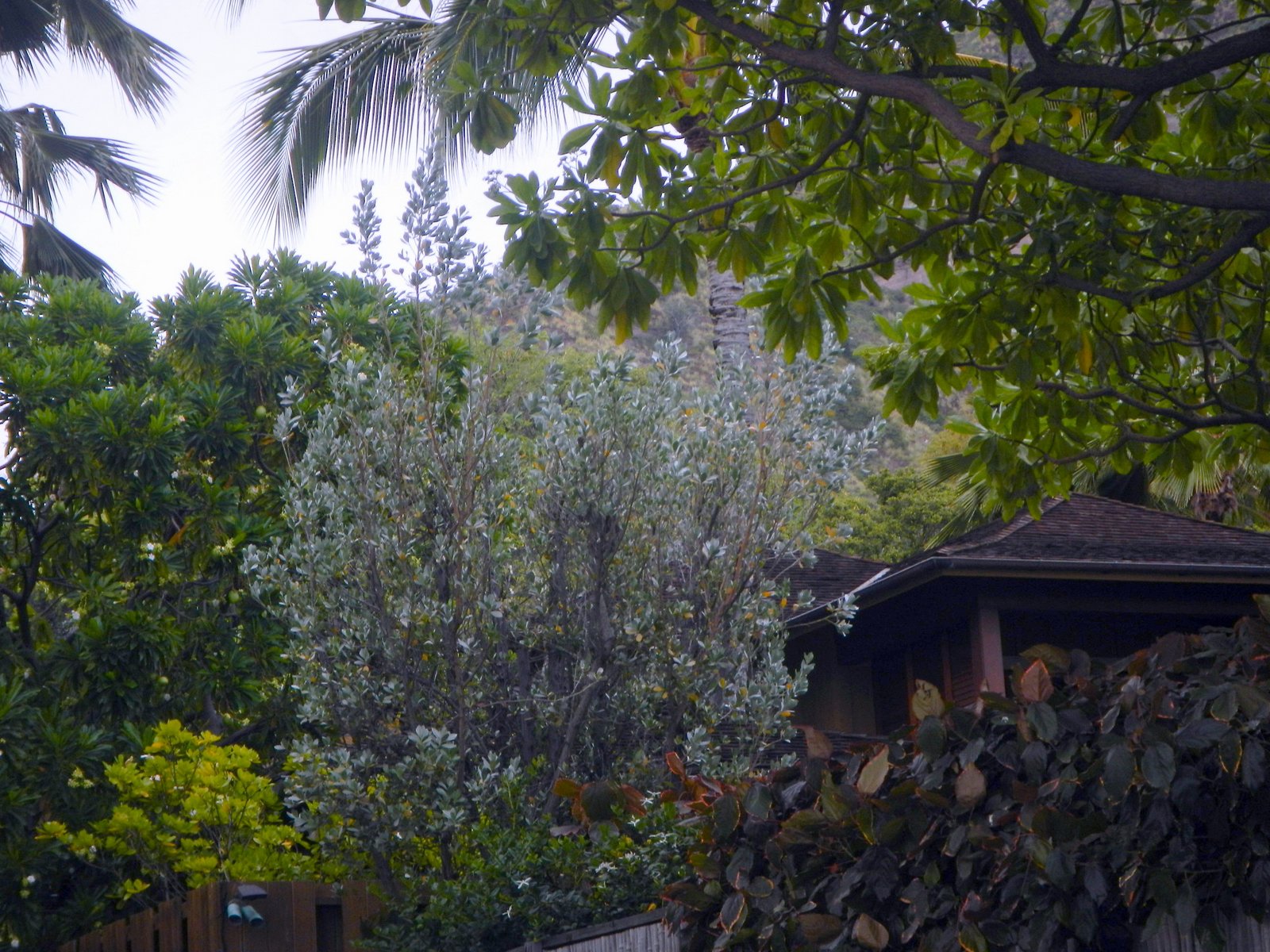
A: Silver buttonwood trees! AKA Sea Mulberry, or Button Mangrove.  Conocarpus erecta is the Latin name.  they grow naturally in mangrove swamps and are in the Combretaceae plant family, they have a very interesting horticultural history that I am happy to share.

As you may know they are very wind resistant, xeric (drought tolerant) and salt tolerant.  The bark and gnarly trunks are very attractive, especially as the trees mature.  You can make lovely lei with them.  Keiki can make a fun lei using masking tape and the leaves – easy and gorgeous!


HB- silver bttnwd tree -landscape

Silver Buttonwood amidst Carissa, Rosemary and Wax Ficus


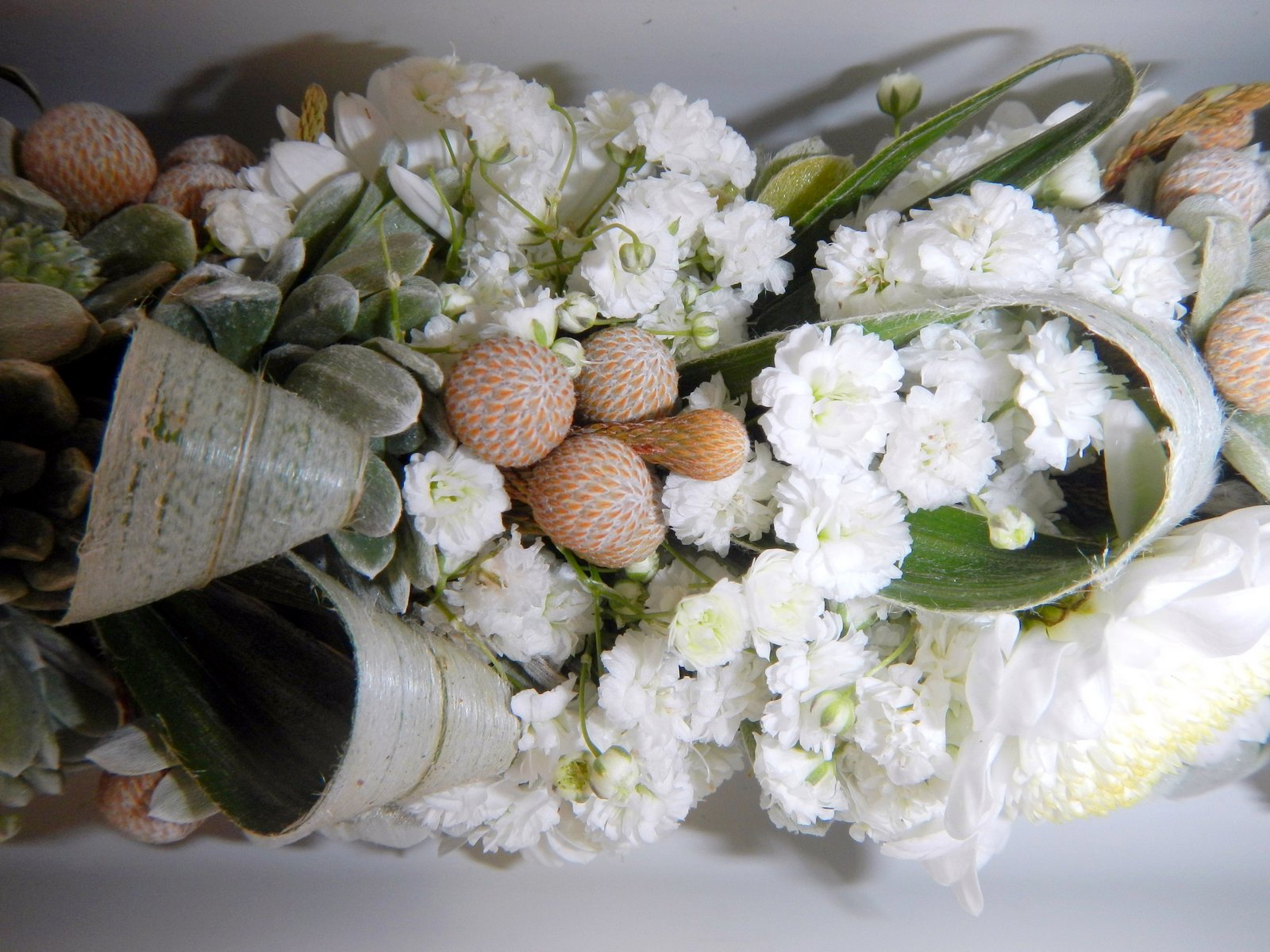
At Lei Day in Kapiolani Park this year (and a HUGE mahalo to all the dedicated City of Honolulu, Parks and Recreation and Honolulu Botanical Garden Employees and Volunteers, who organized and coordinated that major public, free event in our park) we saw some fab lei, using various parts of silver button wood trees.  Some used the fruit clusters, some used the leaves, some crafted the leaves into silver “rose” buds and so on.

Our late mentor Paul Weissich had just become Director of the Honolulu Botanical Gardens (HBG) in 1957.  He was reviewing all of the interesting plants growing in the nursery and lath houses at Foster Botanical garden (FBG).

Weissich found a flat of seedlings.  Some were green and some were silvery.  One keiki was super silvery.


HB-silver buttonwood tree

Silver Buttonwood tree in a salt Drenched, Hot, Dry Diamond Head, coastal Garden; See How it “Lights UP” the landscape?


He selected the silveriest of the silvers and had them potted up into larger individual pots. The best, consistently silver one was selected and more were propagated from air layers. He watched over them and had the expert plant propagators nurture and grow them up. This is a prime example of ‘Horticultural selection’.

He planted a bunch of them at Ala Moana beach park, which was an adjunct Botanic garden back in those days (and still has his legacy of tough, salt tolerant interesting, rare and unusual trees growing).

A mixed silver and green hedge of them is still growing today around the tennis courts at McCoy pavilion.

One of the silveriest was planted at Foster Garden and its gnarly and sprawly and has a growth habit something like an ancient time gnarled Olive tree.  We have been talking about making this an Exceptional Tree.

Over the years more of the silvery trees were grown and planted in beach parks like Sandys and as shady tough street trees in Oahu neighborhoods. They make a tough specimen tree (especially nice when up lit with solar lights for your “Moon Light Garden”), a good hedge or windbreak.

Button woods are native to a broad area from the Bahamas, to the Caribbean coastal tropics and all the way to West tropical Africa.

This is one of the many Horticultural legacies of Paul Weissich who passed away this year at age 93.  He really grew our beautiful and amazing botanic gardens here on Oahu. His legacy is our five Honolulu Botanical Gardens: Foster Lili’uokalani, Wahiawa, Koko Crater and Ho`omaluhia, as well as people like me and my Husband Clark whose career and lives he nurtured, just like that flat of keiki silver buttonwood trees all those years ago!


HB-silver buttonwoord lei

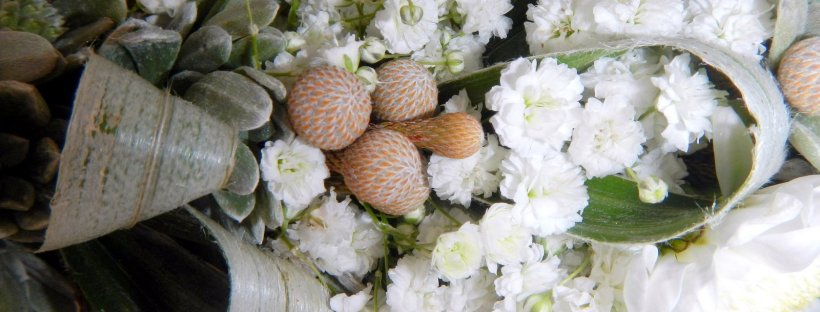
Epic Silver themed Kupuna lei featuring Fruits of silver Buttonwood, Delicate Baby’s Breath, Hinahina and silver leaf.