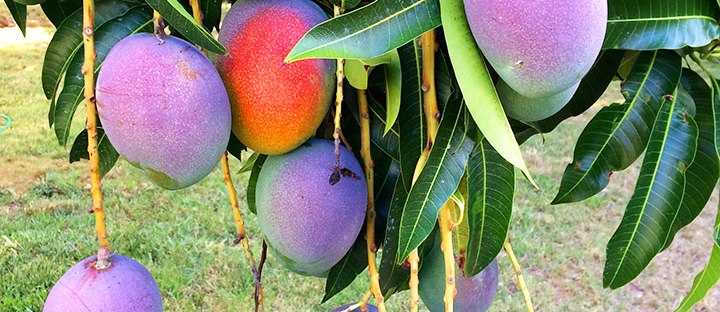
Espalier your Mango!

With land so valuable in Hawaii, homes and gardens are getting smaller, yet we still want to grow fruit trees, but how can we?

Even with towering monster houses and high-rises blocking sunlight and air circulation, espalier is one solution which can help your garden to be more fruitful.

What does espalier mean and how is it done, you may wonder.

Espalier is a technique that is ancient yet artful.  We think it started with the Romans, and was enhanced by Europeans with Castle courtyards. The French enhanced and grew the technique to they could have fruit year round.

The word is French, with Italian origins. Spalla means something to rest the shoulder against in Italian.

Modern landscape design does look to the French and Italians.  Some of the first beautifully designed, landscaped gardens were in Italy, check them out on your next Continental journey. (Gardens are way more fun to visit than a museum, in my opinion, and you get better outdoor exercise too)

Espalier means”to train a fruit or flowering tree to grow flat against a wall, supported by a lattice, or a framework of stakes”.

Today we can use strong cables to train and attach mango or other fruiting tree branches to keep them low, to get maximum sun and air circulation, and for easy harvesting.  Or we can do something more artful and horticultural in our Hawaiian gardens.

The European reasons to do this apply here too:

  • Walls reflect sunlight
  • Walls retain heat overnight (trees use the heat and then cool the air)
  • Orient the leafy branches to absorb maximum light
  • Train the branches parallel to the equator to get max sunlight
  • Espalier extends the growing season

There are many designs of espalier, from a simple V-shape, to fans, crosses, Belgian fences and many more.  Some are curved or spiraled.

England is known for great gardens and akamai horticulture and they have one called a free-standing step over.  They do it with apple and pear trees and we can adopt this practice for our fruit trees here in Hawaii.

Mark Suiso of Makaha Mangoes is great proponent of mangoes and other fruit trees.  He encourages us to graft good mango varieties, prune them correctly and cherish every fruit. Recently he got us all re-excited about espalier.

Suiso and his ohana and friends have participated in Mangoes at the Moana for the last nine years.  We have learned and grown together and met many mango advocates.  It seems to me that we have more fruit these days and that more people are choosing to carefully prune and nurture their legacy mango trees.  People are planting new trees in their gardens.

It’s so important to support farmers, especially here in Hawaii.  To BUY a mango seems outrageous and not at all sustainable, please buy local!

After all, mangoes are the King (or Queen) of Fruit, just ask Queen Victoria (movie with Judi Dench, featuring her wanting to taste a mango from India)

P.s. I think we should try espalier with `Ulu or breadfruit too!  Horticulturists always love a garden challenge and what better one?

I espalier my mulberries, to keep them low for easy picking and out of my neighbor’s yard (they like the ‘golf course grass’ look) I also can net my fruit and protect them from the ravenous alien bulbuls and green escaped parrots that we have on Oahu.

In other places, such as Japan, Taiwan and Australia they do elaborate kinds of Horticulture including espalier to nurture and cherish every leaf, flower and fruit.  We could do this too!

I would love to hear from my readers, who are practicing espalier to nurture their own special fruit tree.  Please send pictures if you have them, we can all learn from and inspire each other.

Heidi Leianuenue Bornhorst is a landscaping consultant, gardener trainer and specialty VIP garden guide. She has been a professional horticulturist for more than 33 years and she is a Certified Arborist. You can contact her via email at heidibornhorst@gmail.com or at 739-5594.

`Ulu aka Breadfruit, Healthy Food Production for Hawaii

Dear Governor Ige, Famers, and back yard gardeners, do you want to increase local Healthy food production?  Eat more nutritious locally grown safe food?  Breadfruit is one of the best solutions for sustainable Food security, better health, and natural beauty.

Breadfruit aka`Ulu is a beautiful tree with great Cultural significance here in Hawaii, and across the Pacific.  Hawaiians and many other local cultures have a long tradition (including varied recipes and preservation techniques) with breadfruit.

`Ulu has many

healthy body benefits, it is rich in fiber, calcium, potassium, B vitamins, and pro-vitamin A carotenoids. It is a “resistant starch”, it does not spike your blood sugar like white rice or white potatoes. If more people ate breadfruit we would cut down on diabetes and other health issues related to refined starch and high sugar diet.

When people tell me they don’t like the taste, I figure they have not had it properly cooked, or it was picked at the wrong time – too green or too ripe.  Yes, the over ripe smashed on the ground ones from an over tall non-pruned tree, are not too ono!

As a Certified Arborist, I recommend keeping backyard trees at a medium height for safe and easy harvesting via careful pruning starting after the first harvest (about three to five years in the ground).

If you have a farm, and a tree climber or cherry picker you can let the tree grow larger, but keep in mind, well-managed trees are far more productive.
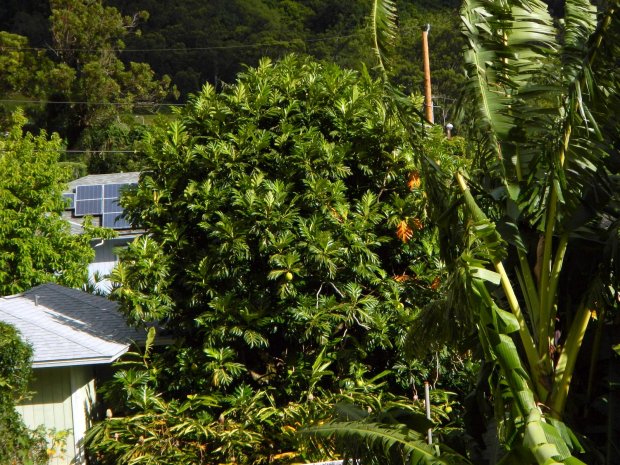
Ulu or Breadfruit Tree

Ulu is a beautiful and simple tree to grow, harvest and care for. It’s easier to grow, harvest and cook than kalo (taro). There is no need to dig up and replant like root and tuber crops. `Ulu are highly regarded as pest and disease resistant, especially when grown in mixed plantings with other crops and useful plants.

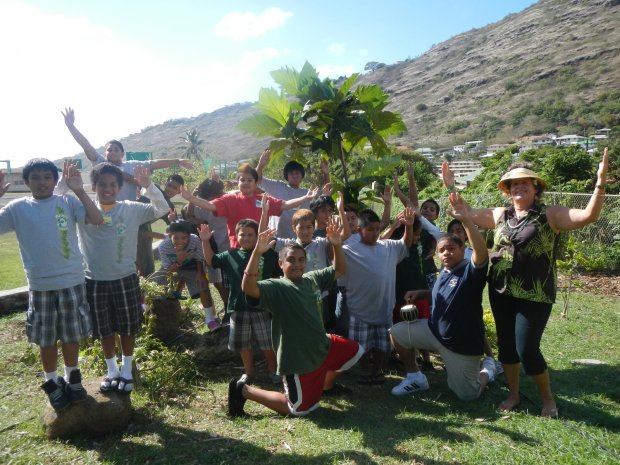
For a number of years I have worked with and learned from Dr. Diane Ragone of the Breadfruit Institute (BFI) of the National Tropical Botanical Garden (NTBG).  We have given away over 12,000 keiki trees here in Hawaii and sponsored numerous breadfruit cooking contests. Our local participating chefs and gourmets are so talented and creative.
hb-ulu-hei-palolo

Chef Sam Choy is one of our amazing and totally giving back to the community Chefs.  For such a famous chef he is so humble, hard-working and just plain fun to partner with. We did the Wai’anae Eat Local Food Challenge, cook off and Breadfruit tree give away with him, Ragone, the Ho’oulu ka ‘Ulu project, and other community partners.

I have participated in numerous Arbor Day breadfruit tree giveaways over the years, these can be  like a feeding frenzy, everybody wants a free tree. Unfortunately not everyone who took a tree actually planted it.

Because our precious `ulu trees are propagated by tissue culture, we decided to make the process of getting one similar to adoption, hoping to attract people committed to and able to grow the trees. We asked people to promise to plant them in the ground within a few months, this gives the family time to make a decision about where in plant and to properly prepare the planting puka (clear away grass and weeds and use compost or stone mulching to make a clear area for the baby tree to thrive).

We utilize social media by sharing pictures and posts to reflect how well the keiki ulu trees are growing and producing healthy ono food.

Mahalo for all those who adopted a tree, keep sharing your feedback and great posts!

Helpful Growing Tips

How to plant:

  • Find a sunny spot away from wires
  • Clear away grass and weeds
  • Use hot mulch to help kill off the grass and weeds
  • Plant the keiki tree
  • Make a ring of mulch
  •  Water daily to establish
  • Replenish the mulch every few month

How to cook:

  • Harvest at mature firm green stage
  • Gently scrub and clean the skin (no need to peel)
  • Oil a big sharp knife
  • Slice ‘ulu into quarters
  • Steam for 20 minutes (or until fork tender)
  • Cool and freeze for future use

Or you can cook to your own liking, I make a simple curry with sautéed onions, garlic and Olena (turmeric).

Please check out the Breadfruit institute page on-line to learn even more about planting, harvesting cooking and the various varieties of ulu that we can grow here in Hawaii.

If you received a tree, please participate in our survey to let us know how your tree is doing.

You can also visit NTBG, they have gardens on Kauai, and Kahanu Garden in Hana that have amazing breadfruit collections for visiting and for inspiration. You can also join and support the NTBG in its important work on our “living library” of valuable trees and plants.

Learn more about when fruit is ready to harvest and how to handle in the Breadfruit Production Guide by Elevitch, Ragone, and Cole. 2014.  Available free   Download: http://ntbg.org/breadfruit/resources/cms_uploads/Breadfruit_Production_Guide_web_edition_2014.pdf or http://hawaiihomegrown.net/breadfruit-publications

Heidi Leianuenue Bornhorst is a landscaping consultant, gardener trainer and specialty VIP garden guide. She has been a professional horticulturist for more than 33 years. She is also a Certified Arborist. You can contact her via email at heidibornhorst@gmail.com or at 739-5594.

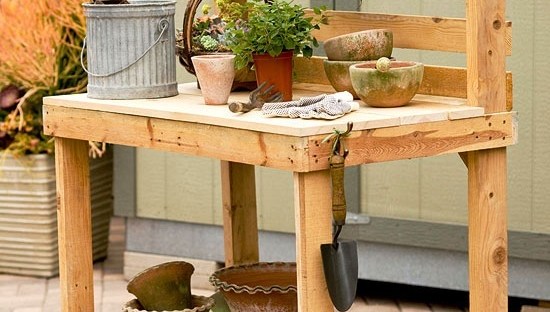
Hawaii Succulents

Succulents are perfect for your Hawaii garden.

Succulent plants can be fun and easy to grow and care for.  They can even help protect your home and garden from wildfire.  They are less thirsty plants, perfect to conserve on water in our gardens and grow a Hawaii style xeriscape.  Some are perfectly adapted for our humid Hawaiian climate.

Others are not so good in Hawaii.  They may prefer a Mediterranean climate like that of California.  These may grow OK at first here in Hawaii, and then they “melt”.  They just wither and fade away and …. It’s NOT your fault!  Ice plant is an example of one of these plants. Native to South Africa, it will grow a year or two in Hawaii, seem to be doing well and then fades away.  We had a nice planting of it at the Halawa Xeriscape Garden on a slope, but its pau now.

Aloe and Jade plants are some of our best gel filled plants for Hawaii gardens.  Not only are they tough and easy, but they also will reward you with a flower now and then.  (Many of our Aloe species bloom in our Hawaiian winter, sending up a pretty lily-like orange or red flower spike).

We also have many epic native Hawaiian succulent plants.  Hinahina the Lei Flower of Kaho’olawe is one of the most beautiful.  It’s tough in the wild, in harsh HOT, ehukai air filled areas.

Our native Hawaiian `ihi or Portulaca species are succulent and tough, with very pretty flowers. Portulaca molokiniensis is one of the most striking, with clusters of golden yellow flowers and a squat succulent growth habit.

`Ala`ala wai nui our Hawaiian Peperomias are also a cute succulent plant with many native species from various dryland and wetland habitats.  In wet places, they can grow happily on big pohaku or boulders, or epiphytically up in trees. These native habitats have perfect drainage.  Something we need to try and horticulturally replicate when we grow them in our gardens.

If you live in a wildfire prone area, you might consider a low scape including succulents. You can find many that are native to and grow well in Hawaii.

In a classic succulent vs fire story from California, a huge wildfire was sweeping through a San Diego, California neighborhood, many homes and gardens were destroyed.  Yet one (artist) lady had grown a low maintenance garden full of succulents including Aloe. It was a giant Aloe plant that is credited with helping save her house.  Though it burnt and appeared dead, its heart was full of moisture and the water stored in its tissues slowed the fire long enough to save the home.  The aloe also survived and with time revived after the fire.

Coastal and dry forest plants have adaptations to survive and thrive in hot dry salty windy areas.  Portulacca molokinienis or Molokini `ihi is one of the cutest, with a fat stalk, rosettes of succulent leaves and clusters of golden yellow flowers.

We have other native Portulaccas, which we call `ihi.  They can have white, pink or yellow flowers.  Most are easy to grow from cuttings.  They can also be grown from seeds.

Hinahina, the lei flower of Kahoolawe has the most gorgeous silvery rosettes of leaves and curled flower spikes of tiny white fragrant flowers.  Super gorgeous in the garden and very xeric once established.

The rare Alula, Brighamia citrina, native to the pali, steep cliff areas and today found only along Kalalau on Kauai, is being saved by gardeners who love its fat stalk, clusters of leaves and long tubular fragrant blossoms.

All of these native Hawaiian succulents need slug and snail protection.  Surround them with coarse black or red cinder, egg shells or a ring of used coffee grounds.  Copper strips and food grade diatomaceous earth also help to repel slugs and snails.

Gardener vigilance is good too.  Check on them at night or after heavy rains and manually remove slugs using a plastic bag to grab and then dispose of them.  Or do like my kolohe neighbor does, poke ‘em jubilantly with his old fishing spear and then dunk them in a bucket of soapy water, then bag them into the trash bin.

Heidi Leianuenue Bornhorst is a landscaping consultant, gardener trainer and specialty VIP garden guide. She has been a professional horticulturalist for more than 33 years and is a Certified Arborist. You can contact her via email at heidibornhorst@gmail.com or at 739-5594.