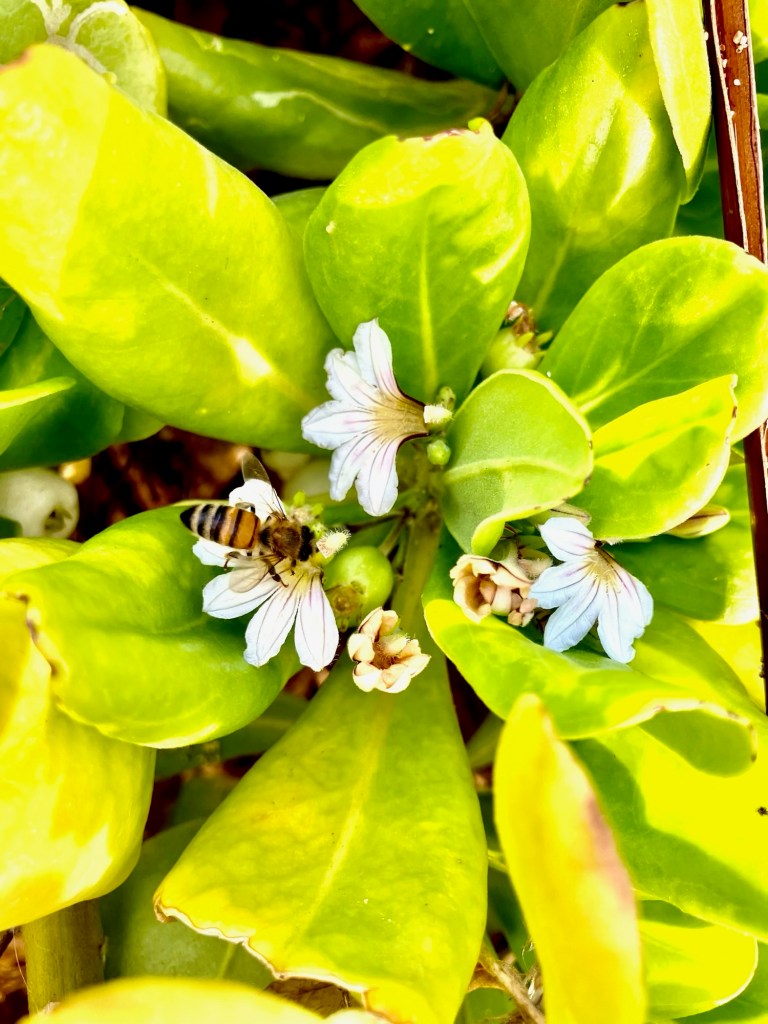
Naupaka is such a simple and elegant native Hawaiian plant to grow in beach gardens, xeriscapes, and to nurture in the wild.
It makes a great hedge, or specimen plant. It protects our coast and holds onto the sand. You can also grow it in large pots.
Naupaka is a less thirsty plant, perfect for your xeriscape garden. It is also salt and wind tolerant.
Grow it from seeds or cuttings or buy some potted ones and support your favorite local nursery.
Strategic landscape designed naupaka hedges can protect beach homes from the strong ehukai, salty winds.
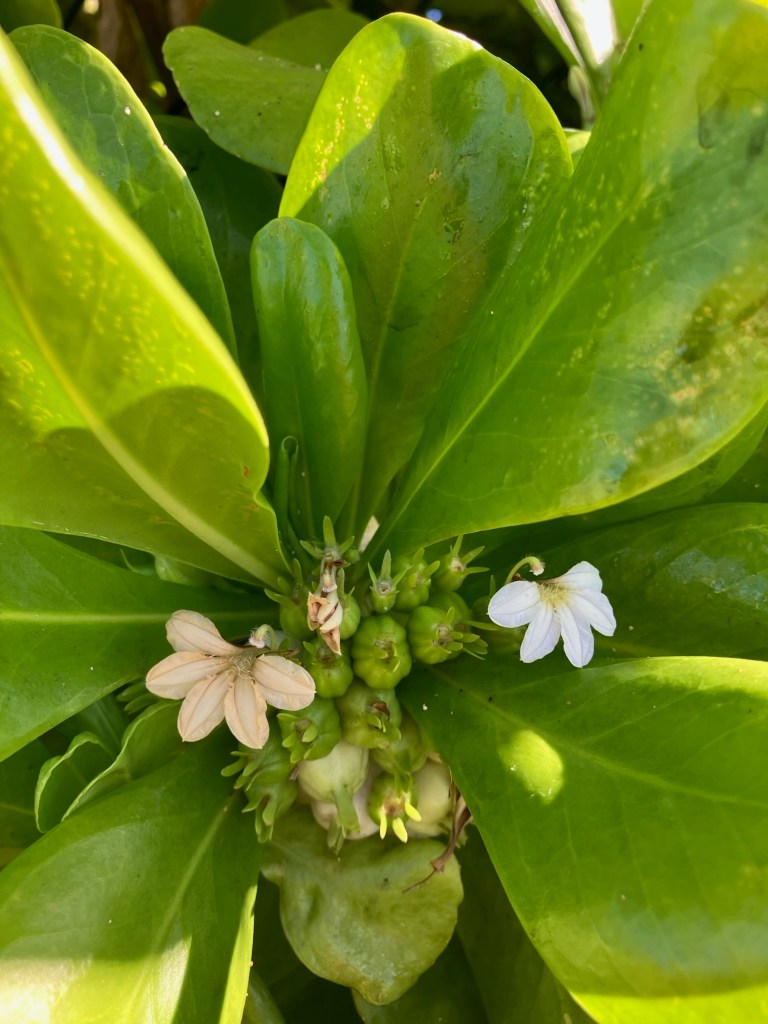
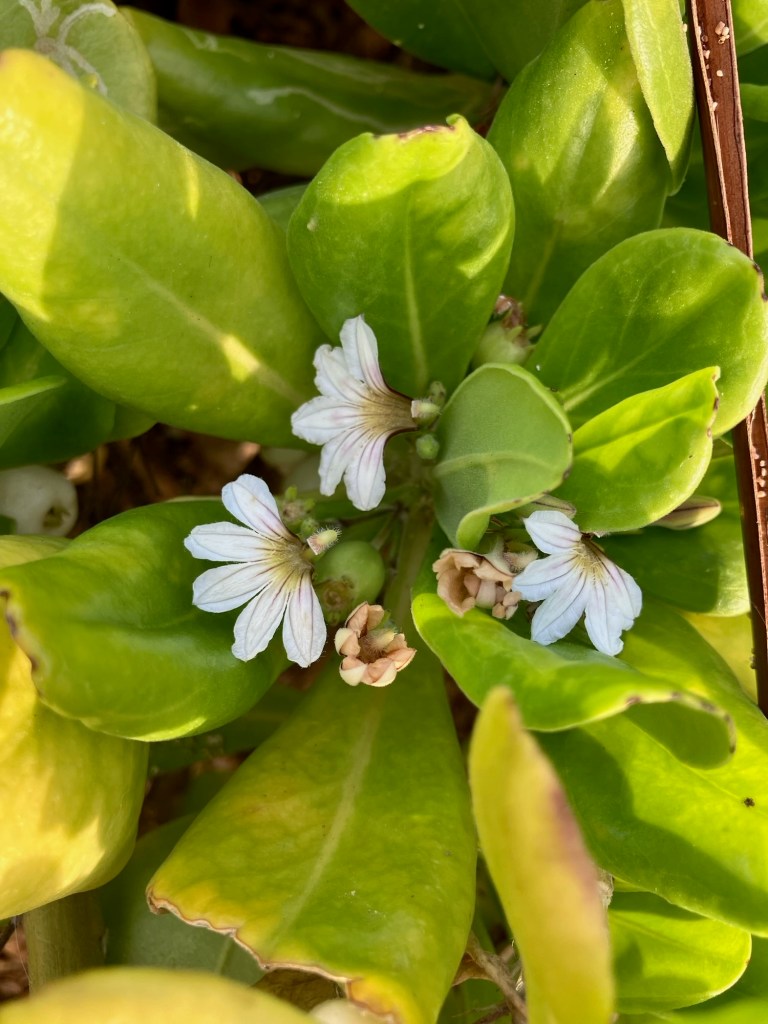
It is beautiful with its soft green leaves and half flowers which are white with a hint of purple. White fruit follow the flowers.
Beach Naupaka, Naupaka kahakai is known as Scaevola taccada to scientists.
It is an indigenous Hawaiian plant, which means it got here on its own, but it grows in other tropical areas too.
We also have native endemic species of Scaevola, Naupaka kuahiwi that inhabit our uplands. They too have a half flower, which features in Hawaiian love legends.
It is the easiest plant to care for if we keep it simple:
• Minimal water once established.
• No fertilizer.
• Keep turf grass away from the root zone.
• Minimal trimming, and only by hand.
As with many of our native Hawaiian plants, modern ‘mow blow and go’ landscape techniques do not agree with naupaka.
The worst is gas powered hedge trimmers, this will mutilate naupaka. Do minimal trimming and shaping with hand clippers or loppers.
Do not TOP naupaka. Prune carefully, and minimally and only when you are in a good mood.
Topping is where you mindlessly cut trees or plants.
The new growth is soft, and the older branches are very woody and tough.
Power equipment trimming shakes up the roots and then makes the branches grow too dense, making habitat for insect and disease pests.
Turf grass should be physically separated from the Naupaka planting area. Use a nice stone, coral, or brick edging to keep grass and naupaka separated.
Hand weed out any invading grass. Grass will compete and rob water, nutrients, light and space from the naupaka.
An edge also makes it easier to mow the lawn.
Thoughtful Landscape design and old fashioned garden maintenance will help you keep your naupaka thriving and Beautiful, as nature designed.
Aloha Hawai`i Gardeners: are we ready to plant and nurture a miniature forest Revolution?
I have wanted to learn about the Miyawaki method for a while. Thanks to generous friends: Chirstine and Pokey, I got my hands on one of the books about the Miyawaki miniature forest method, and plunged in.
The book I just read is called, “Miniature Forest Revolution”, by Hannah Lewis.
Developed in Japan and now spread around the world this is a new and akamai way of forest restoration.
Dr Akira Miyawaki was a Botanist, ecologist, and researcher. He networked with others in Japan and around the world to plant mini climax forests and nurture them.
I have advocated for years, to simply plant a tree, nurture a garden, keep one plant alive, Volunteer at a garden. Go hiking, learn about our Hawaiian forest. Nurture our Hawaiian forests and learn more.
Learn about and nurture our living soils.
This is a new way to do it and is very inspiring.
Trees and forests really do heal our land. Compost really does work. Watersheds can be restored by the forest. Healthy forests of multi layers cover the soil and nourish it.
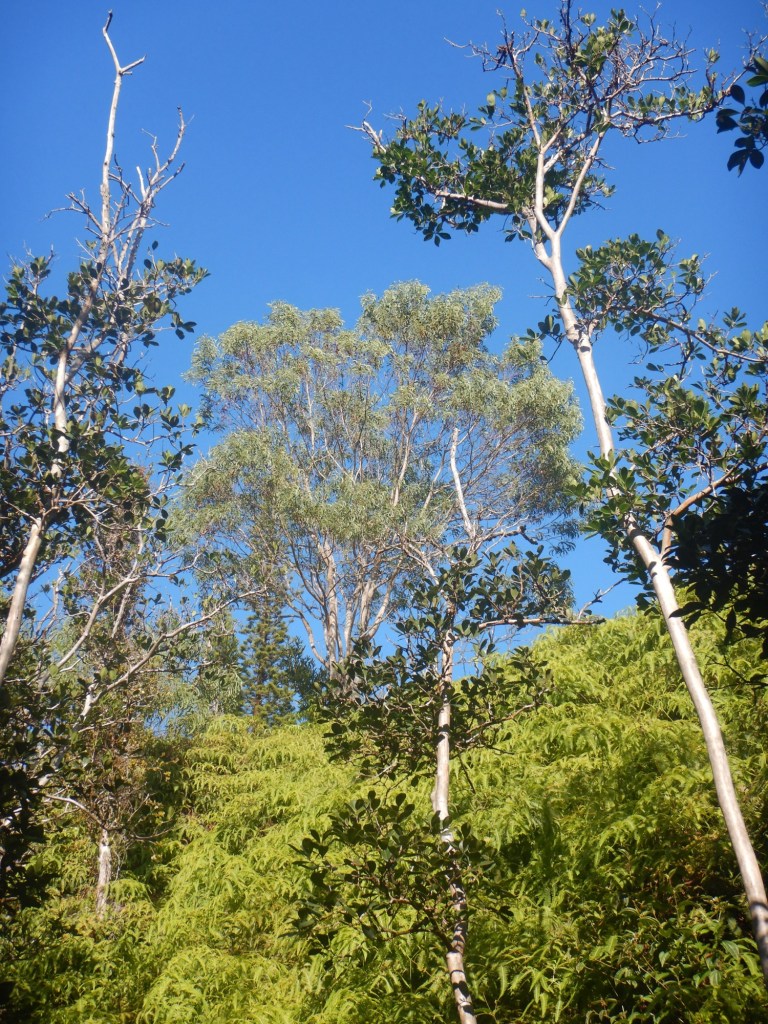
Koa tree and Uluhe ferns
With plants covering soil and adding their leaves to the living soil mix, we have less runoff when it rains.
We like to keep soil alive and where it belongs: on Land
When soil washes into the ocean after heavy rains we have fresh water killing the reef and silt and mud smothering the reef, clouding the water and adversely affecting fish, honu and all the saltwater living life forms.
Healthy forests funnel rainwater down into the ground enhancing our water sources.
There are so many benefits.
To follow the Miyawaki method you get rid of grass and weeds and plant climax species really close together like how they occur in nature.
(Koa and `Ohi`a lehua trees are two Climax species that we do now know how to nurture and grow)
Soil preparation is key. Get rid of weeds and grass and mix in compost. Lots of compost and organic matter gets incorporated into the original soil. Drainage is also very important.
Adding mycorrhizae or native soil from a healthy forest area might be advisable.
Soil tests help determine what soil type and fertility you have.
After all this planning and preparation, the fun begins: Planting the forest.
The plant mix is trees, shrubs, ferns and ground covers, throw in some vines. A different plant mix would be suitable for various soil types, rainfall amounts and elevation. We have so many microclimates and soil types in Hawai`i.
Elevation is a very important consideration for growing native Hawaiian plants.
For example, Koa seeds collected at 5000 feet on the richly soiled flanks of Mauna loa, would probably not thrive in Kapi’olani park. It is partly soil (they do not like sandy salty soil), but even more it’s elevation. Cool night temperatures and other factors
Often lowland plants can grow at higher elevations, but high elevation plants struggle and lower, hotter elevations.
For the first few years you tend the forest, watering, and weeding. The book says you do this for three years. Maybe in Hawaii we need to tend to it longer with watering and weeding and adding to the mulch beds.
Then it can basically care for itself but it’s still good to do some nurturing.
That is what horticulture is: Close monitoring, observation, and careful tending of your plants.
Like in a natural forest, leave the leaves. They nurture the soil.
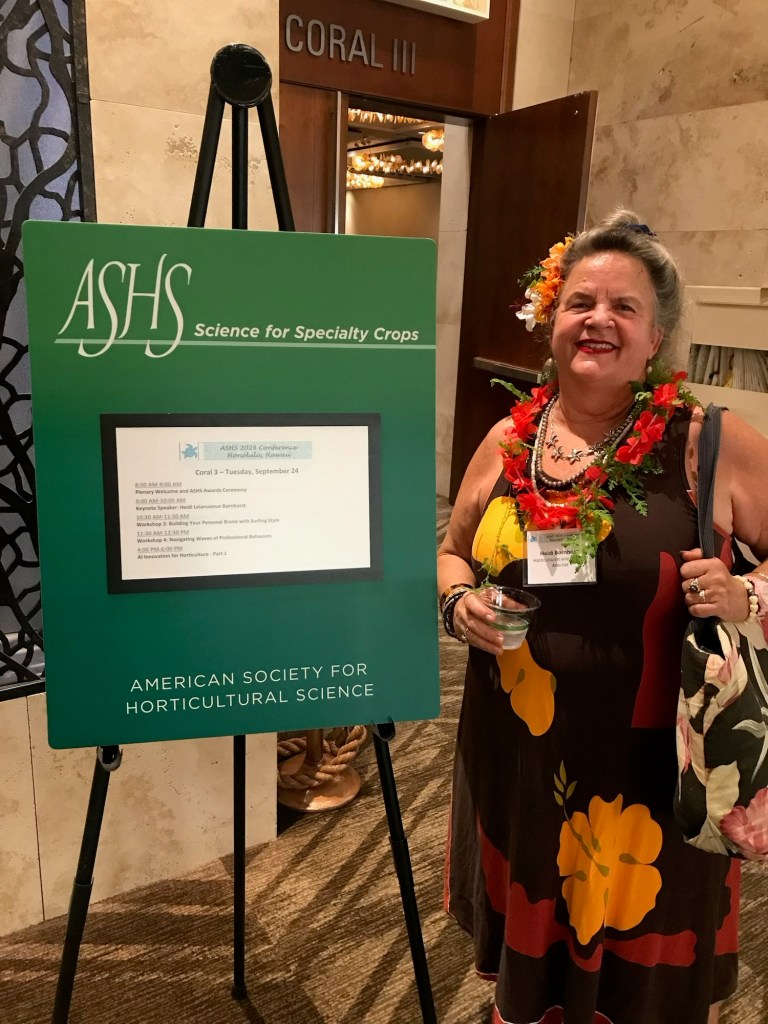
A prestigious Horticulture group is coming to Hawaii for a weeklong conference.
The American Society for Horticulture Science will be here on Oahu for a week long conference beginning Monday September 23, 2024, closing on Friday September 27.
Over one thousand attendees are signed up and registration is still open. (1067) at last count.
This is great for Hawaii gardeners, Horticulturists, Botanists, and plant scientists.
The conference will be held at the Hilton HawaiianVillage hotel, right on the beach in beautiful Waikiki.
Renowned for its extensive gardens, featuring many native Hawaiian plants, along with canoe plants and tropical exotics, it is a great venue for these plant loving scientists to enjoy.
The Hilton is also right next to the Hale Koa Hotel (where I served for over 10 years as Landscape Director).
The extensive landscaped grounds of the Hale Koa were designed as a botanical garden and the plantings there are very impressive and worth a stroll.
There are many wonderful gardens in Waikiki, amidst all of the hotels and high-rises.
I was very honored to be invited to be the keynote speaker for this conference and I plan to be talking about my favorite: Growing native Hawaiian plants.
There are over one thousand native Hawaiian plant species, and we now are growing about 100 of these Hawaiian plant species. We can grow more!
We have 1367 native Hawaiian plant species. Over 90% of them are endemic, meaning they only grow naturally here in Hawaii. About 9% of them are extinct, and many are rare and endangered.
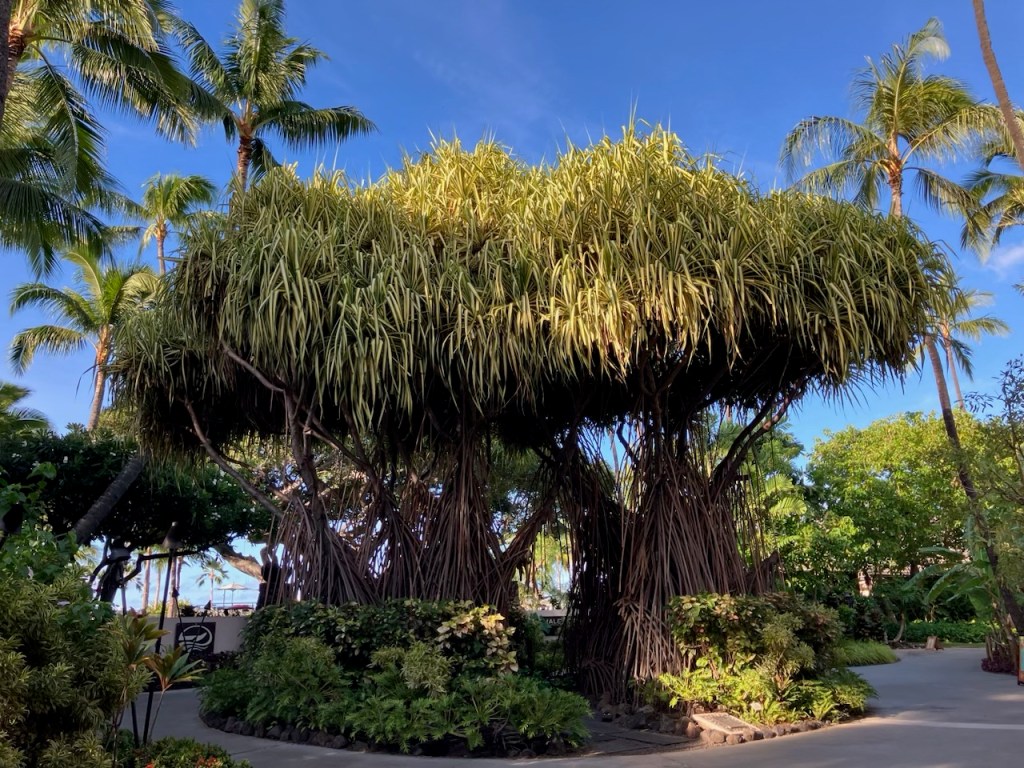
Some are common and easy to grow, and we see them all around. Examples are: Hala, beach naupaka, `ilima, Hapu`u or Hawaiian tree ferns, and Kou and Milo trees.
Other native plants are less common in our gardens and landscape, but horticulturists are working to change that.
My friend, Dr. Mike Opgenorth, who is the Director of Kahanu Botanic Garden in Hana, Maui will be speaking on Thursday about his PhD work on our endangered native Hawaiian Gardenias
Many more students and graduate student at the U.H. are studying how to grow and perpetuate native Hawaiian plants.
The landscape or “Green industry” here in Hawaii is doing the groundwork with native plants.
Home gardens now feature native Hawaiian plants especially those loved by lei makers such as `Ohi`a lehua, `ilima, Palapalai and Pala`a ferns, and our native fragrant Hawaiian white Hibiscus, Koki`o ke`o ke`o.
Our public parks and urban forests are growing more native plants too.
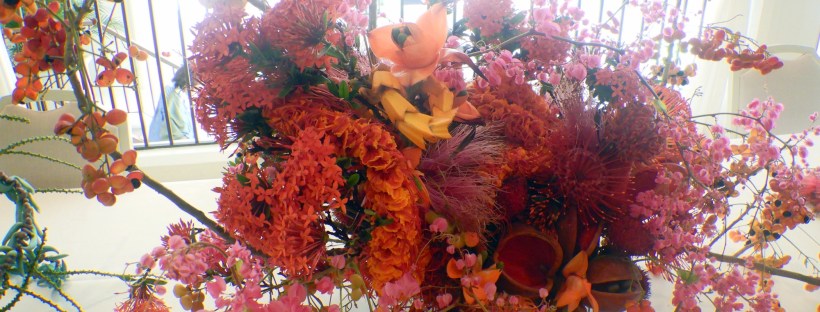
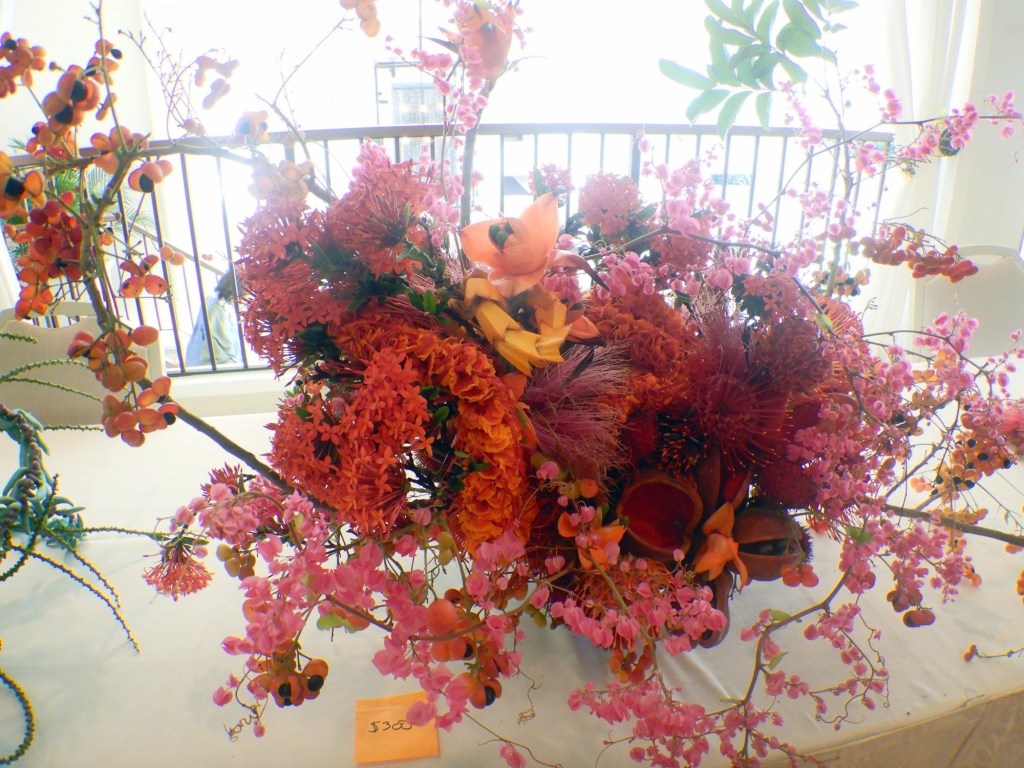
Ren MacDonald-Balasia of RENKO did a Floral demo with the GCH on Wed March 13, 2024.
She likes to use wild, weird and foraged florals, and rare, strange fruit from gardens or Chinatown.
RENKO Floral dragon
This was such an inspiration! We can all gather florals and foliage from our own gardens, from friends and even from wild weeds. Weeds can be beautiful.
We don’t have to import florals. Imported materials have a Carbon footprint big time. They also can be the source of harmful alien pests and diseases.
Many imported florals (e.g. roses without perfume) can last a long time, yet they are substantially dosed with chemical poisons insecticides and fungicides. Since they are not a food crop, they are not heavily regulated.
Some countries which grow imported florals don’t have the chemical safety regulations that we do, and this poisons the growers and us the consumers.
Read the Book Floral Confidential, if you really want to be informed (and Scared!) by this overuse of toxic chemicals.
And as we say: Buy Local! Or even better, Forage Locally. Glean from Local gardens.
The Floral event was at the Halekulani, and I invited my siter Mimi Bornhorst Gaddis.
As we were getting ready to go, my honey Clark Leavitt said, ‘set me up with a lei needle?’
He had gone on the roof and foraged for pua keni keni. So romantic. Our anniversary was the day before and he took his nephew Mark to lunch at Kailua Nico’s.
Mimi and I used the valet service at the Halekulani and walked through the flower filled lobby.
Two women were sitting in an alcove stringing Blue jade lei. “Wow kewl Blue jade!’ I remarked as we walked by (it turned out that these women were our speaker and her helper!)
We went to check in at the Garden Club desk, and as there was no usual flowers on second floor lobby, we walked around.
There was a woman sitting on a bench. Mimi and I introduced out selves and I gave her a tiare li`I li`i.
Her name was Pam and turns out she’s Ren’s mother, just home to care for her 97-year-oldmother who was a journalist for the star Bulletin.
The first AJA writer in Hawaii!
Soon the floral fun begins.
The first arrangement is in a wide tall bowl. She puts in what she called sea tamarind. We were in back and it was hard to see but I’m thinking that doesn’t look like tamarind. I kept trying to figure out what the orange bouncy floral might be. (Turnsout Harpulia, a common street tree in the Lychee family, Sapindaceae.
sterculia Mexican creeper lei Ohai Ali`i Harpulia AKA sea tamarind
She anchors the branches into folded up chicken wire set in the bowl. (Oasis is environmentally out. Mimi and I both have some stashed, just in case)
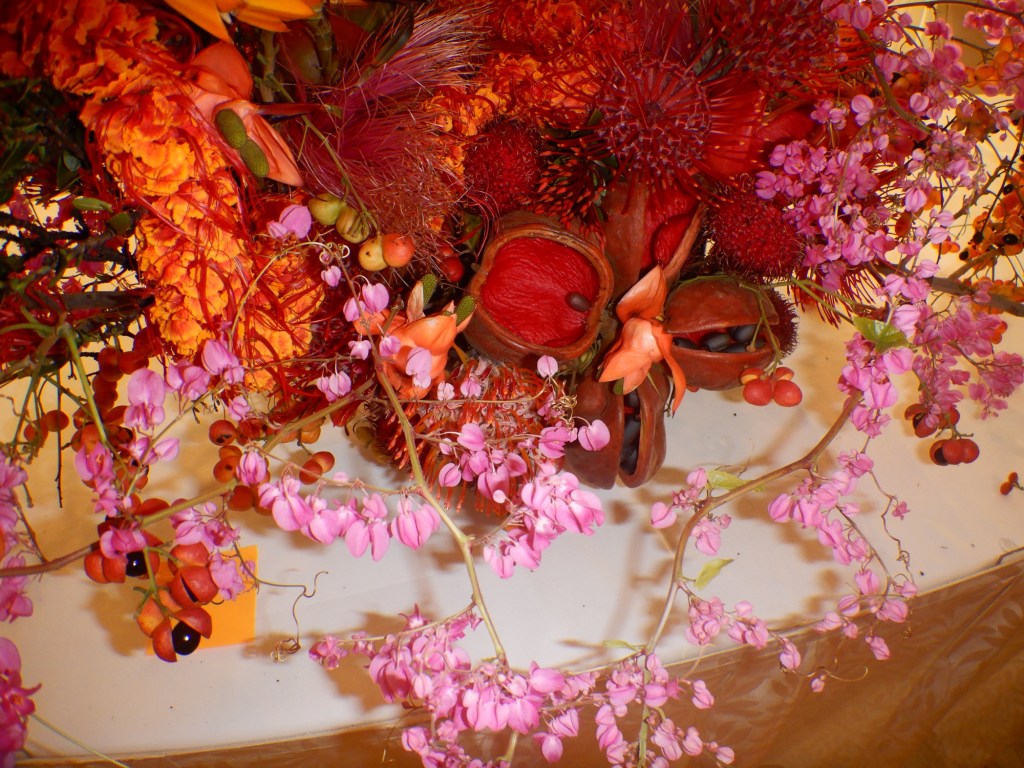
She then added Sterculia, Skunk tree pods, these are heavy and help to weight the other materials down.
Ixora is added. We got these at a gas station, Ren remarks.
Mexican creeper, which used to grow in our Makiki garden is draped all around. She calls it coral vine.
Bombax or shaving brush tree flowers like big puffs of pink added to the flora mix, next the lei she bought at Cindy’s Lei in Chinatown are added, ohai alii and a golden hala. She cuts and drapes and winds them into the arrangement.
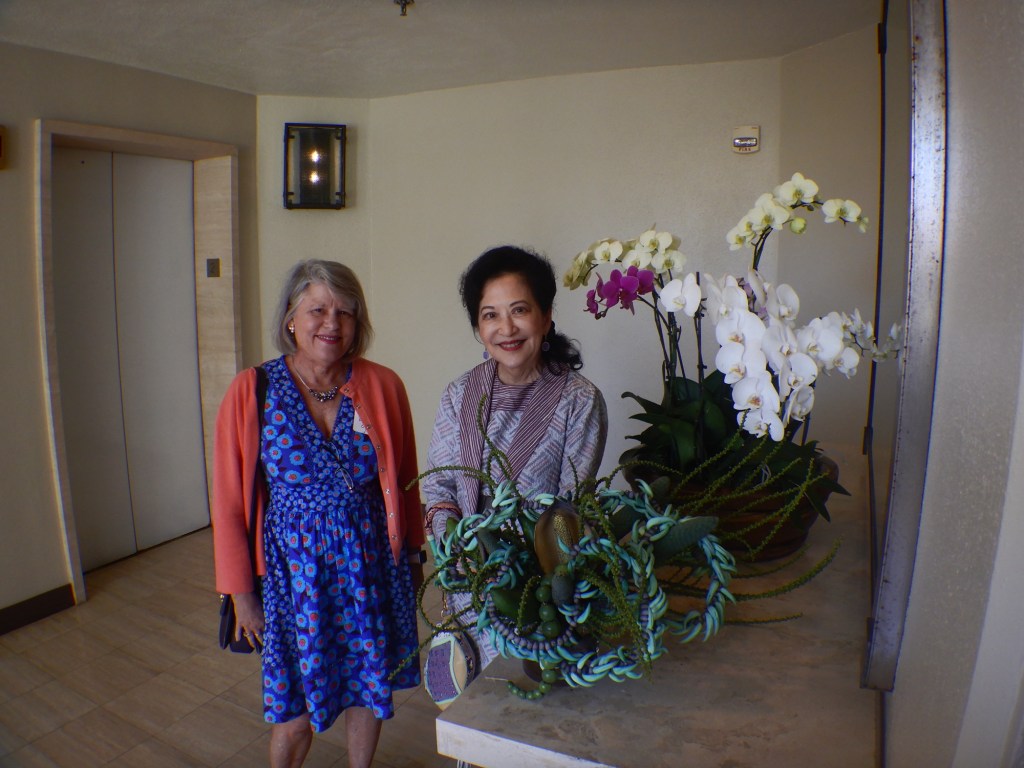
Blue jade lei were added and draped over the arrangement. Such a lovely seasonal Spring beauty from Hawaii gardens!
blue jade and tita Mimi
She scouted for wonderful and strange fruit in Chinatown markets:
Fruiting Clusters of Longan, rambutan and Salak palm. Mimi said that they call it SALAT in SE Asia and it’s really ono. Pretty and scaly in an arrangement.
She had some nice blooming orchid plants that she bought from Kawamoto orchids in Palolo Valley. We kind of gasped when she cut the floral stems and put them in the arrangement. (they would last for a month or more on the plant). But this is what florists do for that wonderful Ephemeral special occasion.
CONSERVATION: instead of imported, chemically laden treated florals these were gathered in gardens in wild places and in local lei shops.
Such a good message we can get so much from our own Hawaii GARDENS!
We had such a weird windstorm with those super strong and gusty west winds! So different then normal.
Up in our valley we lost power twice to the wind and HECO did not restore power until 9:30 p.m. on Wednesday 3/8/2023.
Mangoes and avocados were full of blossoms, Honohono orchids were in bud and some in bloom.
My Portuguese Madeira roses, and native Hawaiian gardenia Na`u have been blooming well, loving the cool and rainy winter were are finally having.
As I clean up the storm debris, (Mahalo for nature’s Arboriculture) including blown down dead twigs and branches, and lots of leaves, some I notice are from my mauka neighbors.
One of the tenets of true Horticulture is to OBSERVE nature and plants, to track the moon, winds, rain and other weather phenomena as see how the plants respond.
I am still reflecting on how the plants would respond.
What do you see? How are your plants after the winds?
Did you have any big tree failures? Or just small or dead branches?
The leaves are whipped on my gingers, Surinam cherries, mulberries, and ohia shed a few flowering branches. A young popolo plant got totally blasted on one side, it was just coming into fruit.
So, we shall see!
Honohono orchids had been in full glorious fragrant bloom as they budded and bloomed early this year. Originally I thought the orchids stood the wind storm but after a few days those in the main wind tunnel area of my garden wilted and withered prematurely.
Went to a neighborhood watch potluck pa`ina and a nice lady, Lokelani, that I always say hi to on my walks was there, with a gorgeous papale lauhala. She admired my honohono and said she caught a whiff of fragrance, from way across the yard, and she looked for the source of this favorite old time Hawaii fragrance, and from where? My hair!
Since she admired the orchids, I had to give them to her, along with maire ferns!
Now a couple weeks after the winds, I’m observing some of my favorite flowers and fruit trees in my garden and neighborhood:
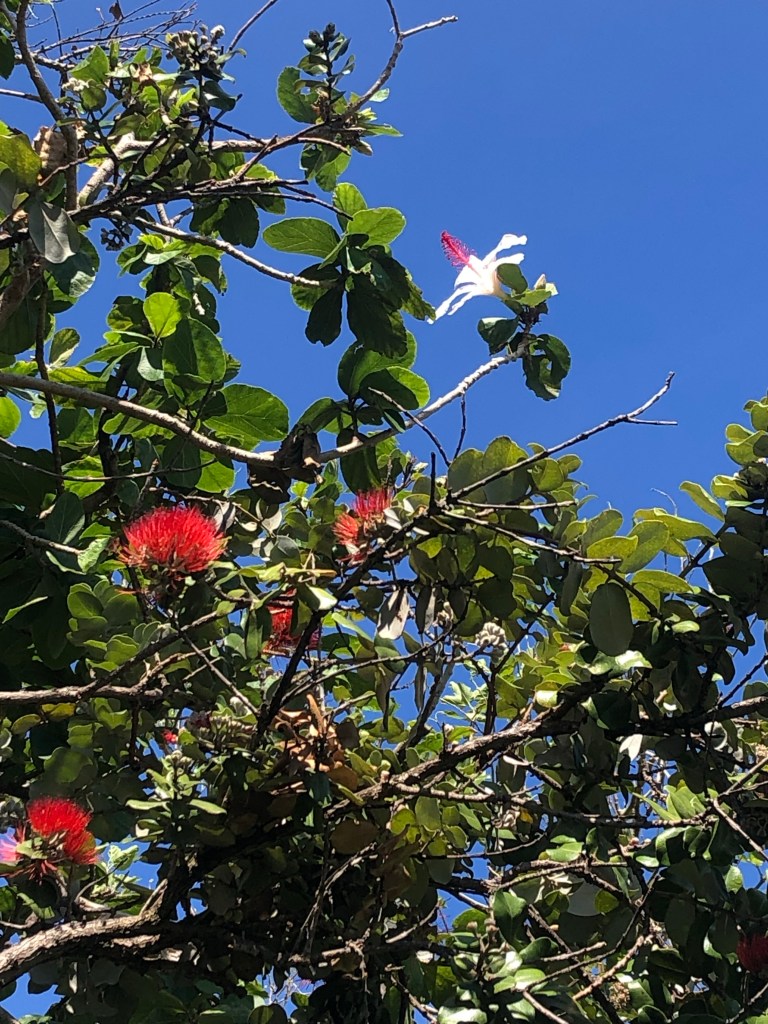
• ‘Ohi’a lehua Blooming profusely, some dead wood branches and twigs broke in the winds
• Native White Hibiscus wind whipped leaves, a few blooms at the very top of the tree
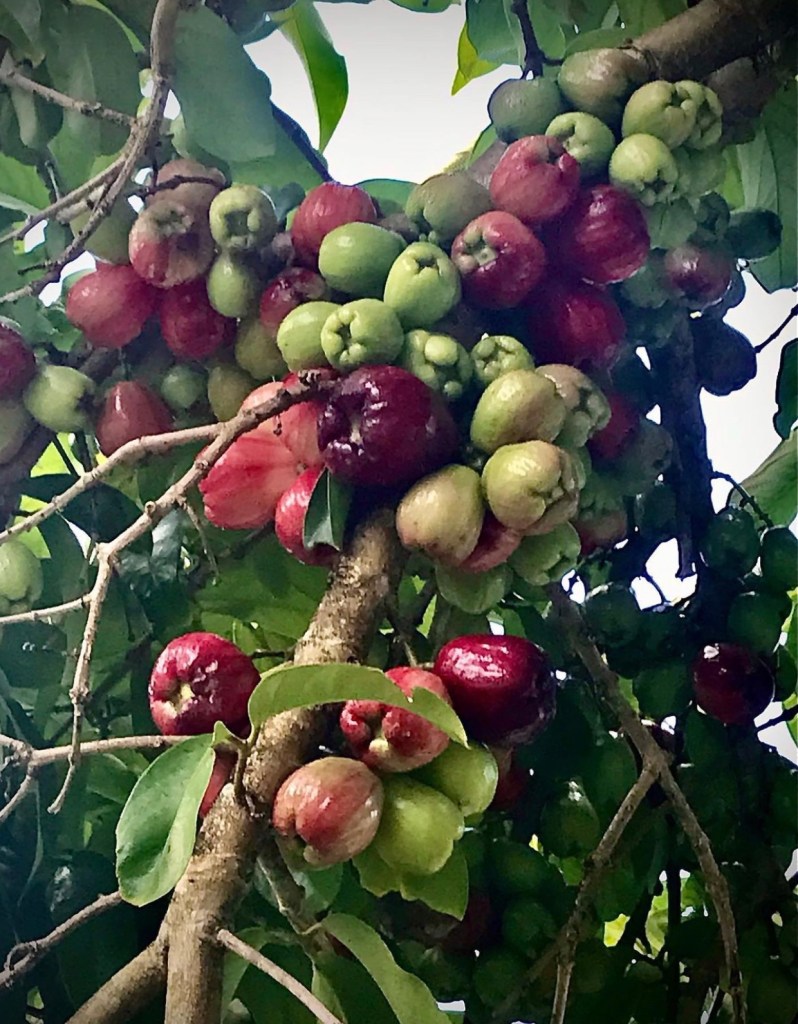
• Tahitian mountain apples were blooming before, still many flowers and now small fruit.
• Gardenias surprise early blooms two on one stem, but no other apparent buds yet. (they usually bloom for me in May).
• Na`u, native Hawaiian Gardenia lots of flowers and buds (also triggered by abundant soft rains before the winds)
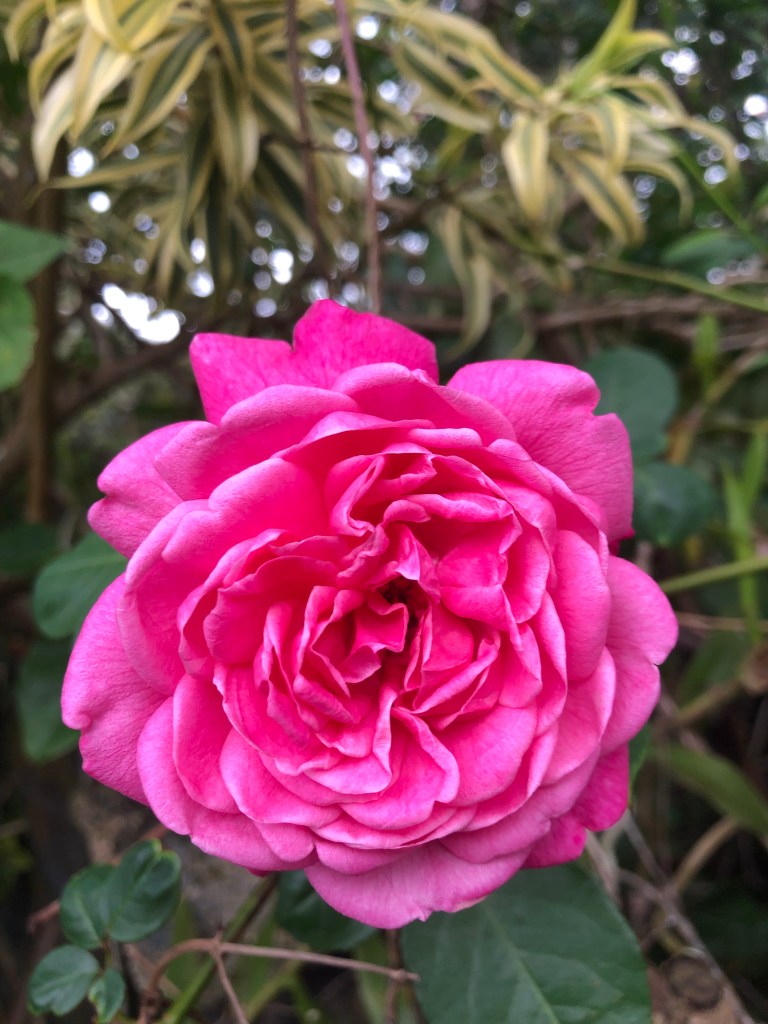
• Madeira roses Blooming profusely.
• Mangoes my Friend Dawn Shim from Makakilo brought me a gift of Haden mangoes, super early for this to fruit.
• Mulberries wind whipped leaves, lots of young fruit
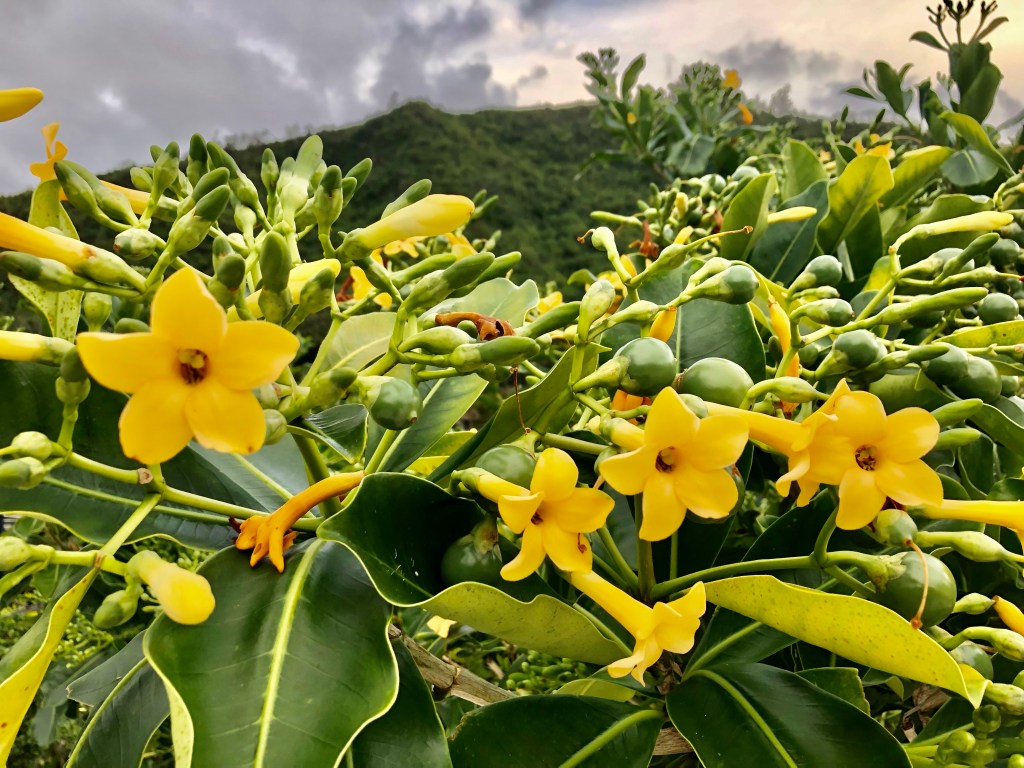
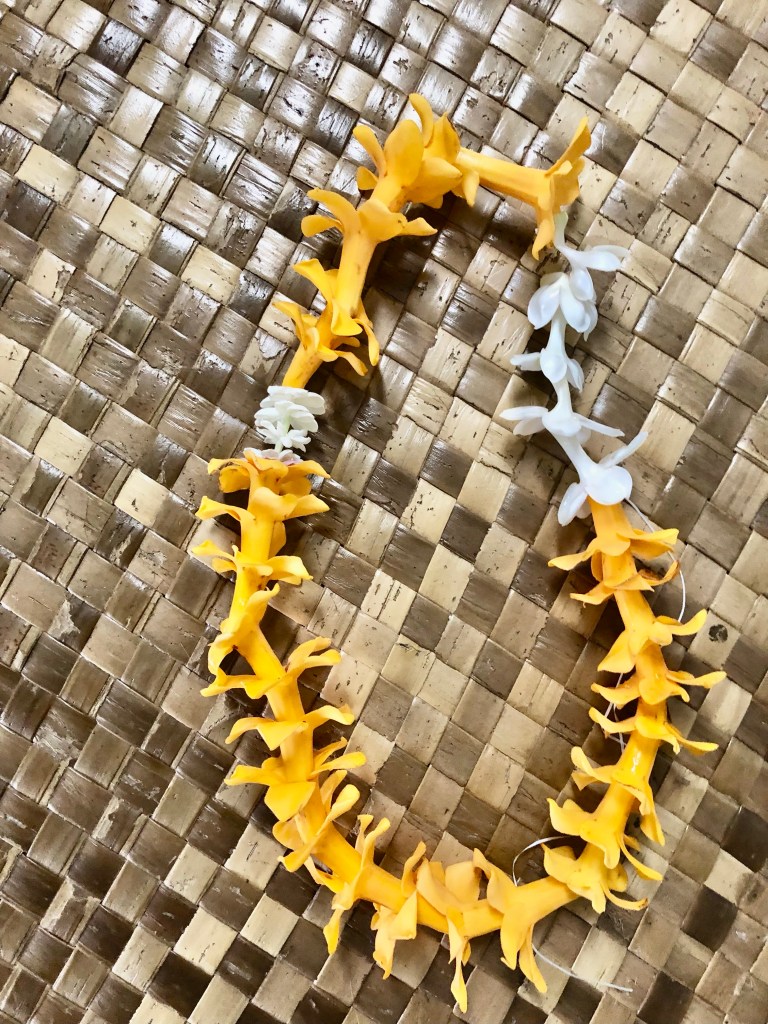
• Pua Keni keni usually Bloom less in winter, BUT after the storm mine are full of Buds, flowers and lots of developing green “ball” fruit. I made some lei for a fundraiser, and plucked and cut off all the young fruit, to encourage more blooms from the tree
What are YOU observing, in your garden in your unique microclimate? I would love to hear back from my Gardening Readers …..
Nowadays people go nuts for Mangos and lychee and `ULU.
Even to far as buying them in the store!
Don’t you all think we should have some fruit trees in our gardens? And share with friends and neighbors? Let’s plant and grow some fruits today!
As kids, mangoes were like stray kittens, people would beg you to take them! We got jobs raking up the fallen smashed ones from super tall trees for elderly neighbors.
I could never get enough lychee even tho the trees were abundant in Makiki where I grew up. Lychee enticed me to move to Wahiawa where we had two lychee trees and then planted a third.
When you offer people mountain apples or `ohi`a `ai some are enthusiastic, some will help you pick and rake up and some meet the offer with distain.
Funny.
Nutritionally they are great; lots of hydration for your body, and rich in vitamins C, Calcium, magnesium, phosphorus, and super rich in potassium.
Also known as `Ohi`a `ai, the `ohi`a that you eat (`Ai) they were carried here by ancient Polynesians in their sailing canoes, an important part of our “imported” landscapes and gardens.
What a gorgeous gift to find when hiking the low moist forests. This fruit will keep you hydrated on your hike!
And you can bring home a seed and grow it to commemorate that special hike. Surprise and share with your hiking buddies at the next festive occasion.
They are nice to grow in our gardens too. A small to medium tree with pretty leaves and bark most of the year and then BOOM! in flower so pretty magenta pom poms
A month or two later you will have that juicy ono fruit. Like jewels up in the tree canopy.
Besides eating them straight off the tree, you can slice and add to fruit salads.
Or as my niece Jalene found out for us, you can make pickles from them to savor for another day.
My friend and akamai farmer Deborah Ward makes a mean mountain apple pie and you can also make mountain apple sauce.
Add some slices to your favorite cold beverage.
You can make a lei with the smaller green and white fruit. Store the lei in the fridge and when you wear it “Fruit cooling air conditioning” ! I made one for my then boss, Sydney Iaukea at a Kupuna Hawaiian studies training session and the lei kept her cool all day.
It’s an unusual lei today. But easy to make and fun and unusual to wear.
The scientific name is Eugenia mallaccensis and they are in the MYRTACEAE plant family along with `Ohi`a lehua, guavas, rose apples, Eucalyptus, and more.
Some call them Malay apple as they are native to the Malay peninsula and southeast Asia.
We have different varieties in Hawaii, a pure white one, a seedless one, squat plump Hawaiian variety and long and big Tahitian variety.
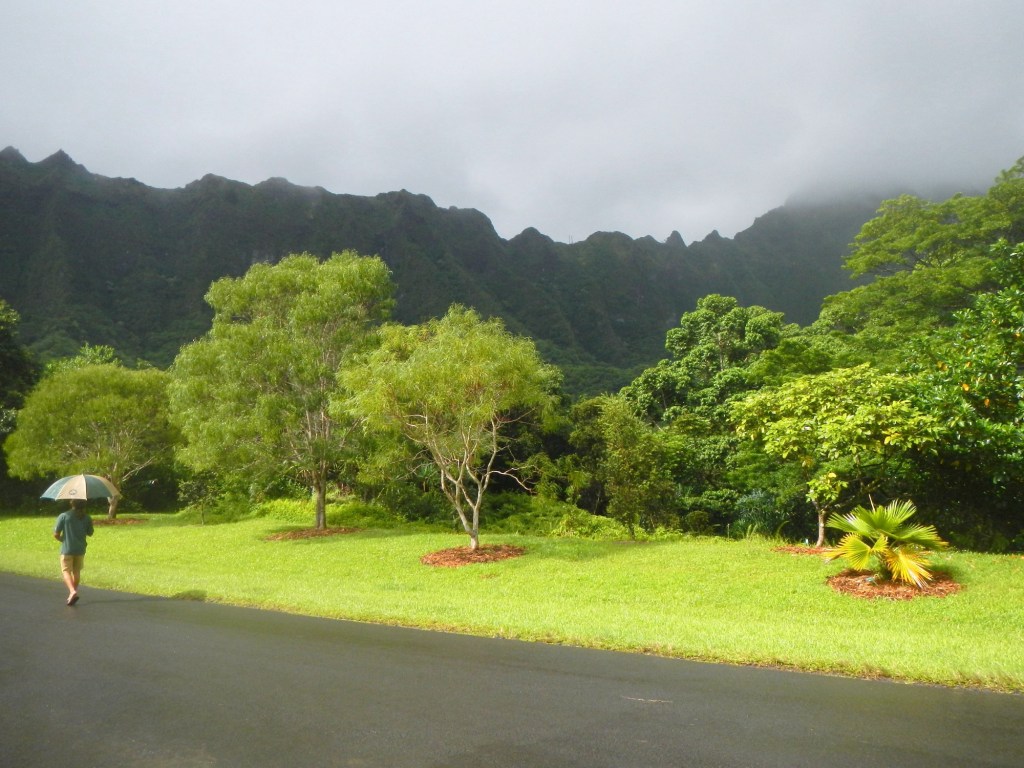
Many grew naturally in the wet lowland tropics of Ho`omaluhia Botanic Garden and then we planted more in the “Kahua Kukui” Polynesian plants section of this amazing and FREE botanic garden in Kane`ohe.
They are easy and fun to grow from seeds. Save a seed from an ono one and plant it right away.
Besides the ono fruit and attractive flowers and tree, bringing shade and birds to yoru garden, mountain apples have medicinal uses.
The bark is a sore throat cure. If you feel a sore throat coming on or are getting a cold, scrape off some young bark, rinse it and chew it. It has lots of tannins and this truly can help ward off a cold.
The nutritious fruit will also help keep you healthy !
Interesting
to learn something new from my honey Clark, the other day, after all these
years, fresh kewl stories! And about plants and gardens, my fave !!
We were out
at the Uluniu beach house in Laie.
Colleen and Randy asked Clark and I about growing some plant out there.
We discussed
various plants and what would grow in strong salt winds.
Clark mentioned
Uncle Griff and how he grew things out in Waialua, right on the beach. That nobody else could
grow.
Or his
looked and thrived better than others.
Clark said Griff’s
secret was to wash the leaves. Rinse off
the salt water residue on the leaves.
Daily, lovingly.
So
interesting! And to think about. Rinsing my leaves more now too. It gets bugs
and eggs off
Nothing like
a big rainstorm to clean the air and our plants and gardens …..
Why to rinse
and bathe our plants with Fresh water (WAI)
Salt
water has major nutrients
Rinsing
gets wai in the stomates?
Rinsing
cools us all
Washing
off pests
And
potential incipient pests
What did he grow? Clark?
I remember a
nice big lawn, with a view of the surf and beach, a better pa`ina spot than our
sandy front yard with a bit of grass and a big Hau tree.
I think we
have pics with Elaine, Clarks mom and Iliahi, our cutie poi dog, maybe at Griff’s
house.
Hawaiian
wife named …. Aunty Mary, silver hair in a flip, wore mu`u mu`u elegantly.
Last name ?
Panker! We both remember at the same time.
Is Butch their son? Or in-law? Carpenter lived in Wahiawa, daughter swim team …
Clark would go out there and immediately trim down the Hau tree, and do other heavy yard work to help out and hopefully get invited again.
The good
yard at Crozier loop was out by the street but too hot in the day, perfect for
a wedding like Rachel and Peter’s!
Rinse your Gardenias and `ohi`a lehua
We love Gardenias and so do various pests:
Sooty
mold
Aphids
and scales
Ants
which spread and protect the sap suckers
Thrips,
the little black pests in the blossoms
The “cure” for all of these Gardenia attackers? SOAP and water ! Gardenias are the one plant that I also fertilize with liquid Miracle Gro fertilizer. (use Miracid, the one in the blue box if your soil tends to be alkaline)
Gardenias
are acid loving plants, so they like our red dirt soils and leafy compost too.
When I fertilize them, I add some liquid soap to the sprayer. Dish soap like Palmolive or Dr Bronner’s peppermint if I’m feeling rich. I spray this on the leaves and let it drip to the roots too. (if you see pests on the stems and leaves, they are probably attacking the roots too.)
After
spraying wait an hour or so and you can then wipe the sooty mold off the leaves
with a soft rag. Or you can just let the
soap do its job.
Rinse the
leaves well the next time you water.
Dead, sap sucking pests like scale, mealy bugs and aphids will slough
right off if they have been effectively smothered by the soapy water treatment.
MAY is
usually when Gardenias bloom. I had buds
earlier this year, but the cool LOVELY weather of April must have delayed
them. Green buds for a long time.
Now its HOT
and they are blooming gloriously.
How to have epic Gardenia blossoms:
Pick them daily. (if you leave them
on the plant, the pests will love you, they will have a pa`ina <party with
good food> and they will multiply.
Spray them, and the whole plant with
water before you pick
Take the buds and pua inside and
rinse them
If they have thrips, drip soapy water
on them or dunk them in soapy water
Let the bugs get smothered by the soap
for a few minutes
Then rinse them off
Cut or pull off lower leaves
Display them in Deep, cool water in a
vase
Change the water daily
Rinse the stems and recut the base
Put the gardenia flowers back in cool fresh water
Inhale
and enjoy!
Since
hearing this Uncle Griff rinse your plants and gardens story I have been doing
my early morning or evening watering a little differently.
I look at
the plant or tree and wonder if it will benefit from a rinse.
If it’s hot
I don’t mind getting a rinse myself ! I
think like a gentle rainstorm, or sometimes like a rainy windy storm is needed.
I have been rinsing my `Ohi`a lehua which are full of blossoms. I rinse the flowers and know it will benefit the birds and bees that visit and pollinate the flowers. Bees get thirsty too! `Ohi`a are from rain-forests so the more wai the better.
As I rinse and spray off my banana leaves, I visualize the washing away of any leaf hoppers. I also remind friends and neighbors to get rid of their clump thoroughly if it gets this disease. It’s like getting a measles shot, it protects all of our community of banana growers.
Rinse your mock orange and Bougainvillea after a kona storm.
I learned
this one while working as Honolulu Zoo Horticulturist. I forget from who, maybe my working foreman Seiko
Tamashiro, or epic Retiree and Volunteer, Tony Kim?
A nice big
fat thick, and very xeric Mock orange hedge surrounded the whole zoo. Periodically
we would have to trim it, and this was a big process involving the whole crew,
trusted CSSP workers and scaffolds. It
took at least a week.
There was a big drought and we were forced and encouraged to save water. I read the night logs, some of my staff worked at night as security, food prep and irrigators. One guy Bob would turn on the sprinklers for the mock orange hedge and run them for several hours. I told him, “Bob, you are watering the ocean!”
What?
Bob, we have
sandy soil, by running those sprinklers for hours you are wasteful. So please,
just about 20 minutes will be fine for the hedge!
‘OK boss
whatever you say’ he said with some skepticism
(what did a 25-year-old with a nice fresh B.S. degree know, right?!!)
Well, we
reduced our irrigation budget significantly and the zoo gardens were still
green enough and healthier. Someone even wrote a letter to the editor about how
great the grounds looked!
Mock orange
is in the citrus family and it comes from driest India. Super deep and wide spreading, tough roots and shiny leaves help make it
drought tolerant. They also come from monsoon areas so after a big rain we see
fresh growth and fragrant blossoms. This
is how they would respond when the monsoon rains come to India.
Somewhere
along the way in this discussion, came the fact that mock orange is sensitive
to the sometimes strong salty kona winds we would get at the zoo. When those came we deployed the sprinklers to
wash all the leaves.
Same is true
of Bougainvillea. We didn’t have a lot
at the zoo, but I had tons of lovely roof planters of Bougainvillea ‘Miss
Manila’ at the Hale Koa hotel. These we would diligently rinse leaves after
kona wind storms.
For many,
many years I have been a Lei Day Volunteer at the Mayor’s Celebration at
Kapi`olani park. It is such an amazing
event and I’ve learned and seen so much every year. Since 1984 in fact ! Yikes
I was first
asked to kokua with plant ID when I was working right across the street at the
Honolulu Zoo as Zoo Horticulturist. I
was reluctant to leave work, even for a few hours, as some of my landscape crew were on the
kolohe side.
Kupuna
Beatrice Krauss, our famed Ethnobotanist, was a fellow lei plant identifier and
any time with her was a precious learning experience. As she got older, she would ask me to drive
her, and again, more time with someone so akamai and kind, a Hawaii woman
Scientist, ahead of her time.
I told
myself when Aunty Bea is pau I will be pau too.
But over the years I have realized what a gift it is to volunteer with
this job. We get to see all the contest
lei as they are delivered at 7 a.m. So
amazing, creative and so much time and energy to grow, select, clean and prep
and then craft the lei. Timing is vital
for freshness and for flowers, like ilima buds to be open.
One year
there was a City-wide strike and we had to move the contest at the Hilton
Hawaiian Village, they also roped me into being a judge. Never again!
To me , all of them are winners.
Identifying the flowers, ferns, nuts and lei fibers is challenging but
way easier for me!
This year there were some stunners, plants with mixed silvery patterns, in the Heliotrope family Boraginaceae. We had native Hawaiian Hinahina, the lei flower of Kaho`olawe, an endemic native Hawaiian plant; combined with Kipukai, an indigenous Hawaiian plant, and Beach Heliotrope Tree or Tahinu, which is an import, that looks and acts like a native coastal and xeric tree.
This twisty
silvery lei combo was so amazing! After
doing our volunteer ID job in the early
morning we sometimes get a chance to talk to the lei makers.
I was
talking to an inspiring and creative young lei maker, Mary Moriarty Jones. I asked her where she collected all those
lovely plants or if she grew them herself.
We talked about them all being in the Boraginaceae plant family.
One
characteristic to identify this family is that the flowers are arranged in a
helicoid cyme. It twists to open like
the fiddlehead of a fern, and the flowers bloom one by one along the curving
floral stalk.
They also tend to have silvery hairs on their leaves. These reflect light and give the silvery Hinahina color. As a xeric adaptation to thrive in dry salty climates the silvery leaf hairs reflect light and also trap moisture and conserve it for the plant as it respires.
This silvery beauty to our eyes is how the plants have thrived for the millennia in harsh dry salty environments.
To grow them
for the long term it’s good to understand where they came from and adapt your
garden methods accordingly. They need
well drained soil and full sun. They are
more difficult to grow in pots than in the ground as they really need to spread
their roots far and wide (not deep). They like daily watering to get
established and then less and less water as their roots spread and adapt.
As my old
boss and mentor Masa Yamauchi would say,
“Observe your plants closely and water only as needed”.
This is a
skill we can all learn and cultivate.
Just as we can learn to grow our own rare and wonderful lei plants.




 Heidi Bornhorst